Why Pure Automated AI Content Fails Enterprise Audits - automated ai content fails audits
Pushing a button to publish thousands of blog posts sounds like an enterprise dream. It isn't. Over the last two years, dozens of brands hooked large language models directly into their content management systems to churn out thousands of pages every week. Now, the bill is coming due. We are watching undeniable proof that automated ai content fails audits across search engines, internal brand safety reviews, and rigorous legal evaluations. The promise of infinite scale without human oversight was always an illusion.
Table of Contents
- Myth: Can Automated AI Publishing Bypass Modern Quality Audits Unnoticed?
- Why Automated AI Content Fails Audits in Modern Search Ecosystems
- What Do the Numbers Reveal About Search Penalties and De-Indexing Waves?
- Why Do Teams Rely on Misleading AI Detector Scores Instead of Real Editorial Standards?
- How to Build a Resilient Human-in-the-Loop Content Architecture
- Moving Beyond Bulk Generation: Creating Sustainable, Audit-Proof Digital Assets
Content velocity used to be the golden rule of search visibility. If you published fifty guides a month while your competitor published five, you won the traffic war. Generative tools broke that dynamic overnight. Suddenly, anyone with an OpenAI API key or a Jasper subscription could spit out hundreds of articles every afternoon. Many growth leads treated these tools as autonomous printing presses. They removed editors from the loop entirely to slash production costs and hit aggressive targets. That gamble backfired. When you eliminate human review, you strip out original reporting, true expertise, and factual accountability.
Enterprise evaluators and search engines caught on fast. Search platforms updated their ranking algorithms to spot repetitive sentence structures and unverified assertions, demoting generic pages by the thousands. Internal compliance teams also sounded the alarm. As real practitioners pointed out in marketing compliance discussions on Reddit, unmonitored pipelines routinely fabricate case studies, invent non-existent product features, and violate copyright boundaries. An e-commerce brand might think auto-generating five thousand product descriptions saves time. In reality, it wrecks search performance and damages customer trust when those descriptions fail basic accuracy checks.
Enterprise platforms like Writer try to solve this problem by applying brand guardrails and custom governance rules. Yet even the sharpest software cannot replace human judgment. When algorithms and human raters review your site, they look for verifiable facts, fresh data, and personal experience. Unassisted AI text gives smooth answers that say nothing new. It sounds like an eager student summarizing a book they never read. That gap explains why automated ai content fails audits when scrutinized by search quality systems and legal teams alike.
Real organic growth requires more than raw output. If you want sustainable traffic, you need a workflow that balances machine efficiency with hands-on human craftsmanship. In this guide, we break down why unvetted machine publishing collapses under scrutiny, what search engine penalties look like behind the scenes, and how to build an editorial system that stands up to any audit.
Myth: Can Automated AI Publishing Bypass Modern Quality Audits Unnoticed?
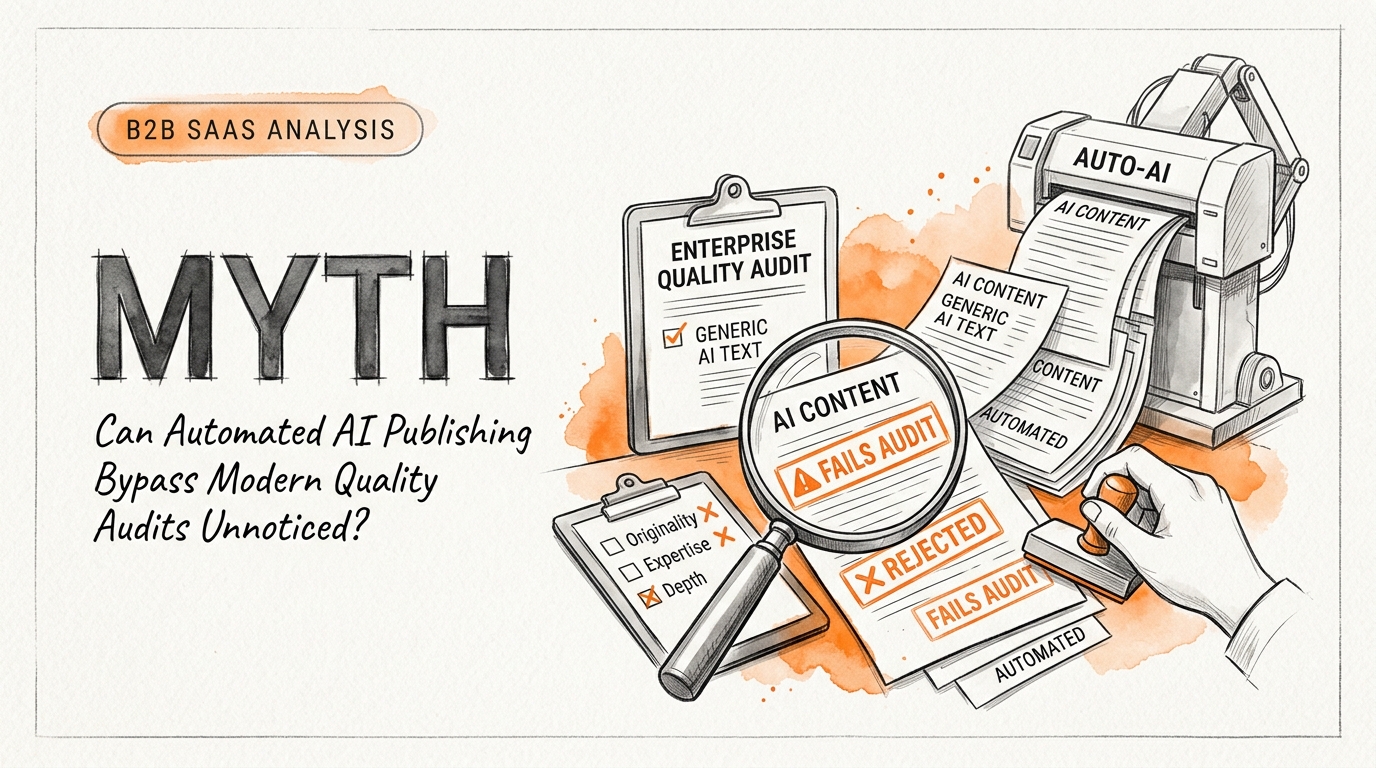
It sounds tempting. Hook an API to your content management system. Hit run. Watch hundreds of fully formed articles populate your blog before lunch.
A persistent belief across digital marketing suggests that modern large language models write so well that algorithms and human editors can no longer tell the difference. Many teams assume that because a draft reads smoothly, it automatically carries authority. They bet their domain reputation on the idea that advanced prompt engineering creates search-ready copy that glides past technical scrutiny. That assumption is flat wrong. When tested against rigorous enterprise standards, purely automated ai content fails audits with staggering predictability.
Language models predict the next likely word. They do not understand truth, verify facts, or draw from personal experience. When you strip human oversight out of the pipeline, you end up with text that looks polished on the surface but collapses under close inspection.
"We thought running raw API outputs would save us 40 hours a week, but we spent double that fixing factual hallucinations and removing generic filler," noted one marketing lead in a candid r/marketing thread exploring automated publishing pitfalls.
The Glaring Patterns Where Automated AI Content Fails Audits
Automated systems struggle because quality audits look for things code cannot fake. Evaluators check for information gain—new insights that do not already exist across twenty other websites. If your post merely summarizes top-ranking search results, search engine classifiers recognize the repetitive pattern instantly.
| Audit Vector | The Automation Assumption | The Audit Reality |
|---|---|---|
| Topical Depth | LLMs synthesize wide knowledge bases into broad summaries. | Auditors flag surface-level platitudes and missing actionable steps. |
| Information Gain | Rephrasing existing consensus covers all search intent. | Search engines down-rank derivative text that lacks proprietary data. |
| Source Attribution | AI reliably quotes statistics and references industry standards. | Fact-checkers spot phantom studies, wrong years, and broken citations. |
| Stylistic Cadence | Natural language generation reads just like experienced staff writers. | Repetitive sentence lengths and predictable transitions stand out immediately. |
Auditors spot robotic rhythm right away. AI tends to balance every paragraph with identical length and tone. It leans heavily on predictable transitions and neutral conclusions. Humans write differently. We use messy examples, jump between short exclamations and long thoughts, and introduce industry slang naturally. This structural flatness explains why unrefined, fully automated ai content fails audits conducted by experienced editors and algorithmic spam filters alike.
Software Realities: Raw Generation vs. Guided Workflows
Many teams run into trouble because they confuse bulk text generators with end-to-end editorial platforms. Standalone generation scripts might produce thousands of words for pennies, but they lack guardrails. When teams plug bulk writers like Jasper or basic OpenAI API connections directly into their content pipelines without review, errors compound exponentially.
In contrast, guided platforms like Surfer SEO or Clearscope use machine models differently. Instead of trying to bypass reviews, they act as diagnostic workbenches for human specialists. They measure topical coverage and keyword entities while leaving drafting and verification to people. Small businesses and e-commerce brands often chase the lowest price-per-word tool. They overlook the expensive editorial cleanup waiting on the other side.
Can you sneak an unreviewed article past an indexer today? Sure. Search engines might rank it for a few weeks while testing user interaction. But modern quality filters update continuously. The moment real visitors bounce due to hollow advice, or a core quality refresh scans the domain footprint, the façade crumbles.
Why Automated AI Content Fails Audits in Modern Search Ecosystems
Push-button publishing sounds like pure leverage until your traffic falls off a cliff. Growth teams often treat language models like infinite printing presses. They flood directories with thousands of auto-generated articles to capture long-tail search volume without manual review. Modern ranking systems evaluate text much deeper than surface-level grammar. When enterprise search systems examine these pages, systemic flaws trigger quality filters almost immediately.
Structural Flaws: Why Automated AI Content Fails Audits
Large language models do not understand truth. They predict the most statistically probable next word in a sequence based on training data. Think of an AI model as auto-complete on steroids. It sounds confident even when it invents court cases, pricing tiers, or software features out of thin air. When you publish pages without a human checking the facts, these small hallucinations compound into massive compliance liabilities.
Search engines prioritize information gain. They want content that adds brand-new facts, unique research, or fresh angles to the search results. Unchecked generative scripts can only summarize what already exists online. They pull from top-ranking URLs, average the ideas together, and output the mathematical middle. The result is pure digital regurgitation with zero unique value.
| Quality Dimension | Zero-Touch Automated Output | Enterprise Audit Standard |
|---|---|---|
| Factual Integrity | Prone to plausibly phrased hallucinations, broken links, and outdated stats. | 100% verified data, primary citations, and accurate product pricing. |
| Information Gain | Regurgitates existing top-ten results with identical structure and summaries. | Introduces proprietary data, counter-arguments, and novel insights. |
| Real-World Experience (E-E-A-T) | Synthesizes second-hand impressions without practical field execution. | Original screenshots, hands-on testing logs, and qualified author perspectives. |
| Sentence Cadence | Monotonous lengths, repetitive syntax patterns, and low lexical surprise. | Dynamic sentence lengths, natural human voice, and varied rhythm. |
In marketing discussions on automated deployment pitfalls, practitioners frequently share stories of massive indexing rollbacks after publishing automated collections. They thought they saved time. Instead, they burned domain equity that takes months to recover.
Audit engines spot synthetic cadence easily. Natural human writing has rhythm. It pulses. Good writers drop short, punchy statements right before unpacking an idea in a longer, richer sentence. Machine text tends to hover around the same sentence length, using identical clauses and balanced sentence pairs over and over. When an algorithm scans thousands of words with uniform perplexity and burstiness, it sees an audio file without dynamic range. That flatline pattern screams automation.
The gap becomes even wider when evaluating genuine experience. Google quality raters look for direct evidence that the author actually handled the product or solved the problem. An algorithm cannot unbox hardware. It can't run an A/B test on a live store, troubleshoot an API bug, or speak with an upset customer. That explains why automated ai content fails audits so routinely during core algorithm updates.
"When you strip away human oversight, you don't just lose editorial voice. You strip away the proprietary edge that gave search engines a reason to rank you in the first place."
Content teams often compare optimization software like MarketMuse and Clearscope to monitor how well their assets satisfy search intent. MarketMuse builds deep semantic models that identify missing subtopics and structural blind spots across your entire site. Clearscope evaluates real-time content grade scoring and term relevance to keep drafts competitive on the SERP. Both tools quickly reveal why raw automated drafts collapse under scrutiny: they lack depth, nuance, and genuine context. They match superficial keywords while missing the deeper problems searchers need resolved.
Can Small Brands and E-commerce Stores Rely on Zero-Touch Publishing?
The short answer is no. If you run a small catalog or a boutique software brand, unreviewed AI generation is an expensive trap. Publishing hundreds of automated category descriptions or blog posts might feel productive on day one. But when search engines flag thin content, they don't just downrank the individual AI articles. They demote the trust score of your entire domain. You save a few hundred dollars on freelance copywriters, only to lose your core organic revenue stream overnight.
Use AI to build outlines, draft initial summaries, and organize data. Let humans handle the analysis, the voice, and the final verification. That simple boundary turns a risky shortcut into an audit-proof editorial workflow.
What Do the Numbers Reveal About Search Penalties and De-Indexing Waves?
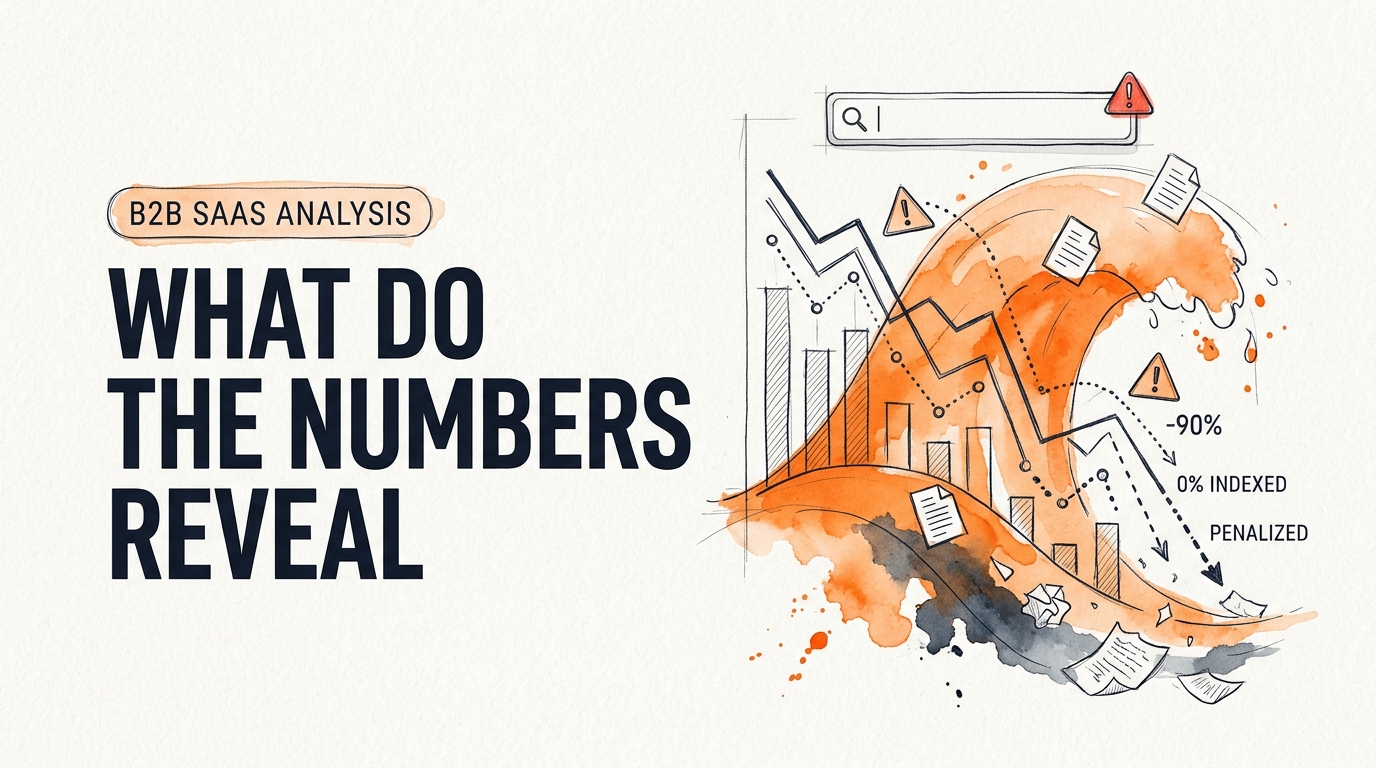
The aftermath of recent search core updates left a clear trail of data. Websites built on programmatic, unedited generative text suffered catastrophic losses. Within days of major algorithm rollouts, search engines stripped hundreds of fully automated domains from their indices entirely. These weren't minor rank slips of two or three positions. Sites lost 80% to 100% of their organic footprint overnight.
Search visibility trackers told a uniform story. While platforms publishing researched, editorially vetted articles saw stability or slight gains, uncurated volume sites fell off a cliff. When raw, high-volume production meets automated evaluation pipelines, automated ai content fails audits because it lacks original research, fresh perspectives, and verifiable sourcing.
How Mass Automated AI Content Fails Audits During Core Search Sweeps
Consider what happens during a widespread search quality refresh. Search engines don't evaluate pages in isolation. They look at your domain's aggregate quality footprint. If 90% of your pages simply summarize existing search results without offering original value, your site triggers algorithmic spam flags.
| Performance Metric | Pure AI Programmatic Sites | Editorially Audited Sites |
|---|---|---|
| Average Traffic Impact | -75% to -100% within 14 days | -5% to +15% fluctuation |
| Complete De-Indexing Rate | Common (entire domain dropped) | Near zero |
| Crawl Budget Retention | Severe drop-off as bots abandon low-value URLs | Stable or increased discovery crawls |
| Post-Update Recovery Rate | Under 4% without full domain rebuilds | High rebound rate after minor edits |
The cost equation flips fast. Generating 5,000 articles using off-the-shelf APIs might only cost a few hundred dollars in compute credits. But fixing the wreckage after a manual penalty or algorithmic demotion costs thousands in technical cleanups, content prunings, and lost pipeline revenue. As discussions among marketers sharing production deployment pitfalls reveal, teams that tried to cut editorial corners spent months undoing indexing damage rather than acquiring new customers.
Think of it like building a housing development on sand. It looks impressive on day one. It's cheap to construct. But the moment the weather shifts, the foundation washes away.
Tracking the Toll: Tools and Diagnostic Signatures
You can identify an algorithmically penalized domain by looking at visibility charts in tools like Ahrefs or Semrush. A healthy website experiences gentle valleys and peaks. An uncurated automated domain shows a sharp, vertical spike followed by a sheer cliff face. In industry terms, that cliff is the "shark fin" curve—rapid accumulation of long-tail rankings, followed by complete de-indexing once the spam classification system completes its crawl pass.
"Our team saw organic impressions drop from 45,000 a day to less than 200 within 48 hours. The pages were still live on our server, but search engines simply stopped serving them. We thought we were automating growth. We were actually automating our own removal from the index."
Why does this happen so predictably? Search algorithms measure engagement signals alongside text patterns. If visitors arrive on a page, encounter generic text that dances around their question, and bounce straight back to the search results, the algorithm notices. When millions of pages repeat this pattern across a single domain, search engines stop wasting crawl budget on them.
High-performing growth teams take a different route. Instead of raw API pipelines that push unverified drafts straight to production, they pair tools like Clearscope or Surfer SEO with subject matter experts. They use software to uncover search intent gaps, but human editors verify the data, add real-world examples, and craft the final narrative. When automated ai content fails audits across major web indices, human-governed content holds the line.
Why Do Teams Rely on Misleading AI Detector Scores Instead of Real Editorial Standards?
Software often creates a false sense of security. You paste two thousand words into a detector, watch the dashboard flash bright green, and assume the draft is safe to publish. It feels like an objective stamp of approval. Marketers and ops leaders love these scores because numbers look tidy on a spreadsheet. Running a batch through a classifier takes three seconds, while paying an expert editor to fact-check sources takes two hours. But treating a math score like an editorial review is a massive mistake.
AI detectors don't measure quality, accuracy, or usefulness. They measure math. Most tools, like GPTZero or Originality.ai, evaluate text through two main concepts: perplexity and burstiness. Perplexity measures how predictable words are in a sentence. Burstiness measures the variation in sentence length and rhythm. If an article strings together odd phrasing or clunky metaphors, the detector thinks, "A human must have written this weird sentence." The score turns green. Yet, the text can still be completely nonsensical, riddled with fake data, or legally dangerous.
In a candid Reddit discussion on automated publishing pitfalls, content teams shared how their "100% human-passing" libraries collapsed during manual reviews. Their drafts sailed past detection software, but internal compliance teams rejected them immediately for fabricated statistics and hallucinated case studies.
The Classifier Blindspot: Why Automated AI Content Fails Audits Despite Green Scores
Enterprise auditors and quality raters don't run text through free statistical checkers. They evaluate risk, originality, and user value. When an organization conducts a formal quality or legal review, they grade drafts against clear editorial criteria rather than probabilistic guesses. This exact disconnect explains why automated ai content fails audits at mature organizations: a document can be statistically random yet completely devoid of original analysis or factual grounding.
| Evaluation Criterion | What AI Detectors Check | What Editorial & Compliance Audits Require |
|---|---|---|
| Factual Accuracy | Ignored completely. Detectors only care if the word order seems statistically normal. | Rigorous verification against primary research, industry benchmarks, and active product docs. |
| Legal & Regulatory Risk | Zero review for copyright infringement, defamatory claims, or unvetted advice. | Scrutiny of intellectual property rights, fair use, medical or financial liability, and FTC disclosures. |
| Information Gain | Measures burstiness (sentence length patterns) rather than insight. | Proof of proprietary data, unique points of view, SME quotes, or first-party field experience. |
| Audience Utility | Detects whether phrasing mirrors typical large language model training weights. | Ensures the article directly solves a searcher's problem without fluff, circular reasoning, or filler. |
Consider how this gap plays out in practice. A bulk-generated article about business tax deductions might get a flawless "human" score on a detector simply because an automated prompt introduced colloquial idioms and varied sentence fragments. But when the company's legal counsel reviews the text, they find outdated tax bracket tables and advice that could trigger an IRS penalty. To a compliance auditor, the text is a corporate liability. The green detector score won't protect the brand from a lawsuit.
"Passing an AI detection test proves nothing more than your text sounds slightly erratic to a statistical language model. It says nothing about whether your advice works."
Teams looking to scale sustainably are moving away from passive detector scores. Instead of relying on checkers like Copyleaks to police raw machine output, high-performing brands use enterprise governance platforms like Writer or Acrolinx to enforce actual style manuals, terminology guidelines, and source checks. These platforms don't pretend to guess whether an algorithm typed the letters. They check if the words meet real brand standards.
If you rely on automated content pipelines without human verification, you're setting yourself up for failure. A computer cannot verify real-world facts it cannot see. Detectors won't tell you if a link is broken, if a quote is made up, or if your post contradicts your brand values. Those responsibilities require editorial judgment, subject-matter expertise, and rigorous manual workflows.
How to Build a Resilient Human-in-the-Loop Content Architecture
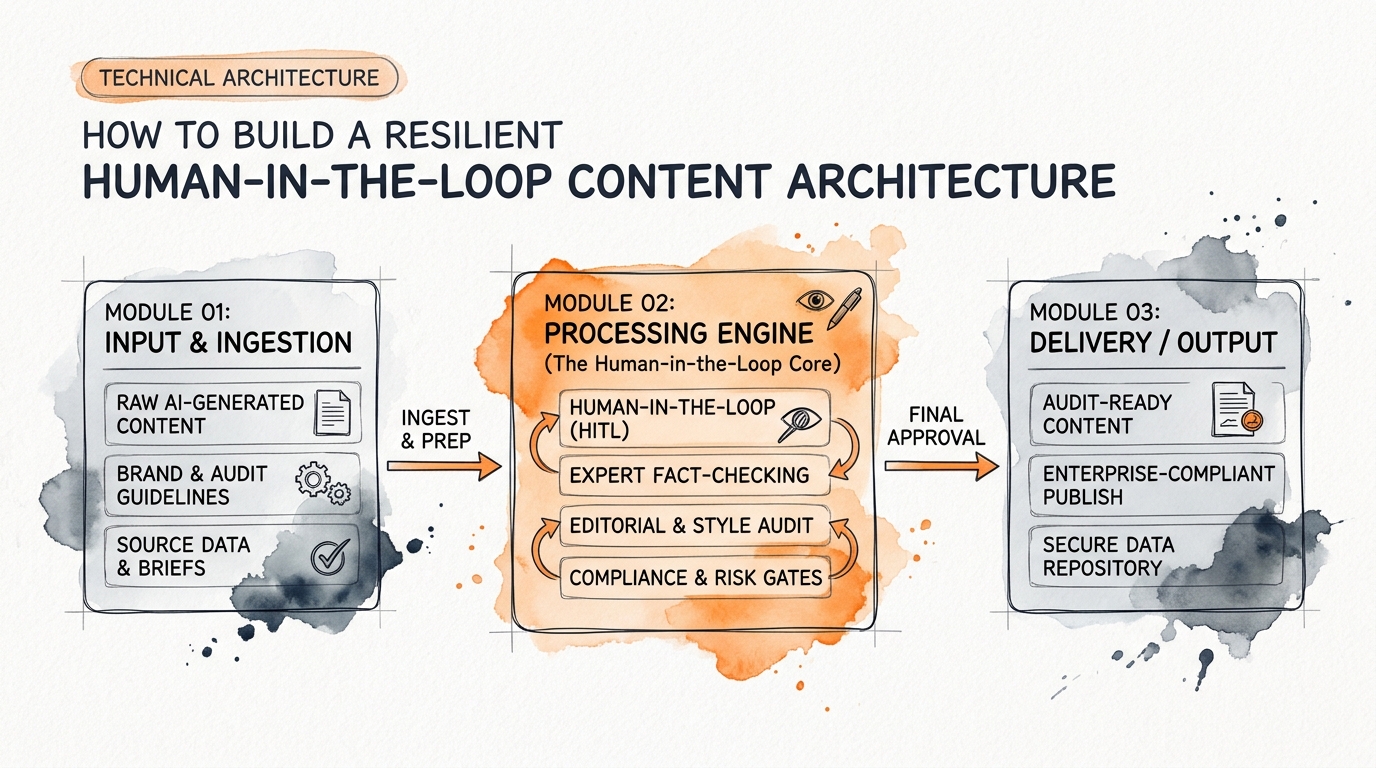
Think of unedited machine output like a prefabricated house. The framing goes up in hours, but if nobody checks the foundation, plumbing, and electrical wiring, building inspectors will condemn it before anyone moves in. This structural defect is the root cause when raw, purely automated AI content fails audits conducted by search engines and enterprise editorial boards.
A resilient Human-in-the-Loop (HITL) architecture bridges the gap between machine velocity and human judgment. It takes raw text generation and runs it through an uncompromising assembly line. The goal isn't just to make sentences sound smoother. The real objective is to inject distinct information footprints that software algorithms can't synthesize on their own.
Why Automated AI Content Fails Audits Without Systematic Verification
Large language models predict the next most probable word based on public web training sets. They don't know truth from fiction, and they certainly don't have firsthand operational experience. When search evaluators look for unique value, standard generative prose offers zero original insight. It simply restructures consensus thoughts.
To turn fragile drafts into durable assets, your team needs a four-stage editorial gate:
- Prompt Scaffolding and Boundary Setting: Don't ask an engine to write an entire 2,000-word guide at once. Feed it modular briefs containing target search intent, counter-arguments, and mandatory subtopics.
- Proprietary Data Injection: Algorithms prioritize primary information. Add internal telemetry, platform metrics, private survey findings, or customer case studies. If every competitor quotes the same public industry report, your internal dataset becomes your strongest moat.
- Subject-Matter Expert (SME) Interrogation: Don't make highly paid engineers or specialists write basic introductions. Instead, hand them a structured draft and ask them to break it. Have them fix technical inaccuracies, nuance edge cases, and add unscripted war stories.
- Primary-Source Fact Checking: AI frequently invents citations or attributes real quotes to the wrong people. Every statistic must point directly to a verifiable primary source before reaching staging.
"Pure generative tools give you a fast starting line, but they leave you stranded ten feet before the finish. If an expert can't stake their professional reputation on every claim in the article, that piece isn't ready for production."
Small teams often wonder if adding human review ruins the cost savings of automation. Participants in SaaS community discussions on human-in-the-loop architectures frequently ask whether manual oversight delivers an acceptable return on investment compared to hands-off publishing. The answer lies in survival rates. Publishing fifty unverified articles a month costs very little initially, but it leaves your domain vulnerable to sudden index purges.
| Workflow Dimension | Raw Automated Generation | Resilient HITL Architecture |
|---|---|---|
| Production Cost | $2 – $10 per asset | $60 – $180 per asset |
| Turnaround Time | Minutes | 2 to 4 business days |
| Information Gain | Zero (synthesized repetition) | High (original benchmarks, expert commentary) |
| Audit Resilience | Vulnerable to mass de-indexing | Defensible against algorithmic quality sweeps |
To orchestrate this workflow, consider dedicated governance platforms rather than basic consumer chatbots. Writer works well for mid-market and enterprise teams because it lets you configure custom style guides, factual constraints, and compliance checks directly inside the drafting interface. For content scoring and search intent coverage, pairing Writer with Clearscope gives your editorial team objective benchmarks for semantic completeness. While Writer catches off-brand terminology and compliance issues, Clearscope shows your reviewers where an AI draft glossed over essential context that needs real-world clarification.
Setting up this operational architecture takes time and discipline. You must build clear intake forms, train editors to spot subtle model hallucinations, and compensate experts fairly for their review hours. Still, the math works out in your favor. A smaller library of defensible, high-utility pages will always generate more enterprise value than thousands of generic drafts that disappear after the next major search update.
Moving Beyond Bulk Generation: Creating Sustainable, Audit-Proof Digital Assets
Pumping out hundreds of unvetted articles each week used to feel like an unfair advantage. Today, it is an enterprise liability. When search engines update their quality systems, they look for real proof of work, fresh testing data, and distinct human perspectives. Churning out generic summaries might fill an editorial calendar fast, but it leaves your entire domain vulnerable to manual actions and algorithmic wipes.
Sustainable visibility requires a mindset shift. You have to treat content like an engineered product rather than disposable copy. Think of your digital library like a physical building. Slapping together cheap, pre-fab walls lets you construct an office overnight. But the first structural inspector who walks through the door will condemn the property. Real editorial craftsmanship takes longer upfront, yet it survives every regulatory shift.
Why Automated AI Content Fails Audits and How Teams Can Pivot
When enterprise evaluators review your library, pure automated ai content fails audits because it lacks proprietary data, authentic testing, and genuine accountability. Algorithms can quickly spot repetitive sentence patterns and predictable phrasing across large catalogs. If ten sites publish the same synthesized advice, search engines have zero incentive to rank any of them.
Many marketing leaders ask whether slowing down is worth the cost. In recent marketing discussions on AI generation compliance pitfalls, operators shared how recovering from automated index purges took six to twelve months of grueling remediation. Rebuilding lost search equity always costs more than producing verified work from day one.
To audit-proof your brand, pair human subject-matter experts with smart analysis tools rather than fully autonomous writing bots. For instance, platforms like Clearscope help writers identify semantic gaps and verify search intent without generating empty paragraphs of synthetic filler. If you manage a large domain, an enterprise tool like MarketMuse analyzes topical coverage across your entire catalog, revealing exact subject areas where your brand needs original research rather than more surface-level pages.
True authority comes from saying something your competitors cannot replicate with a basic prompt. If a language model can synthesize your article in thirty seconds, your content offers no defensible value.
Start investing in unique assets that machine systems cannot fabricate. Interview internal engineers for real project war stories. Publish original customer benchmarks. Share real product tear-downs with original screenshots. These authentic signals tell readers and search raters that an actual practitioner stands behind every claim.
Scale is tempting. Speed feels productive. But durable organic performance belongs to teams that respect their audience's time and intelligence. Protect your search presence by trading reckless volume for undeniable domain depth.
