Enterprise AI Content Audit Checklist for 2025
Publishing digital copy used to take weeks of drafting, editing, and legal reviews. Generative engines changed that overnight. Modern marketing departments now produce thousands of articles, technical guides, and landing pages with simple prompts. Speed creates friction. Without a comprehensive enterprise ai content audit checklist, brands entering 2025 face massive operational clutter, voice dilution, and silent search traffic drops.
Table of Contents
- Why Enterprise Teams Face an Unprecedented AI Content Governance Challenge
- Phase 1: What Data and Asset Inventories Are Required Before Auditing?
- Phase 2: The Enterprise AI Content Audit Checklist for Quality, Truthfulness, and Brand Voice
- Phase 3: How to Audit AI Content for Legal, Privacy, and Regulatory Compliance
- Phase 4: How to Audit AI Content for Search Visibility and Generative Engine Optimization
- Phase 5: How to Triage, Rewrite, or Prune Low-Performing AI Content
- What Automated Systems and Workflows Enable Ongoing Content Oversight?
- Translating Your Audit Results into a Sustainable Enterprise AI Roadmap
Unmonitored generative tools act like a runaway printing press in an empty warehouse. They spit out pages around the clock, but nobody verifies whether the text solves actual user problems or spreads bad advice. In a recent discussion, practitioners on Reddit's marketing community warned about production edge cases where automated drafts invented product features, broke brand tone, and sparked customer support headaches. When regional teams, agencies, and product squads adopt separate tools without unified oversight, your digital footprint fractures into conflicting claims.
Governance platforms have emerged to tackle this sprawl. Solutions like Writer offer strong custom templates and brand guidelines that keep daily team writing uniform, while platforms like Acrolinx supply rigorous linguistic scoring suited for regulated industries like finance and healthcare. Software alone can't scrub legacy mistakes, though.
Search engines and generative answer engines now actively downrank repetitive, generic copy that fails to bring original research to the table. If your site hosts unvetted AI drafts, organic discoverability can drop overnight. Working through a systematic enterprise ai content audit checklist gives cross-functional leaders a clear path to catch compliance errors, safeguard search visibility, and restore high editorial standards across every asset.
Phase 1: What Data and Asset Inventories Are Required Before Auditing?
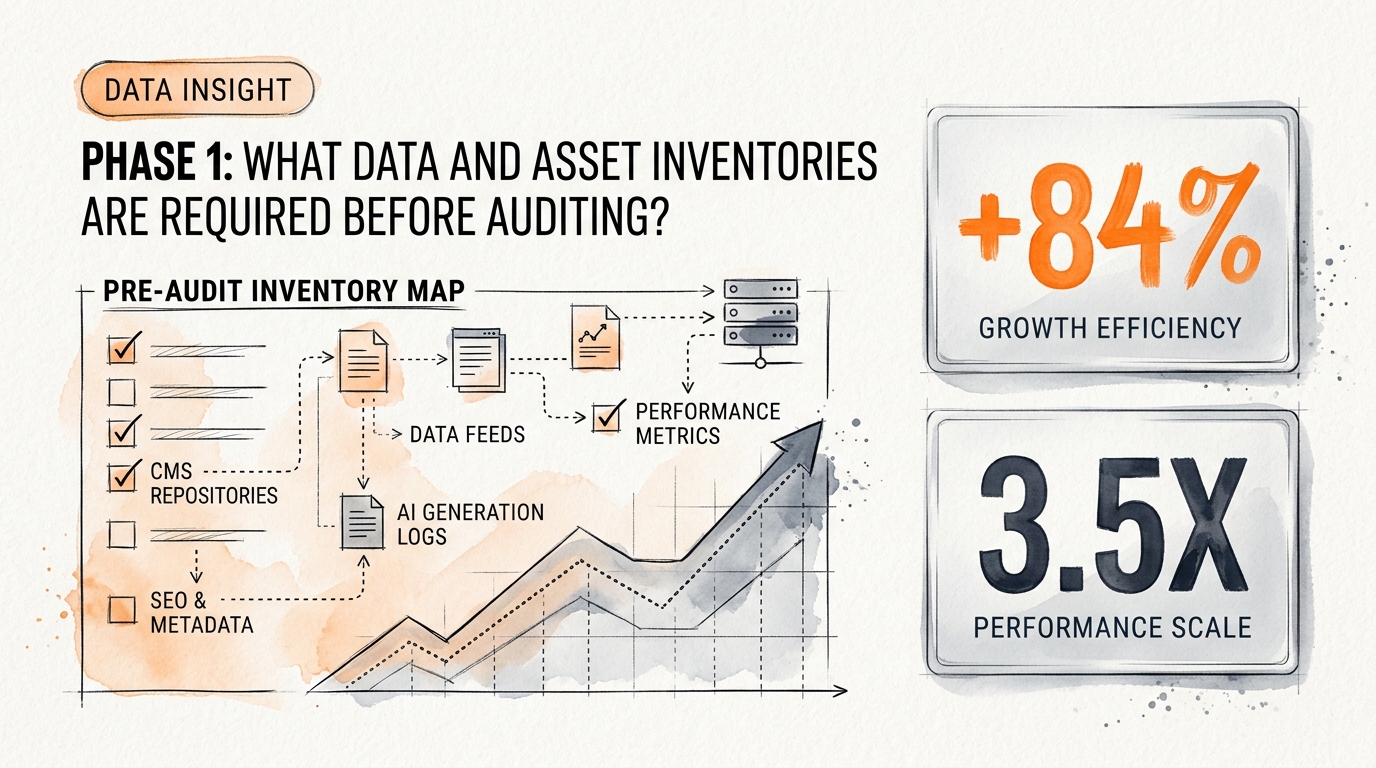
Jumping directly into copy editing without a comprehensive inventory is a fast way to waste money. Many brands spent the last two years churning out hundreds of thousands of AI-assisted pages, help articles, and product descriptions. If you try to audit that copy by clicking through your website URL by URL, you will miss the dark corners where risk actually hides. You cannot fix what you cannot find.
Before testing readability or legal compliance, you need a single source of truth. Think of this stage like an unglamorous warehouse audit. Before checking whether food is expired, you first have to count every box on every shelf across all storage depots.
Extracting the Complete Enterprise Text Corpus
Start by pulling every published asset into a centralized data lake or flat analysis file. Relying on basic web crawlers often falls short at enterprise scale. A standard site crawler like Screaming Frog is excellent for public URLs, but it struggles with gated customer portals, multi-language variations, and dynamic single-page applications.
Instead, connect directly to the database layer. If you run a headless CMS like Contentful or Sanity, write scripts to extract raw JSON payloads via their delivery APIs. For monolithic setups like Adobe Experience Manager (AEM) or WordPress VIP, export database tables directly to an analytics warehouse like Google BigQuery or Snowflake. This ensures you capture raw body copy, metadata fields, alt text, and translated variations without crawler timeouts.
Every asset entry in your inventory should match this minimum data schema:
{
  "asset_id": "CNT-89042",
  "live_url": "https://example.com/solutions/cloud-security",
  "cms_location": "pages/enterprise/security",
  "publish_date": "2024-03-12T14:30:00Z",
  "origin_flag": "hybrid_llm_edited",
  "author_of_record": "[email protected]",
  "cms_template": "product_deep_dive_v3"
}
Capturing template IDs and component models is vital. Many compliance errors stem from systemic template configurations rather than rogue copywriters.
Data Tagging and Triage in the Enterprise AI Content Audit Checklist
Executing a thorough enterprise ai content audit checklist requires knowing which systems generated specific words. You need to segment content into three distinct buckets:
- Pure AI: Bulk programmatic copy, automated category blurbs, and machine-translated pages produced with zero human editing.
- Hybrid Assets: Articles, white papers, and guides where humans used LLMs for outlining, initial drafting, or section rewrites.
- Manual Legacy: Heritage content published before your company adopted generative AI platforms.
How do you distinguish between these buckets if your authors didn't log their prompts? Do not rely entirely on commercial statistical detectors. They generate too many false positives on technical business copy and can misidentify non-native English writing as machine text.
Instead, audit git commit histories, CMS revision logs, and internal workflow tools. Platforms like Writer offer enterprise audit trails that log whether team members ran prompt completions inside drafts. Pair that editorial data with production timestamps. Any content spike between late 2022 and today that coincides with headcount drops or sudden publishing spikes should be marked as likely AI-assisted until proven otherwise.
Real-world practitioners highlight this classification hurdle often. In marketing operations discussions on pre-audit deployment pitfalls, operators routinely share that trying to classify legacy content by hand wastes months. Automating origin tags based on publication dates, user permissions, and API delivery logs saves hundreds of manual hours.
Mapping CMS Architectures and Hidden Content Layers
Enterprise content rarely sits on a single page. It lives in fragmented modules. A standard marketing landing page might pull its header from an editorial blog feed, its pricing table from an automated product catalog, and its FAQs from a support desk database.
"If your inventory tracks only static URLs, your audit will fail. You must inventory the source components. Otherwise, you'll fix an AI hallucination on one page, only to have the CMS inject that exact same bad snippet onto forty other pages the next morning."
Map out all micro-copy repositories. This includes chatbots, customer support auto-responders, transactional email templates, and localized site clones. Mark whether each system uses static hardcoded text, dynamic API calls, or real-time LLM generation.
Cross-Departmental Governance and Ownership Alignment
A technical inventory means nothing if no one owns the remediation tasks. Content teams often assume legal will review drafts, while legal assumes marketing handles accuracy. Everyone assumes product manages programmatic tables.
Before auditing a single line, establish an operational RACI matrix (Responsible, Accountable, Consulted, Informed) across your teams:
| Audit Inventory Task | Content / Marketing | Legal & Compliance | Product & Engineering |
|---|---|---|---|
| Corpus Extraction & API Access | Informed | Informed | Responsible |
| Content Origin Tagging | Responsible | Consulted | Informed |
| Risk Threshold Sign-Off | Consulted | Accountable | Informed |
| CMS Triage & Schema Fixes | Consulted | Informed | Responsible |
Lock down these cross-team roles now. When the data collection phase finishes, you'll have thousands of assets flagged for review. Knowing who has authority to delete, rewrite, or clear an asset keeps your upcoming audit on schedule and on budget.
Phase 2: The Enterprise AI Content Audit Checklist for Quality, Truthfulness, and Brand Voice
When enterprise teams unleash generative models across marketing, support, and sales documentation, content volume explodes. But accuracy usually collapses at the same rate. Thousands of published assets end up sounding vaguely authoritative while saying things that are completely wrong. Manual editing teams get overwhelmed within weeks, letting dangerous factual blunders slip into public view.
As marketing leaders pointed out in a Reddit SaaS community thread on scaling content workflows, human-only reviews quickly hit a breaking point once content volume passes hundreds of assets per sprint. You need an objective, repeatable way to grade every asset. Applying an enterprise ai content audit checklist helps teams catch subtle shifts in factual accuracy and tone before brand credibility takes a permanent hit.
Core Areas of the Enterprise AI Content Audit Checklist
Large language models do not think. They predict words. Think of an unguided model like an eager junior contractor who wants to please you so badly that they make up numbers rather than admit they don't know the answer. Run every generated page through these five operational filters:
- Phantom Citations and Fake Data: Models routinely invent academic papers, DOI numbers, and industry statistics. Every link must be clicked. Every stat must trace back to a verifiable, primary industry report. If an article mentions that "73% of CIOs prefer hybrid cloud architectures," locate the original survey or strike the line immediately.
- Stylistic Drift and Cadence Monotony: Models lean hard on repetitive phrases. Look out for overused tropes like "in today's fast-paced digital landscape," "game-changer," or "unlocking potential." When models generate content without strict prompt limits, all your pages start sounding like the same generic press release.
- Terminology Inconsistencies: Generative systems swap precise proprietary names for generic equivalents. They might call your custom "Autonomous Pipeline Engine" a "workflow automation feature." Make sure product features, tier names, and brand identifiers match your current product catalog word-for-word.
- Algorithmic Bias and Tone Deafness: Training sets reflect historical web text, complete with outdated assumptions and stereotypes. Audit persona examples and industry case vignettes to ensure your copy uses modern, inclusive language without alienating key demographic groups.
- Promise and Capability Drift: Synthetic text tends to over-promise. The model might tell readers your software integrates with legacy systems that your engineering team stopped supporting three years ago. Cross-reference all feature lists against your live engineering changelogs.
Field Rule: If an AI-generated claim lacks a verifiable URL or an identifiable human researcher's name, treat it as a hallucination until proven otherwise.
Auditing Software vs. Manual Reviews: What Works at Scale?
Teams often ask whether software can replace human editors during a content audit. The short answer is no, but software acts as a necessary first line of defense. Relying strictly on manual reviews costs too much time, while relying purely on automated scripts lets nuanced factual errors slide by.
| Audit Layer | Primary Tooling | Target Defect | Human Effort Required |
|---|---|---|---|
| Automated Governance | Writer or Acrolinx | Banned phrases, reading level, tone drift | Low (Rules-engine setup only) |
| Link & Citation Scraping | Custom Python scripts, Screaming Frog | 404 errors, fake domains, broken anchors | Medium (Reviewing flagged exceptions) |
| Subject Matter Fact-Check | Internal wikis, Jira changelogs | Invented features, inaccurate technical claims | High (Specialist review) |
For brands balancing high output with tight quality standards, tools like Writer and Acrolinx handle the initial pass effectively. Acrolinx shines in deeply technical, enterprise-scale governance environments where strict compliance scoring is required across thousands of contributors. Writer gives commercial growth teams an agile way to build custom style guidelines, train models on brand assets, and automate terminology enforcement across decentralized departments.
Operationalizing the Checklist: Step-by-Step Execution
Don't try to audit all assets at once. Group your pages into tiers based on business risk. High-traffic product landing pages and security documentation need direct manual verification. Older, top-of-funnel blog posts can pass through automated style filters first.
First, run your automated scanning tool across your content repository to flag broken links, poor readability scores, and banned vocabulary. This weeds out the obvious mechanical failures. Second, assign your content editors to sample 10% to 15% of the passed articles to spot semantic issues that automated scanners miss, such as awkward metaphors or overblown product claims. If that sample shows a failure rate above 5%, pull the entire batch back for full editorial revision.
Third, log every recurring error into your prompt library and governance guidelines. Auditing shouldn't just clean up messy pages. It must actively improve the generation prompts and guardrails your team uses moving forward.
Phase 3: How to Audit AI Content for Legal, Privacy, and Regulatory Compliance
Generative models don't build text from thin air. They predict sequences based on billions of training documents, and sometimes they repeat those inputs word for word. When your company publishes machine-generated copy, your brand absorbs every legal liability attached to it. If an engine spits out a verbatim paragraph from a copyrighted whitepaper or exposes an internal database string, the legal department takes the hit. A proactive risk review stops these liabilities before material goes live.
Think of training-data memorization like an intern who copied pages out of a library book and pasted them directly into a customer proposal. The intern might not realize they violated someone's property rights, but your company still faces the lawsuit. Putting an enterprise ai content audit checklist into practice gives your reviewers the exact guardrails needed to catch these blind spots across high-volume pipelines.
Legal and Regulatory Enterprise AI Content Audit Checklist
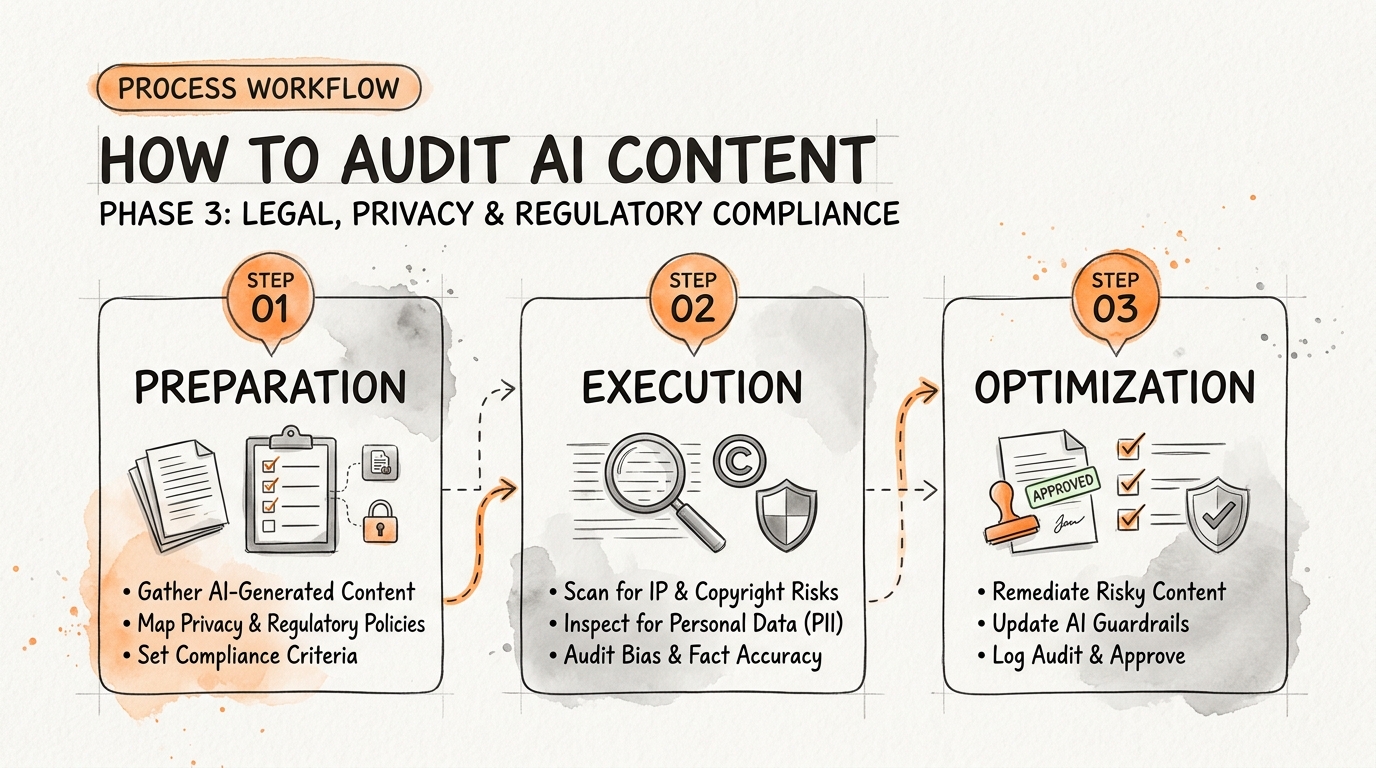
Auditing content for legal and regulatory exposure requires distinct checks across three main vectors: copyright risk, privacy leakage, and statutory compliance. Run each asset through this sequence before publication.
| Risk Category | Audit Check | Enterprise Tooling | Target Standard |
|---|---|---|---|
| Copyright & IP | Verbatim regurgitation scan | Copyleaks / Originality.ai | Zero matches > 10 continuous words without license |
| PII & Confidentiality | NER & regex entity scrubbing | Private AI / Nightfall AI | 100% removal of employee names, customer IDs, and keys |
| EU AI Act (Art. 50) | Transparency & machine-readable tags | Internal CMS metadata flags | Clear labeling of synthetic public-facing media |
| FTC Compliance | Factual claim substantiation | Manual source validation | Direct citations for every product performance claim |
Guarding Against Copyright and Intellectual Property Exposure
Large language models memorize rare phrases. If a prompt triggers the model to output a snippet of source code, proprietary text, or trademarked brand slogans, you risk direct copyright infringement claims.
How do you stop this? You run every generated batch through a deep-search plagiarism tool. We recommend enterprise-focused engines like Copyleaks over standard consumer tools. Copyleaks checks for direct text overlap while flagging close paraphrasing that mimics copyrighted source material. Another solid option is Originality.ai, which works well for web publishing teams tracking content originality and generation probability side by side. Set your scanning threshold strictly: any output matching more than eight to ten continuous words from external source pages must be rewritten or cleared by legal counsel.
"Manual spot-checking fails the moment your editorial engine scales past fifty articles a week. You miss the subtle trademark violations every single time."
Many practitioners struggle during rollout. As highlighted in marketing discussions around AI compliance edge cases, teams often think an editorial read-through is enough to catch intellectual property conflicts. It isn't. When a model borrows an obscure paragraph from an academic journal or an competitor's patent filing, human editors won't catch it without automated text-matching software.
Eliminating PII and Proprietary Data Leakage
Data privacy breaches happen fast. When staff members use customer chat transcripts or internal roadmap documents to create marketing assets, generative tools often carry that sensitive text into the draft.
This creates serious risks under GDPR, CCPA, and HIPAA. To prevent sensitive disclosures:
- Audit input datasets and prompts: Check that engineers or writers haven't included customer names, contact information, internal IP addresses, or unreleased product schematics in prompt chains.
- Deploy automated redaction: Tools like Private AI use natural language processing to identify and replace Personally Identifiable Information (PII) before documents hit your CMS. Private AI processes text locally, keeping sensitive records off third-party servers. Alternatively, Nightfall AI scans cloud data stores and generative applications for sensitive tokens, API credentials, and credit card numbers.
- Scan final drafts for hidden entities: Review final outputs using automated regex patterns designed to catch phone numbers, social security IDs, customer IDs, and physical addresses.
Adhering to Emerging Regulatory Mandates
Regulators are moving quickly. Compliance is no longer voluntary advice; it is becoming statute.
Under Article 50 of the European Union AI Act, providers and deployers of AI systems must ensure that AI-generated content is clearly marked as artificial. If your enterprise distributes synthetic text to the public on matters of public interest or commercial products, you need clear disclosures. The disclosure must be visible to regular readers and embedded in machine-readable metadata for search crawlers and verification software.
The Federal Trade Commission (FTC) enforces similar rules under truth-in-advertising standards. If an AI tool creates a product review, a customer testimonial, or a performance claim, you must have hard evidence backing that claim. Hallucinated quotes or fabricated customer metrics violate Section 5 of the FTC Act. Your audit must verify every case study, quote, and statistical claim against real primary research.
Integrating these compliance steps into your wider enterprise ai content audit checklist prevents costly regulatory fines and protects hard-earned customer trust.
Phase 4: How to Audit AI Content for Search Visibility and Generative Engine Optimization
Search visibility isn't a single-track race anymore. It's split right down the middle. On one side, traditional crawlers like Googlebot scan your URLs to rank classic blue links. On the other, generative engines like ChatGPT Search and Perplexity retrieve and synthesize content directly into conversational answers. When automated pipelines publish hundreds of thin variations, both engines suffer. Crawlers choke on bloated directories, while generative engines discard text that lacks distinct, extractable facts.
Teams often jump headfirst into bulk publishing without realizing how easily AI text triggers search penalties. As seasoned practitioners noted in a marketing discussion on AI deployment pitfalls, unchecked algorithmic output usually ends with indexation plateaus, cannibalized keywords, and wasted crawl spend.
Technical Crawl Health: An Enterprise AI Content Audit Checklist for Search Bots
Executing a disciplined enterprise ai content audit checklist prevents automated page generation from devouring your site's crawl budget. When search engine bots visit your domain, they allocate a limited amount of time and server requests based on your site's authority and host speed. If a bot spends its allotted visit hitting 40,000 near-identical product landing pages created by a generative model, it won't crawl your high-margin revenue pages.
Evaluating this risk requires looking at duplicate content through a mathematical lens. Large language models (LLMs) rely on consistent prompt templates. Even if the wording shifts slightly across 5,000 generated articles, the underlying syntactic structure and semantic vectors remain nearly identical. Search engines spot this programmatic duplication quickly. Think of it like serving fifty flavors of vanilla ice cream. Googlebot takes three bites and skips the rest of the bowl.
| Audit Area | What to Check | Recommended Tooling |
|---|---|---|
| Crawl Budget & Server Response | Identify 5xx server errors, slow time-to-first-byte (TTFB), and orphaned AI-generated pages buried more than 4 clicks deep. | Botify for 10M+ URL enterprise architectures; Screaming Frog for local crawls under 2 million pages. |
| Near-Duplicate Clustering | Scan for pages sharing more than 80% lexical or structural similarity across bulk-published categories. | Sitebulb (Content Similarity algorithm) or custom Python scripts using MinHash / SimHash analysis. |
| Index Bloat vs. Yield | Compare total indexed AI URLs in Google Search Console against those generating zero organic impressions over 90 days. | Google Search Console API cross-referenced against your primary data warehouse (BigQuery / Snowflake). |
| Robots Directives & Self-Canibalization | Verify canonical tags point to original source material instead of circular self-referencing duplicates. | Ahrefs or Semrush Site Audit modules to flag duplicate title tags and cannibalized search queries. |
If you're balancing budget against performance, pick tools matched to your scale. Screaming Frog remains the industry workhorse for mid-market diagnostics because you pay a flat annual fee and control custom regex scrapers locally. However, if your enterprise manages millions of dynamic URLs across global locales, Botify justifies its higher price tier by joining log-file analysis directly with organic performance metrics.
Auditing Google E-E-A-T and Information Gain
Google doesn't penalize content simply because an algorithm wrote it. The real penalty lands on content that adds zero value to the wider web. Generative tools naturally summarize what already exists online. If your post repeats the exact same consensus advice found on the top five SERP results, search algorithms have no incentive to rank it. They look for "information gain"—fresh points of view, proprietary data, and real-world experience.
"Information gain is the dividing line between AI content that ranks and AI content that tanks. If your audit doesn't measure proprietary inputs, you're building on shifting sand."
During the audit, inspect your articles for tangible proof points:
- First-Party Data and Research: Does the page include proprietary survey results, internal telemetry, benchmark figures, or unique graphics? If you can swap your company name for a competitor's without changing the text, the content lacks original value.
- Expert Validation: Are real authors with verifiable credentials attached to the byline, or does the page cite "Editorial Team"? Check whether the cited contributor has an active LinkedIn presence, published academic work, or relevant industry history.
- Direct Quotations: Automated writers rarely gather interviews on their own. Verify that subject matter experts contributed direct perspectives rather than generalized summaries.
- Clear Disclosures: Check that your team transparently documented how AI assisted the editorial process, adhering to FTC guidelines and emerging global standards.
Optimizing for Retrieval-Augmented Generation and AI Answer Engines
Search engines aren't just indexing documents to show links; they're breaking text down to answer direct user questions. Platforms like Perplexity, SearchGPT, and Claude pull content via Retrieval-Augmented Generation (RAG). In a RAG pipeline, the system breaks your page into small, bite-sized sections (often 200 to 500 words) called "chunks." It converts these chunks into numbers called vector embeddings and stores them in a vector database.
When a user types a prompt into Perplexity, the engine finds the most relevant chunks across the web, reads them, and summarizes an answer. If your content is buried inside rambling, fluffy narrative prose, the retrieval bot simply skips it. Clear structure wins citations.
Here is how you evaluate pages for generative engine readability:
- Answer-First Formatting: Does the paragraph immediately following an H2 or H3 answer the query directly in 40 to 60 words? AI answer models favor concise, self-contained definitions they can parse without reading surrounding text.
- Semantic Heading Hierarchy: Headings must state clear topics instead of creative puns. Replace headings like "The Secret Sauce" with "How to Configure Webhook Endpoints in Apache Kafka." Clear labels help parsers categorize information accurately.
- Schema Markup Completeness: Audit your structured data. Validate that FAQPage, TechArticle, and Organization schemas correctly define your entities in JSON-LD. This gives language models machine-readable breadcrumbs that confirm your data's authority.
- Data Density via Tables and Lists: Transform narrative explanations into cleanly coded HTML tables and ordered lists. LLM crawlers extract structured data pairs far more reliably than prose paragraphs.
Many enterprise brands wonder if auditing for both classic bots and generative models makes sense for smaller divisions or localized e-commerce catalogs. The answer depends on your commercial goals. If your revenue depends on conversational discovery or high-intent technical searches, optimizing for answer extraction pays immediate dividends. If you run low-margin programmatic pages with thousands of generic SKUs, basic crawl cleanup should take priority over bespoke GEO restructuring.
Phase 5: How to Triage, Rewrite, or Prune Low-Performing AI Content
Auditing thousands of synthetic web pages leaves you with a massive spreadsheet and a sinking feeling. You know hundreds of articles are underperforming, yet your editorial team can't manually rewrite every post before the next search engine core update hits. You need an objective triage system.
Think of this remediation process like an emergency room. When forty patients arrive at once, doctors don't bandage everyone in chronological order. They check vitals, treat life-threatening injuries first, stitch up the treatable wounds, and send uninjured folks home. Your content needs that exact same split-second clarity. We evaluate pages across three distinct axes: organic traffic, backlink authority, and business conversion value.
Executing the Enterprise AI Content Audit Checklist Remediation Framework
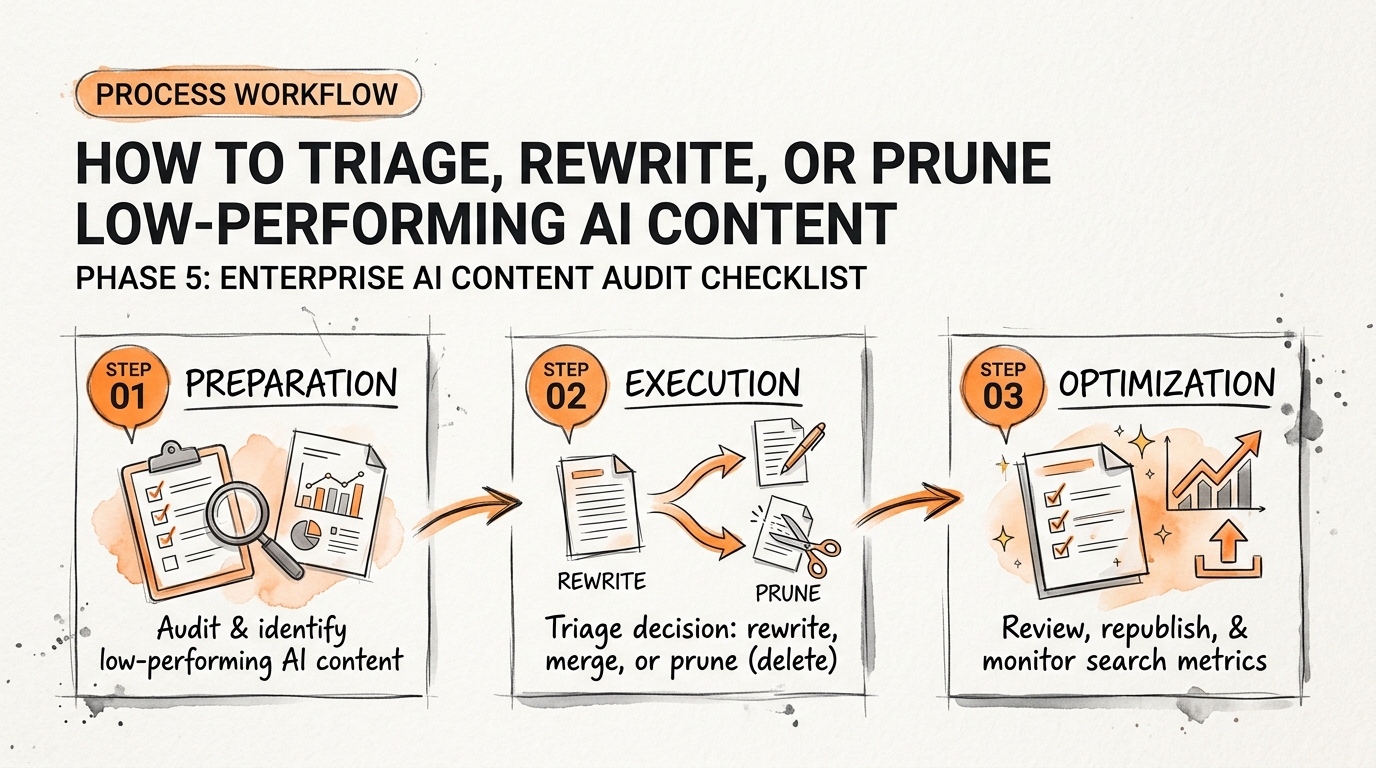
Every low-performing page must fall into one of four distinct buckets. Never leave an audited URL in limbo. Assign each page an explicit status code and owner directly within your master audit sheet.
| Triage Bucket | Diagnostic Signals | Remediation Action | Expected Impact |
|---|---|---|---|
| Keep (Monitor) | Stable search rankings, zero factual hallucinations, passes legal review, converts visitors. | Leave as-is. Set automated quarterly traffic monitoring to catch future decay early. | Protects revenue-generating assets without wasting editorial hours. |
| Humanize / Enhance | High impressions, declining click-through rates, thin AI tone, zero expert quotes. | Inject real practitioner insights, original screenshots, custom graphics, and proprietary survey data. | Reclaims lost SERP spots by satisfying Google's Information Gain scores. |
| Consolidate | Multiple AI URLs targeting the exact same keyword variant (cannibalization). | Merge unique value into the single highest-performing URL. Point remaining URLs via 301 redirects. | Pools fragmented internal link equity into a single authoritative powerhouse. |
| Prune (410 or 301) | Zero clicks over 180 days, zero referring domains, outdated or hallucinated text. | Delete the URL. Return a 410 Gone status code (or 301 redirect to a relevant parent topic if links exist). | Recovers crawl budget and cleans out site-wide quality drag. |
Phase 5 of your enterprise ai content audit checklist transforms massive data dumps into clear operational tasks. If a page generates direct revenue or assists pipeline deals, you defend it at all costs. If a page has dozens of quality external backlinks but stale copy, you rewrite it. If it has no links, no traffic, and reads like boilerplate generated in 2023, you delete it without hesitation.
"Our team spent three months trying to polish 4,000 thin programmatic blog posts. Once we finally cut 2,800 of them and redirected the rest to eight comprehensive resource guides, our overall site impressions surged by 42% in six weeks."
Choosing Your Remediation Tool Stack
Triage at enterprise scale falls apart if you rely solely on manual copy-pasting. You need tools that combine page performance metrics with content depth analysis.
For raw data aggregation, Screaming Frog SEO Spider remains the workhorse. You can connect it directly to the Google Search Console, Google Analytics 4, and Ahrefs APIs. This lets you pull backlink counts, organic sessions, and conversion events alongside your audited content inventory in one crawl. It costs roughly $259 per year per license, making it accessible for any budget. However, it requires an analyst who knows how to configure crawl custom extractions.
For evaluating content quality and topical gaps during rewrites, enterprise platforms like MarketMuse or Clearscope shine. Clearscope starts around $189 per month, while MarketMuse enterprise plans often run between $1,500 and $3,000 monthly. These platforms analyze top-ranking SERPs to reveal exactly what subtopics your synthetic copy missed. If your budget is tight, Screaming Frog paired with Google Search Console exports provides plenty of signal to make fast pruning calls.
Addressing Practical Triage Pitfalls
Marketers often run into fierce internal resistance when proposing content cuts. Content creators feel attached to their work, even if an algorithm generated the initial draft. In online communities, practitioners frequently share stories about common edge cases and compliance pitfalls in content triage. The most common mistake? Deleting thousands of pages overnight without checking historical backlink equity.
Always check your referring domains before issuing a 410 status code. If an underperforming AI article earned high-authority backlinks from news outlets or industry blogs, deleting it throws away hard-won domain authority. In those edge cases, choose consolidation instead. Move the useful nuggets to your primary product or solutions page, then set up a permanent 301 redirect.
What about e-commerce stores with thousands of auto-generated product summaries? For small teams and catalog managers, rewriting every product description manually isn't realistic. Focus manual enhancement solely on the top 10% of revenue-generating SKUs. For the remaining long-tail catalog, use structured data schema, user reviews, and technical specifications to carry search visibility rather than generic AI paragraphs.
Remediation isn't a one-time clean-up. It's a continuous hygiene habit. Pruning dead weight frees up crawl budget, reduces legal liability, and lets your top-performing assets shine.
What Automated Systems and Workflows Enable Ongoing Content Oversight?
Manual audits expire fast. If you review ten thousand articles this week, your team might publish five hundred more next Monday. Machine learning models update without warning. Writers tweak system prompts. Regulations shift. Treating oversight as a one-time project is like checking the air pressure in your tires once and expecting them to stay inflated forever.
You need continuous verification. Think of automated oversight like a municipal water filtration system. You don't test the water once a year at the kitchen sink. Instead, you run automated sensors at every pipe junction to catch contaminants long before anyone takes a sip.
Automating Pre-Publish Gates with Content CI/CD
Software developers don't release code directly to production. They push code through continuous integration and deployment (CI/CD) pipelines. These pipelines run automated tests to catch syntax errors, security vulnerabilities, and broken logic. Editorial teams can adopt this exact workflow for generated copy.
When an author or automated agent generates a draft in your Content Management System (CMS), an event webhook triggers a headless verification pipeline. The draft passes through several automated gates before reaching a human editor:
- Synthetic Claim Verification: An evaluation model extracts factual claims and compares them against verified corporate knowledge bases and product documentation.
- Voice and Tone Scoring: Natural language models evaluate sentence complexity, reading grade level, and brand sentiment against baseline style embeddings.
- Regulatory and PII Scanners: Pattern-matching regex and named-entity recognition (NER) scan for private customer data, unsupported performance guarantees, and banned industry terms.
- Hallucination Detection: Secondary consensus checks run the source prompt across alternative models to spot divergence or fabricated citations.
If the draft scores below your minimum threshold, the pipeline blocks publication. It routes the asset back to the creator with inline annotations explaining why the system flagged it. Editors only review drafts that pass these automated gates.
Operationalizing the Enterprise AI Content Audit Checklist with Continuous Monitoring Tools
Building oversight systems from scratch takes serious engineering time. Most organizations deploy commercial enterprise governance software to enforce their standards. The market splits into linguistic rule-engines and generative alignment platforms.
| Platform | Core Architecture | Key Strengths | Best Use Case |
|---|---|---|---|
| Acrolinx | Linguistic rule engine with custom corporate lexicons | Deep terminology governance, precise editorial rule authoring | Highly regulated enterprises (pharma, finance, defense) |
| Writer | Knowledge-graph-backed LLM with built-in style rails | Fast deployment, native CMS integrations, automated fact-checking | Mid-market to enterprise marketing and product teams |
| Custom Eval Pipeline | Open-source frameworks (DeepEval, Ragas) using LLM-as-a-judge | Infinite customizability, direct database integration, zero seat fees | Technical teams with dedicated engineering resources |
Enterprise platforms like Acrolinx cost between $25,000 and $100,000 annually. Smaller businesses and growing e-commerce stores often balk at these contracts. For leaner teams, building an internal evaluation pipeline using custom scripts and API calls delivers comparable governance at a fraction of the cost. You can feed your standards directly into an LLM-as-a-judge prompt to score output drafts in batches before they enter your live repository.
Automating content gates doesn't eliminate edge cases; it just concentrates them. Teams often get stuck trying to automate 100% of nuanced policy decisions right away, as highlighted in production compliance pitfalls shared by marketing practitioners. Start by screening for clear violations first, then layer on voice and subjective stylistic checks over time.
Quarterly Audits and Statistical Sampling Cadences
Pre-publish gates protect your front door. Post-publish drift requires a different strategy. Over months, small search engine algorithm updates, product revisions, and conversational shifts cause content to degrade. You cannot manually read fifty thousand indexed pages every quarter. You can, however, audit a statistically representative sample.
Structure your quarterly sampling program using risk-weighted tiers:
- Tier 1: High Liability (100% Coverage). This tier covers healthcare advice, financial claims, legal terms, and pricing pages. Automated scanners run continuously, and dedicated subject matter experts review every live URL quarterly.
- Tier 2: High Traffic (20% Sample). This group includes product landing pages and top-ranking search articles driving the bulk of your inbound pipeline. Audit twenty percent of these URLs quarterly, rotating the sample so the team inspects every asset across a fourteen-month horizon.
- Tier 3: Programmatic Footprint (5% Sample). For massive collections of programmatic SEO pages or category listings, pull a stratified random sample of five percent. Check this cohort for hallucinated data points, broken dynamic links, and engagement decay.
If your random sample in Tier 3 reveals an error rate higher than two percent, trigger a mandatory automated sweep across the entire batch to catch systemic failures.
Assembling an AI Content Center of Excellence
Technology enforces rules, but humans must write those rules. An enterprise AI Content Center of Excellence (CoE) acts as the central governing body. It unites the disconnected departments that create, review, and regulate automated copy.
Without a CoE, marketing teams publish copy that legal later redacts, while engineers deploy language models that editorial finds unreadable. A functional CoE breaks down these silos with four distinct roles:
- The Managing Editor: Sets brand voice, vocabulary benchmarks, and reading levels. This person makes the final call on stylistic edge cases.
- The Regulatory Counsel: Defines safe harbor statements, disclosure requirements, and prohibited product claims. They translate new court rulings and privacy laws into strict automated checks.
- The Prompt & Systems Architect: Translates editorial and legal requirements into executable evaluation prompts, embedding vectors, and pipeline integrations.
- The SEO & Performance Analyst: Tracks ranking volatility, generative citation visibility, and organic bounce rates to identify which AI formats sustain real user interest.
This cross-functional group meets monthly to review flagged drafts, evaluate audit logs, and tune automation scoring models. They are responsible for updating your living enterprise ai content audit checklist to handle newly discovered model behaviors, keeping your continuous oversight sharp as generation technology accelerates.
Translating Your Audit Results into a Sustainable Enterprise AI Roadmap
Don't abandon your audit findings in a spreadsheet. An enterprise ai content audit checklist is only as valuable as the operational shift it creates across your company. Most teams treat audits like an autopsy. They comb through hundreds of published articles, spot broken claims, and panic. That reactive loop burns out editors. It frustrates leadership. Fix the workflow first. When you translate raw audit rows into clear executive priorities, you stop playing endless whack-a-mole with hallucinated facts, copyright risks, and robotic phrasing across thousands of URLs.
Take your findings to department heads with three clear metrics: total legal risk surface, monthly cost of editorial rework, and generative search visibility losses. Your Chief Legal Officer doesn't care about minor variations in brand tone. They care about customer-facing hallucinations, privacy violations, and copyright claims. Your organic growth lead cares about index bloat and search drops caused by generic filler. Uniting these stakeholders around unified governance milestones transforms your audit from an annoying post-mortem into an approved business priority.
Operationalizing the Enterprise AI Content Audit Checklist
Sustainable governance requires software that stops low-quality text before it goes live. Modern enterprise tools make this transition painless. Platforms like Writer help teams build custom knowledge graphs and enforce company-specific style rules directly inside the drafting interface. Meanwhile, enterprise engines like Acrolinx excel at deep linguistic scoring, terminology control, and automated compliance tracking across massive content libraries. Both approaches keep your teams from repeating old mistakes.
Relying purely on post-publish corrections is a recipe for failure. As one team highlighted when discussing compliance pitfalls when deploying AI workflows, cleaning up bad text after the fact quickly becomes far more expensive than producing original copy by hand. Real-time guardrails prevent that waste entirely.
Set rolling ninety-day milestones to prune toxic pages, update prompt libraries, and mandate human verification for all high-risk topics. Run quarterly micro-audits to verify that your guardrails hold as generative search engines evolve. Automated content generation isn't slowing down, but speed without verification ruins trust. Use the findings from your audit to build accountable workflows, safeguard your brand voice, and turn AI into a genuine competitive advantage.
