
Surfer SEO vs AI Writers for Scaling Content
Every content team wants to publish faster without losing rankings. The ongoing debate over surfer seo vs ai writers comes down to a simple trade-off: speed versus precision when scaling content. You can prompt a generic tool to generate fifty articles in an afternoon. That sounds great on paper. But if those pages fail to crack Google's top twenty, you've essentially built an empty digital library that nobody visits.
Table of Contents
- Surfer SEO vs AI Writers: What Is the Fundamental Difference in Architecture?
- Why Standalone AI Writers Struggle to Rank Without Live SERP Calibration
- What Sets Surfer AI Apart from General-Purpose Drafting Platforms?
- How to Build a Hybrid Workflow Using AI Writers and Surfer SEO
- How Do Costs, Token Economics, and Production Scalability Compare?
- How Do Search Algorithms and Generative Engines Evaluate Both Content Types?
- Making the Final Investment Call for Your Organic Growth Strategy
Content marketing has split into two competing philosophies. One side bets entirely on brute-force writing speed using tools like Jasper or native language models. The other side relies on correlation engines like Surfer SEO to map out page structure, entity frequencies, and search intent before typing a single sentence. If you pick the wrong approach, you'll burn your content budget on articles that get lost in indexation limbo.
A candid Reddit SaaS discussion on production workflows reveals that teams pushing raw generative copy straight to publication often hit a visibility wall after algorithmic updates. Generative tools work like creative copywriters who never look at search results. They guess what should come next based on probability. Correlation platforms work more like search forensics labs. They scan the top-performing pages right now, analyze hundreds of on-page signals, and hand you a blueprint based on real ranking data.
When comparing surfer seo vs ai writers, your evaluation shouldn't just center on cost per word or generation speed. It comes down to whether your editorial stack prioritizes quick drafts or predictable search visibility. High-performing growth teams don't pick one in isolation. They evaluate how real-time SERP data, factual depth, and production pipelines connect to drive revenue.
Surfer SEO vs AI Writers: What Is the Fundamental Difference in Architecture?
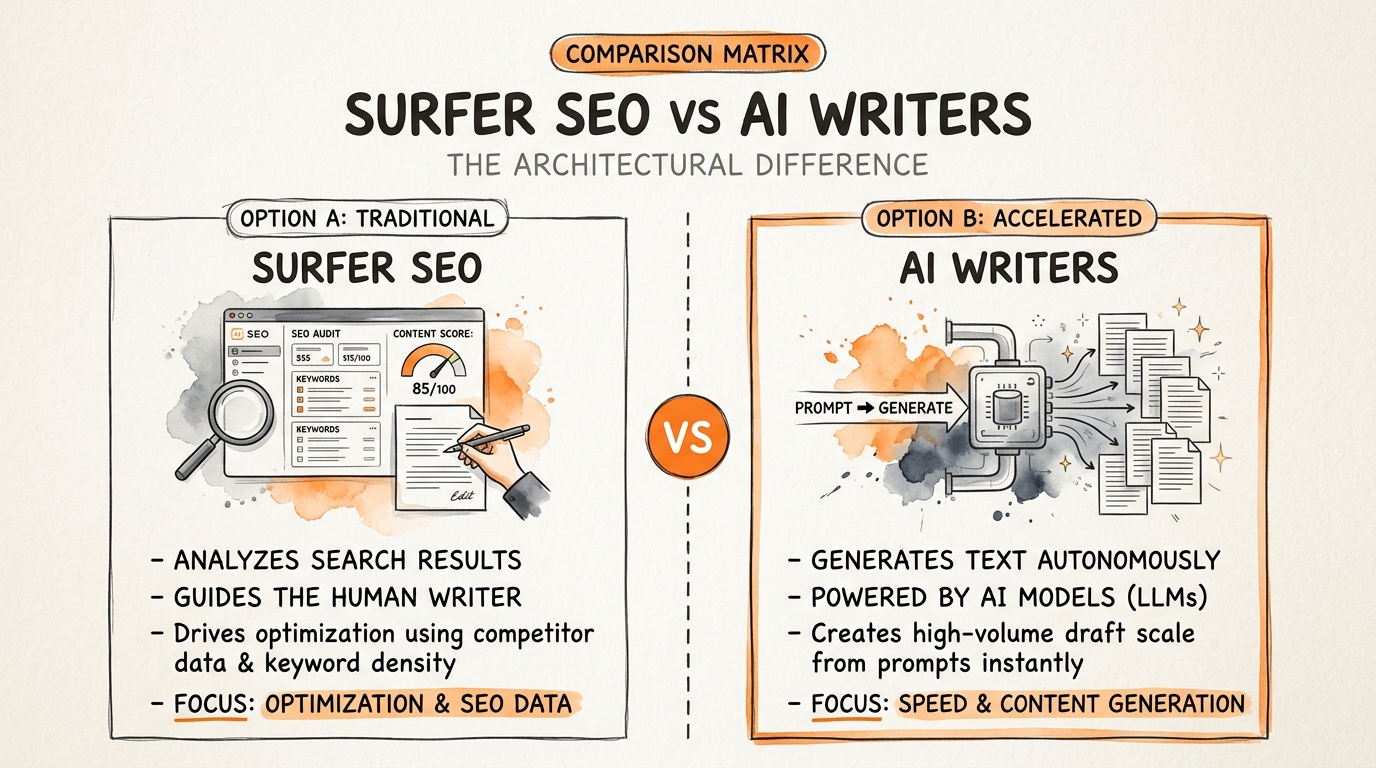
When comparing surfer seo vs ai writers, most teams make the mistake of treating them like competitors in the same software category. They aren't. They run on fundamentally different software architecture, solve different mathematical problems, and look at web text through opposite lenses.
A standalone AI writer—whether you use Jasper, Copy.ai, or a direct connection to OpenAI's GPT-4—is an autoregressive large language model (LLM). Its sole engineering purpose is next-token prediction. When you feed an LLM a prompt, the system breaks your words into numerical tokens. It calculates probability distributions across its billions of parameters to guess which word should come next. It prioritizes semantic plausibility and grammatical rhythm. The software doesn't know whether a sentence is true, nor does it know what currently ranks on search engines. It only knows what sounds like natural human speech based on historical training data.
Surfer SEO does not work this way. Surfer is an empirical correlation engine. It doesn't guess what should sound convincing. It audits what is already winning.
Live SERP Correlation vs Next-Token Prediction
When you enter a search term into Surfer SEO, its scrapers fetch the live search engine results page (SERP) in real time. The software pulls the top-ranking documents, strips out the navigational junk, and analyzes the raw structural markup. It extracts document metrics across several distinct layers:
- Live Competitor Benchmarking: It inspects the exact pages ranking right now for your target location, ignoring outdated historical training sets.
- NLP Entity Extraction: Using Natural Language Processing APIs, it maps the salient entities—people, places, concepts, and technical terms—and calculates their density relative to document length.
- Structural Document Geometry: It tallies the exact ratio of H2 and H3 tags, paragraph counts, character counts, and image alt attributes used by top performers.
Think of it like building a house. An AI writer is a skilled carpenter who can frame walls blindfolded based on memory. Surfer SEO is the building inspector standing on the lot with a laser tape measure, reading the local city zoning codes. The carpenter can build a beautiful room that completely violates local height restrictions. Without the inspector's blueprints, the house gets red-tagged.
| Architectural Layer | Standalone AI Writers (e.g., Jasper, GPT-4) | Surfer SEO Analysis Engine |
|---|---|---|
| Core Engine | Neural network sequence prediction | Statistical correlation and web scrapers |
| Primary Data Source | Static, point-in-time training corpora | Live SERP competitors fetched on demand |
| Semantic Metric | Syntactic fluency and conversational coherence | Entity frequency, co-occurrence, and TF-IDF variance |
| Document Limits | Context window token limits | Target ranges for headings, word count, and media |
The core tension between surfer seo vs ai writers comes down to constraint management. An LLM tends to write generic fluff when asked to fill a 2,000-word brief. It rephrases the same points because its training rewards smooth transitions over dense factual coverage. Practitioners in SaaS community discussions on content quality frequently point out that raw AI generation often looks polished on the surface but lacks the topical depth needed to rank for competitive terms.
Surfer SEO imposes rigid mathematical constraints on that generative process. It scores documents using algorithms that reward specific entity distributions. If Google's top five results for a query all mention four specific sub-concepts in their headings, Surfer flags that gap in your draft. It doesn't care how poetic your prose is. It cares about semantic completeness.
Generative tools guess what an answer sounds like. Optimization engines calculate what an index rewards.
You can't swap one for the other without changing your final output. An AI writer gives you raw speed and volume. Surfer SEO gives you the mathematical boundaries required to turn that volume into organic search visibility.
Why Standalone AI Writers Struggle to Rank Without Live SERP Calibration
Writing an article with a raw language model feels like magic at first. You type a prompt into ChatGPT or Jasper, and paragraphs appear within seconds. Then you publish the post, wait six weeks, and watch it settle on page five of Google. The text reads fine, but the algorithm ignores it completely.
Search engines don't rank text because it sounds convincing. They rank pages that best answer search intent while matching the semantic footprint of the top results. When looking at surfer seo vs ai writers for scaling content, the biggest gap comes down to live search engine result page (SERP) calibration. Without a direct data pipe into what's currently working on Google, raw generative models operate in a vacuum.
Surfer SEO vs AI Writers: Unpacking the Structural Blind Spots of Raw Generation
Large language models predict the next most likely word in a sentence. They don't run web scrapers before they answer your prompt. That fundamental design creates four distinct roadblocks for organic search performance:
- Entity density blindness: Modern search engines rely on natural language processing (NLP) to map topical entities—the specific people, places, concepts, and technical terms associated with a subject. An off-the-shelf AI writer doesn't know that ranking for "best email marketing software" requires mentioning terms like "deliverability rates," "DKIM records," and "CAN-SPAM compliance" at specific frequencies.
- Missing competitive headers: General-purpose AI tools build outlines based on generic logic. They don't inspect what the top three ranking URLs cover in their H2s and H3s. If every winning page features a dedicated troubleshooting section or a pricing matrix, an uncalibrated AI draft will likely skip it entirely.
- Semantic hallucinations: AI models aim to sound plausible, not truthful. They invent studies, scramble software features, and guess at pricing tiers. These factual errors undermine user trust and trigger quality flags under Google's search evaluation standards.
- Zero live SERP feedback: Search algorithms constantly shift ranking factors depending on user behavior. A standard generative tool can't tell you if page one expects a 3,000-word deep dive, a short 800-word definition, or a custom comparison table.
"We scaled 40 articles using raw generative AI prompts, and almost none broke into the top 30. The articles read nicely to our team, but they were missing all the sub-topics competitors were covering."
This pain point mirrors common findings shared in marketing discussions on AI generation pitfalls. Writers who rely solely on prompt engineering often find themselves doing more manual rewrites after the fact than if they had built an outline from live search data first.
| Dimension | Standalone AI Writers (ChatGPT, Copy.ai) | SERP-Calibrated AI Workflow |
|---|---|---|
| Data Source | Static training weights and general knowledge | Live page-one scrape of active search competitors |
| NLP & Entities | Random, unmeasured distribution | Frequency targets matched to current top-ranking pages |
| Content Length & Structure | Arbitrary guess based on prompt context | Dynamic averages calculated from current top performers |
| Intent Alignment | Assumes user intent based on common sense | Reverse-engineers live search results for commercial vs. informational intent |
Think of it like cooking a meal for a panel of food critics. A standalone AI writer is like a talented chef locked in a windowless room. The chef can cook a delicious dish, but has no idea what the judges ordered. If the critics asked for spicy noodle soup and the chef delivers beef stroganoff, the dish gets rejected no matter how good it tastes.
A calibration layer—whether through a dedicated platform like Surfer SEO or Clearscope—acts as the server who walks into the dining room, checks what the judges are eating, and hands the chef the exact recipe requirements. That audit step bridges the gap between readable prose and ranking content.
What Sets Surfer AI Apart from General-Purpose Drafting Platforms?
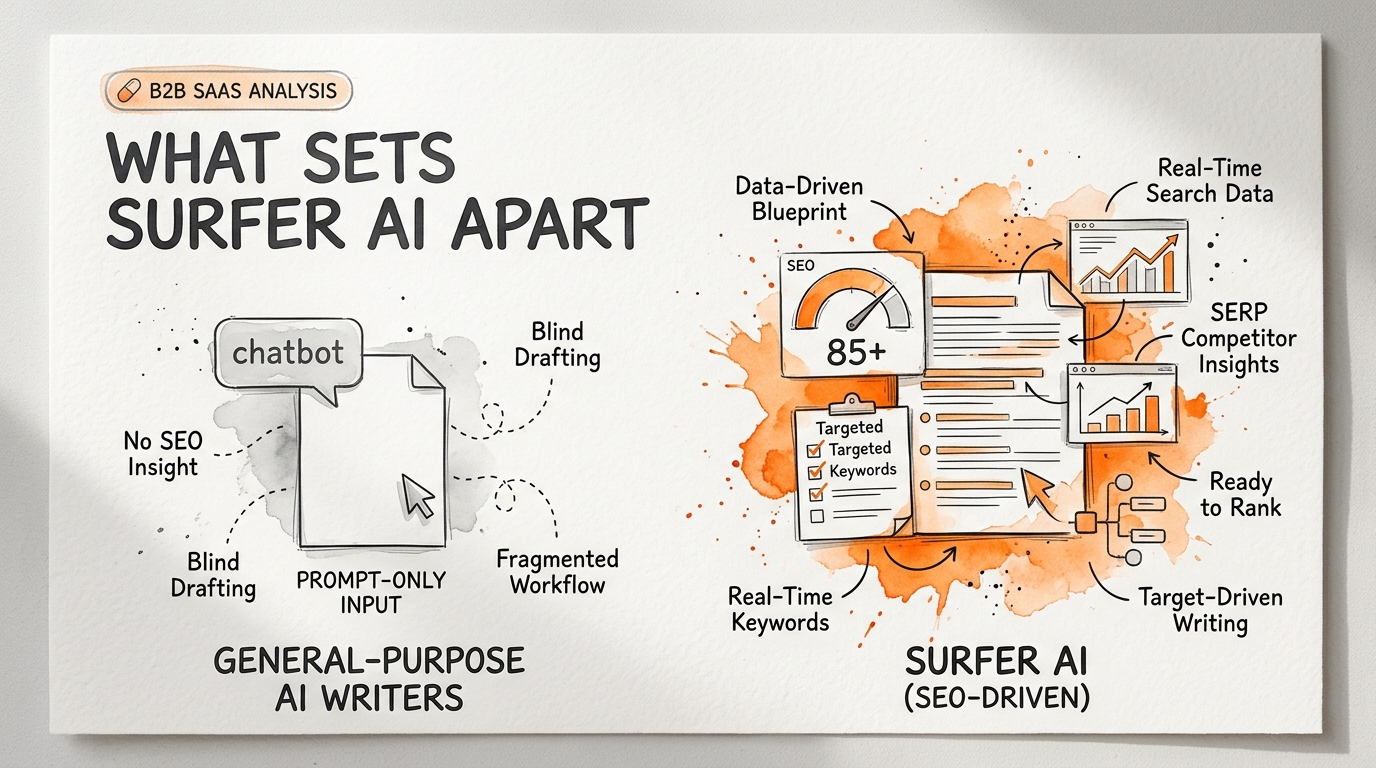
Most standalone generators write in a vacuum. You give ChatGPT, Claude, or Writesonic a creative prompt, and they predict the next likely word based on patterns in their training data. They produce smooth sentences. They sound convincing. Yet, they have no idea what Google rewards on page one right this second. Surfer AI changes this setup by tethering its writing pipeline directly to a live search engine crawler.
Think of a general-purpose model as a talented copywriter who has spent the last year cut off from the internet. If you ask them to write a buying guide, they will deliver polished prose filled with outdated assumptions or generic advice. Surfer AI acts like an SEO director standing over that copywriter's shoulder with an analysis of the top twenty ranking competitors, dictating exact semantic entities, target word counts, and structural heading hierarchy before a single sentence gets drafted.
Comparing Surfer SEO vs AI Writers on Real-Time Search Intelligence
When evaluating surfer seo vs ai writers, the core distinction lies in how live data guides the draft. Modular assistants like Anthropic's Claude or OpenAI's ChatGPT produce fantastic prose, but they leave the ranking mechanics entirely to you. You must create the prompt, scrape competitor outlines yourself, run audits, and manually weave in missing topical entities. Surfer AI merges the drafting engine and the optimization engine into a single pipeline.
| Capability | Surfer AI | General AI Writers (ChatGPT, Claude) |
|---|---|---|
| SERP Calibration | Live analysis of top-ranking URLs for word counts, headers, and NLP terms. | Static training data or uncalibrated live web browsing. |
| Internal Linking | Automated contextual link injection synced to your domain via Google Search Console. | Prone to hallucinating dead links unless manually fed exact sitemaps. |
| Tone Adaptation | Scrapes competitor tone profiles or analyzes your pasted reference URLs. | Relies on user-written prompt adjectives like "witty" or "authoritative." |
| Cost per Article | Credit-based pricing (roughly $19 to $29 per generation). | Flat monthly fee ($20/month) with unlimited short-form drafting. |
Automated internal linking solves one of the biggest headaches in content production. General models often guess URLs or fabricate site architecture, which ruins user experience and wastes crawl budget. Surfer AI indexes your domain footprint, spots natural insertion anchors across your text, and places live links directly into the copy. It links relevant topic clusters without making you open five separate tabs.
Tone matching operates on the same empirical approach. Instead of guessing how an expert speaks, the software inspects top-ranking pages in your niche to gauge sentence rhythm, vocabulary density, and readability scores. If the ranking consensus relies on concise, no-nonsense answers, the engine avoids the flowery filler words that plague tools like Writesonic or Jasper.
"We have been evaluating Surfer AI versus other market options. Does anyone have benchmarks on pricing, rendering speed, and consistency?"
This question appears constantly in Reddit SaaS community discussions on drafting quality. The platform's per-article fee makes many content heads pause. Paying roughly twenty dollars for one generation feels steep when standard language model subscriptions cost the same amount for a whole month of prompts.
The difference comes down to labor hours. Building a comprehensive article with raw language models requires writing custom prompts, pasting in keyword lists from third-party tools, checking headings, and manually adjusting term frequency to reach a competitive score. That manual cycle takes forty-five to ninety minutes per post. Surfer AI handles that groundwork in about ten minutes, delivering an article that hits an 80+ Content Score right out of the box.
Raw text is cheap. Search-aligned text is not. For teams managing tight editorial calendars or scaling e-commerce catalog pages, Surfer's direct pipeline removes the friction between drafting sentences and meeting ranking criteria.
How to Build a Hybrid Workflow Using AI Writers and Surfer SEO
Blindly relying on generative tools produces generic content that misses search intent. Spending ten hours manually typing every paragraph inside an optimization tool slows your publishing velocity to a crawl. You don't have to choose between speed and ranking power. When you combine them, you get the best of both worlds.
Think of an LLM like a powerful racecar engine. It has immense power, but it can't see the road ahead. Surfer SEO acts as the GPS navigation system. It reads the curves of the search engine results page (SERP) and shows the engine exactly where to steer. Merging these tools creates a repeatable assembly line that lets you scale content without sacrificing editorial standards.
A Practical Production Blueprint: Surfer SEO vs AI Writers
The biggest mistake content teams make is dumping an entire Surfer keyword list into ChatGPT or Claude and asking for an article in one go. That approach creates robotic, keyword-stuffed fluff that alienates readers. A proper hybrid production pipeline runs in five clear stages.
1. Calibrate Your SERP Competitors
Before opening an AI writer, create your query in Surfer's Content Editor. Surfer automatically selects the top-ranking pages to establish baseline metrics for word count, heading structures, and natural language processing (NLP) terms. Don't accept the default list blindly. Manually deselect outliers like Reddit threads, Amazon product pages, or massive directory sites. Keep three to five competitors whose site authority and search intent match your target domain.
2. Build an Intent-Driven Outline
Export the suggested headings from Surfer or use its outline builder to identify recurring subtopics among top performers. Arrange these into a logical hierarchy (H2s and H3s) that answers user questions faster than competing pages. Group Surfer's suggested NLP terms by heading rather than keeping them in one massive list. When you assign five to seven relevant terms to a specific subsection, your AI tool incorporates them naturally without awkward phrasing.
3. Draft with Modular Prompts in Claude or ChatGPT
Avoid prompting for 2,500 words at once. LLMs suffer from context drift when asked to generate long-form articles in a single prompt. Generate your draft section by section. Feed your LLM the specific heading, the target sub-points, and the designated NLP terms for that block.
"Write a 350-word section under the H2 heading: 'Key Factors When Evaluating CRM Systems'.
Adopt a clear, professional tone suitable for software managers.
Explain complex features using plain business scenarios.
Naturally integrate these concepts: customer lifetime value, automated lead routing, pipeline visibility, onboarding curve.
Do not use corporate jargon or words like 'delve', 'tapestry', or 'crucial'."
Tools like Claude 3.5 Sonnet handle these granular prompts exceptionally well, maintaining natural sentence cadence while ticking off topical entities. If your team relies on dedicated writing apps like Jasper, you can connect its native Surfer integration to monitor your score live as you prompt.
4. Run the 70-Score Polish in Surfer
Paste your modular AI draft back into Surfer's Content Editor. Your initial score will usually hover between 55 and 68. Read through the text to eliminate repetitive transition phrases and robotic filler. Check the missing NLP terms. You'll often find that simple tweaks—swapping a generic synonym for an exact industry phrase—will push your score past 75 in under ten minutes.
Don't chase a perfect 100 score. Forcing every single recommended term into your text risks over-optimization and makes your writing sound unnatural. Aim for the green zone (typically 70 to 85 depending on keyword competitiveness).
5. Add the Human Experience Layer
This is where you make the piece truly rankable under modern search standards. Have an editor spend 15 to 20 minutes injecting original value:
- Add direct quotes, internal data points, or proprietary case studies.
- Verify factual claims, dates, and software version numbers cited by the AI.
- Insert contextual internal links to relevant landing pages and complementary blog posts.
- Format scan-friendly elements like bolded takeaways, bullet points, and summary callouts.
"Teams that expect full automation get burned by thin content penalties. The real payoff comes from slicing the initial research and first-draft turnaround by 70%, leaving human editors with the energy to focus on storytelling and fact-checking."
Many digital publishers share these exact concerns. In a detailed SaaS discussion on hybrid AI content workflows, practitioners highlighted that without strict outline boundaries and hands-on editing, AI tools frequently miss the commercial intent of competitive keywords.
By pairing structural guidance with raw drafting speed, you cut production time from eight hours down to two per article. You get the velocity needed to compete across wide topic clusters, backed by the structural accuracy search engines expect.
How Do Costs, Token Economics, and Production Scalability Compare?
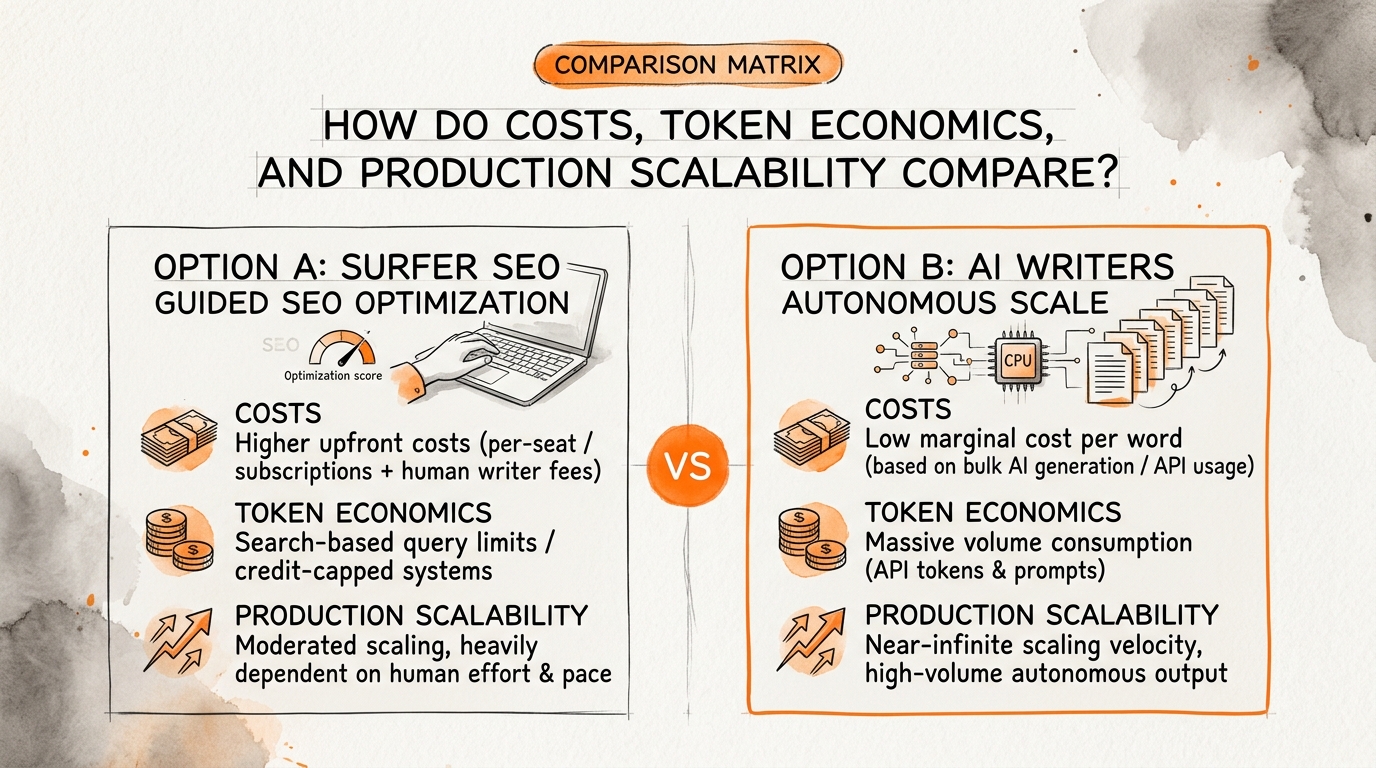
Buying software for content operations often feels straightforward until the credit-card statements arrive. On paper, picking between an optimization platform and an automated text generator looks like a simple line-item decision. In practice, the financial math behind surfer seo vs ai writers depends heavily on your team's workflow, how many articles you produce each month, and how much human editing your quality standards demand.
Every tool charges you differently. Some bill a flat monthly fee with word quotas. Others sell individual run credits or bill you directly for underlying machine learning compute. To calculate your true cost per published page, you have to look beyond monthly software fees and factor in the labor required to take a draft across the finish line.
| Platform / Approach | Base Software Cost | Marginal Cost per Article | Average Human Editing Time |
|---|---|---|---|
| Direct LLM APIs (GPT-4o, Claude 3.5) | $0 (Pay-as-you-go) | $0.05 – $0.30 | 2.5 – 4.0 hours |
| Turnkey AI Writers (Jasper, Copy.ai) | $49 – $125 / month | Included in seat quota | 2.0 – 3.5 hours |
| Surfer SEO (Editor Only) + Human Writer | $89 – $129 / month | $75 – $250 (Freelance fee) | 0.5 – 1.0 hour |
| Surfer AI (End-to-End Generation) | $89 / mo base + credits | $19 – $29 per generated post | 0.75 – 1.5 hours |
Evaluating True ROI: Surfer SEO vs AI Writers for High-Volume Publishing
Token economics explain why standalone text engines look so cheap upfront. When an artificial intelligence model processes language, it breaks words into tiny syllables called tokens. Roughly 1,000 tokens equal 750 words. Large language model providers charge fractions of a cent per thousand tokens. Because of this, tools like ChatGPT or basic drafting platforms cost pennies to output a 2,000-word post. It creates the illusion of near-free publishing.
The catch is relevance and ranking accuracy. Raw language models predict the next likely word based on training history. They do not examine who currently occupies the top spots on Google, how those pages organize their subheadings, or what specific entities search engines expect to see. The draft arrives quickly, but it lacks structural intent.
"We saved money on automated generation credits, but our editors spent four hours per post fixing hollow phrasing and retrofitting search terms." — Insights shared during a Reddit SaaS discussion on production workflows and quality benchmarks.
Surfer SEO handles commercial value from the opposite direction. You pay for data processing rather than raw words. Surfer scrapes real-time search engine results pages (SERPs), breaks down competitor structural patterns, and runs natural language processing algorithms over live market winners. When you write manually inside its Content Editor, you pay roughly $2 to $3 per analysis query under standard tiers. If you run Surfer AI, you pay an additional premium per post ($19 to $29 depending on credit volume) because the platform combines deep search modeling with automated drafting.
Consider the total operational cost for a mid-sized site publishing 20 optimized articles per month:
- The Bare AI Workflow: A subscription to a generative writer costs about $60 monthly. The software generates 20 posts for pennies. However, an in-house editor spending 3 hours per article to fact-check, restructure headings, and manually add missing topical terms spends 60 hours. At an editorial rate of $40 per hour, that adds $2,400 in hidden labor. Your true production cost is $2,460 ($123 per article).
- The Hybrid Optimization Stack: You pay $89 monthly for Surfer SEO and write with an external generative engine like ChatGPT Plus ($20/month). The editor pastes the text into the Content Editor and works directly against the real-time content score. Reaching an optimal score takes roughly 1.5 hours per piece. Total labor drops to 30 hours ($1,200). Your total monthly cost sits around $1,309 ($65.45 per article).
- The Integrated SERP AI Approach: You run 20 articles through Surfer AI credits at roughly $24 each ($480), alongside the baseline platform plan ($89). The drafts arrive pre-structured with verified headers, internal links, and relevant entity density. Reviewers only spend 45 minutes verifying claims and polishing brand tone. Total labor takes 15 hours ($600). Your final monthly cost is $1,169 ($58.45 per article).
Tool stacking creates another hidden expense small teams overlook. If you buy a standalone generative copywriter, you still need separate subscriptions for keyword tracking, search analysis, and plagiarism auditing. Jumping between three disconnected apps wastes billable hours through constant copy-pasting and formatting resets.
Scalability isn't just about how fast an engine outputs sentences. It is about how many articles cross into Google's top search tiers without falling victim to content decay. Spending less on software upfront often yields lower rank visibility, forcing brands to redo low-scoring articles six months later. Choosing a platform with built-in search intelligence lowers operational drag, minimizes editorial fatigue, and provides a much clearer path to positive organic revenue.
How Do Search Algorithms and Generative Engines Evaluate Both Content Types?
Search algorithms have gotten remarkably good at spotting shortcuts. They don't read words like humans do. Instead, they evaluate text through mathematical models, semantic entity mapping, and user satisfaction signals. When you look at surfer seo vs ai writers, each tool targets a different side of this mathematical equation. Each also carries a distinct risk if you lean on it without editorial judgment.
Google wants to reward helpful, original material. Meanwhile, generative engines like Perplexity and Google AI Overviews want direct, verifiable facts they can summarize for users. Understanding how these platforms evaluate machine drafts versus keyword-tuned pages helps you avoid running your content strategy off a cliff.
Analyzing Surfer SEO vs AI Writers in Generative Engine Citations
Language models like ChatGPT or Jasper work by predicting the next most likely word. That means, by their very nature, they produce average answers. They gather what already exists across the web and blend it into a smooth summary. The end product sounds fluent, but it suffers from a fatal flaw: zero information gain.
Information gain is an actual metric search engines use to see whether your article adds fresh facts, data, or perspective to the topic. If an AI writer gives you 1,500 words that merely repeat the top five articles in different phrasing, Google has no reason to rank it. Why index a mirror image of what's already on page one? Generative engines skip these generic drafts entirely because they lack unique data points to cite.
Surfer SEO attacks the problem from the opposite direction. It analyzes the pages currently ranking on page one, strips them down to their mathematical bones, and tells you which entities and phrases to include. But this creates its own danger: algorithmic over-optimization.
Marketers frequently fall into the trap of chasing a perfect 100 Content Score. When you force every single suggested term into a blog post, your writing becomes clunky, unnatural, and exhausting to read. You might satisfy an NLP crawler, but you drive human readers away instantly.
As professionals pointed out in a discussion on common content scaling pitfalls, teams run into trouble when they treat software as an autopilot solution. Blindly pushing for green scores leads to awkward phrasing, while relying purely on raw AI prompts produces bland fluff that loses rankings after algorithm updates.
| Evaluation Metric | Pure AI Writers (ChatGPT, Jasper) | Over-Optimized Content (Surfer SEO) | The Ideal Hybrid Post |
|---|---|---|---|
| Information Gain | Extremely Low. Repeats known consensus without original angles. | Variable. Can be high if the writer adds original research alongside keywords. | High. Combines unique case studies or quotes with broad topical context. |
| Readability & Flow | High surface flow, but often hollow, repetitive, and wordy. | Low to Medium. Often feels robotic and cluttered with exact-match phrases. | High. Reads naturally for people while hitting core topical entities. |
| Generative Citations | Poor. Usually too vague for answer engines like Perplexity to extract. | Mixed. Easy for crawlers to parse, but can look like spam if overdone. | Exceptional. Clear factual answers that generative engines love to quote. |
Steering Clear of the Twin Content Hazards
To win rankings and earn citations in generative search, you must steer between these two extremes. You can't publish empty AI fluff. You also can't publish mechanical keyword salad.
Start by treating optimization tools like Surfer SEO or its rivals, such as Clearscope and Frase, as guardrails rather than scorecards. Stop editing the moment your draft feels complete and hits a sensible threshold, usually around 70 to 75. Forcing extra phrases just to push a dial into the green turns your prose into mush. Search quality systems easily detect when a piece of writing prioritizes keyword frequency over user utility.
Next, fix the generic nature of drafts generated by large language models. Treat initial AI outputs as rough scaffolding. Strip out the fluffy introductory remarks and filler sentences. Then, insert your own real-world proof: customer metrics, quotes from internal subject matter experts, or hands-on product comparisons. Those proprietary details give search algorithms the information gain they crave, while Surfer ensures you don't miss the broader context needed to rank.
Making the Final Investment Call for Your Organic Growth Strategy
Choosing your content stack comes down to identifying your real bottleneck. Do you need raw text? Or do you need organic visibility? Many teams jump straight to generative drafting platforms because watching an algorithm generate a thousand words in thirty seconds feels like magic. Yet, as highlighted in SaaS user discussions regarding organic content stacks, thousands of uncalibrated words often end up stuck on page five. That burns budget fast. We've seen this cycle play out across dozens of publishing teams.
Surfer SEO vs AI Writers: The Definitive Decision Framework
When evaluating surfer seo vs ai writers, remember that producing prose and engineering search visibility are two completely different jobs. If you're deciding how to allocate your software budget for scaling content, run your strategy through this three-tier operational checklist:
1. Small Teams and Bootstrapped Businesses
If you publish fewer than eight articles a month and operate with a lean budget, avoid committing hundreds of dollars to disconnected tools. Standalone drafting assistants like Jasper give you copy quickly, but they won't tell you why competing pages outrank you. If you must choose one tool, pick an optimization platform like Surfer SEO and handle the writing yourself or use basic models to draft sections manually. Real-time SERP data protects you from wasting hours writing articles that never had a chance to rank.
2. High-Velocity Content Publishers and Affiliates
If your growth model demands 30 to 50 articles each month, manual optimization creates an immediate bottleneck. You can't spend two hours adjusting NLP keywords for every post. In this scenario, investing in an automated solution with built-in SERP analysis—such as Surfer AI or a custom script pairing Claude with real-time audit tools—delivers immediate ROI. You pay a higher upfront cost per article, but you drastically reduce the human editing hours needed to make machine-written drafts rank ready.
3. Mature Brands and Enterprise In-House Teams
Enterprise teams rarely suffer from a lack of written content. Their primary challenge is maintaining editorial consistency and semantic depth across multiple internal writers and external agencies. For these organizations, an optimization engine functions as an objective editorial gatekeeper. It establishes clear guidelines for word count, heading hierarchy, and entity coverage before any draft hits the CMS. Here, raw generative writers offer little value, but SERP intelligence platforms protect existing domain equity.
Generative writing software solves writer's block. Optimization engines solve search intent. You can replace a drafting tool with disciplined writing, but you can't replace competitive SERP analysis with guesswork.
Search engines don't reward the speed of your production line. They reward relevance, freshness, and authority. Don't invest in software that merely accelerates the production of average content. Put your budget into systems that verify your work against what the audience and search algorithms actually expect.
