7 AI Content Editing Templates for Enterprise Teams
Generative models can draft a 2,000-word article in seconds. Yet enterprise teams quickly discover that raw outputs read like hollow corporate pamphlets full of recycled clichés and factual traps. Without structured ai content editing templates, scaling production doesn't build an audience; it creates an operational bottleneck. Your editors end up spending more hours fixing disjointed phrasing and fact-checking phantom statistics than they would have spent writing from scratch.
Table of Contents
- Why Raw AI Text Demands a Systematic Editorial Framework
- What Essential Components Belong in an AI Editing Framework?
- Phase 1 Execution Checklist: Verifying Accuracy and Eliminating Hallucinations
- Phase 2 Execution Checklist: De-AI-ing Syntax and Calibrating Brand Voice
- How to Build Custom AI Content Editing Templates for Your Brand
- Phase 3 Execution Checklist: Search Intent, Entities, and Generative Engine Optimization
- How Can Teams Integrate Editing Templates into Operational Publishing Workflows?
- Mastering Editorial Workflows for Consistent AI-Assisted Publishing
Unchecked language models suffer from predictable blind spots. They love uniform sentence patterns. They lean on tired filler phrases, stuffing paragraphs with claims about fast-changing landscapes and unlocking growth. More dangerously, large language models predict words rather than verify facts. They invent case studies, misquote whitepapers, and present flat falsehoods with complete confidence. When your writers paste these drafts directly into your content management system, search visibility drops and reader trust disappears.
Ad-hoc line editing cannot solve this problem. When editors review drafts without concrete guardrails, they rely on personal taste. One reviewer cuts every passive verb, while another lets unverified metrics slip through unnoticed. It burns out your staff and destroys editorial consistency across departments. Modern organizations need repeatable ai content editing templates that turn subjective line reviews into systematic quality control checklists. As seen in marketing discussions on AI deployment pitfalls, teams that skip systematic editorial controls run into serious compliance mistakes, search penalties, and generic output that damages brand authority.
Specialized governance tools like Writer or Grammarly Business help catch basic spelling slips, banned words, and surface-level tone issues. But rule-based software can't determine whether a draft satisfies genuine search intent or offers fresh industry perspectives. High-volume publishing requires a structured, multi-phase human review. By standardizing your review phases into clear templates, you give your team an exact system to verify claims, fix robotic rhythm, and inject genuine brand personality before anything goes live.
What Essential Components Belong in an AI Editing Framework?
Telling an editor to "make AI text sound human" never works. It leads to random edits, missed errors, and wild swings in brand voice. An editing system works like an aircraft pre-flight checklist. Pilots don't glance at the wings and guess. They check specific dials in a set order. Enterprise teams need that exact rigor when reviewing machine-generated drafts.
Without standard rules, team members waste hours on stylistic debates instead of fixing root problems. A recent thread in a marketing discussion on common AI deployment pitfalls pointed out that unguided editing often takes longer than writing from scratch. A high-yield system solves this issue. It divides the editorial review into distinct, manageable checkpoints.
Building Blocks for Enterprise AI Content Editing Templates
Every dependable framework contains five core layers. When building your internal system, make sure your review sheets account for each of these areas:
- Input Parameters: What was the original prompt, target audience, and primary search intent? Editors cannot judge whether an article hits the mark without knowing the brief. Define the audience reading level, buyer stage, and primary business goal upfront.
- Factual Verification Triggers: Large language models generate plausible fiction with total confidence. Your framework needs explicit tripwires. Any sentence containing a statistic, a direct quote, a legal claim, or a product feature must have a verified link to a primary source before publishing.
- Voice and Tone Guardrails: Define your company's personality on a sliding scale. Are you irreverent or reserved? Academic or blue-collar? Spell out mechanics like sentence length diversity, use of contractions, and point of view (such as first-person plural vs. neutral third-person).
- Structural Flow Rules: AI outputs suffer from monotonous rhythm. Machine copy tends to generate paragraphs of uniform length: usually three to four lines each, followed by a predictable summary. Your framework must enforce visual breathing room, such as callout boxes, varying section depths, and scannable subheadings.
- The AI Tropes Ban List: A strict negative keyword list that strips out robotic idioms before a draft moves forward.
To see how these parts interact during production, look at how an enterprise workflow evaluates a raw draft:
| Framework Layer | What It Evaluates | Fail Condition |
|---|---|---|
| Verification Trigger | Data points, claims, and case studies | Uncited stats (e.g., "studies show an 80% increase") |
| Voice Guardrails | Tone consistency and readability score | Passive phrasing, stuffy corporate jargon |
| Cadence Check | Sentence and paragraph length diversity | Three consecutive sentences with identical word counts |
| Blacklist Scan | Formulaic transitional words and metaphors | Presence of "beacon," "tapestry," or "game-changer" |
Managing these checkpoints manually in Google Docs can slow your team down. That's why many organizations combine their documented guidelines with automated governance platforms. For example, Writer.com allows teams to hardcode custom style guides, terms, and banned phrases directly into an automated checker. For teams with simpler setups, Grammarly Business provides baseline tone detection and clarity suggestions. While Grammarly excels at surface-level mechanics, Writer.com gives enterprises deeper control over terminology and compliance rules across whole content libraries.
Purging the Tell-Tale AI Clichés
Raw model output carries distinct verbal tics. Readers spot them instantly. When search engines or prospective buyers see these phrases, trust drops fast.
"If an article reads like a high-school valedictorian trying to impress a college admissions board, an algorithm wrote it."
High-performing ai content editing templates maintain an explicit blacklist. Keep these terms in your style guide and flag them automatically:
- Dead Giveaway Transitions: "In today's fast-paced digital landscape," "Moreover," "At its core," "In summary."
- Inflated Verbs and Nouns: "Delve," "tapestry," "beacon," "testament," "plethora," "revolutionize."
- Empty Slogans: "Game-changer," "unlock your potential," "pave the way," "seamlessly integrate."
Good writing is direct. It picks the simpler word every single time. Instead of saying an enterprise tool "serves as a testament to operational agility," write that the tool "saves teams ten hours a week." Concrete details always beat decorative fluff.
When you build these five elements into your daily routines, your writers stop guessing. They spot errors quickly, preserve brand personality, and turn robotic drafts into clear, punchy copy that actually converts.
Phase 1 Execution Checklist: Verifying Accuracy and Eliminating Hallucinations
Large language models do not lie on purpose. They simply guess words. Because these engines predict what sounds right rather than verifying what is true, they invent industry benchmarks, misattribute research, and fabricate URLs with absolute confidence. If you publish those errors, your brand takes the hit.
A routine complaint across Reddit marketing discussions detailing AI compliance pitfalls centers on how easily phantom case studies slip past tired human reviewers. Setting up structured ai content editing templates that isolate factual verification from stylistic polishing solves this problem directly. You cannot fix grammar while fighting hallucinations; you must tackle truth first.
Embedding Accuracy Audits into AI Content Editing Templates
Every draft generated by an enterprise model must pass through a strict four-part verification gauntlet before any stylistic editing begins. Treat raw AI copy like testimony from an eager but unreliable intern: trust nothing until you see the original paperwork.
| Audit Focus | Common Hallucination Signal | Verification Protocol |
|---|---|---|
| Market Statistics | Round percentages (e.g., "75% of CTOs agree") attributed to generic entities like "Gartner" or "Forbes" without years. | Search the raw statistic in quotes via search engines. Trace back to the primary survey PDF or dataset. If missing, delete it. |
| External URLs | Real domain names appended with plausible-sounding but dead slugs (e.g., domain.com/blog/state-of-cloud-2024). |
Click every link manually. Check for 404 responses or soft redirects to generic homepages. Replace with exact anchor targets. |
| Customer Stories | Quotes from executives who do not hold the stated title, or case studies showing impossible returns (e.g., "500% revenue spike in two weeks"). | Audit executive names on LinkedIn. Cross-reference the company's official press releases or investor relations pages. |
| Technical Specs & Code | Deprecations, imaginary library flags, or non-existent API endpoints mixed into valid syntax patterns. | Run sample commands through official documentation or sandbox environments. Verify SDK releases against current package repositories. |
When running this checklist, tool selection matters. Many teams rely on general search engines, but specialized verification tools save serious time. For instance, running claims through Perplexity Enterprise Pro lets editors check citations against live web indices with cited source blocks. Unlike baseline generative tools, it grounds answers in indexed documents. Pair that with a dedicated plagiarism and content origin checker like Copyleaks to make sure your LLM did not reproduce whole paragraphs from an existing trade journal.
The Four-Step Information Integrity Protocol
Work through these four steps sequentially. Mark each item off inside your editorial tracking sheet before passing the text to voice editors.
- Step 1: The Statistical Deep-Trace. Highlight every number, percentage, currency figure, and growth claim in yellow. Require the writer or reviewer to paste the direct URL to the primary research study into your editing document's comments. If the source is a secondary blog quoting another blog, keep digging until you locate the original methodology. If you cannot find the primary source within three minutes, cut the statistic entirely.
- Step 2: Ghost Citation Eradication. AI tools love making up academic sources. They will combine a real professor's name, a legitimate university, and a fake study title into one neat sentence. Search Google Scholar for the paper title. If no exact match exists, remove the reference. Never allow an article to cite a study your team has not physically skimmed.
- Step 3: Auditing Anecdotes and Quotes. Check every corporate success story. Did Company A actually use that tool to achieve that outcome? Frequently, an AI model blends two separate news events into a single composite narrative. Confirm that the company named actually authorized the case study, or replace the specific brand name with an anonymized, accurate description of the workflow.
- Step 4: Technical and Chronological Vetting. Language models struggle with time. They often describe multi-year migrations as overnight solutions or treat software features deprecated in 2022 as current best practices. Check product version numbers against the vendor's changelog. If an article mentions compliance rules, such as GDPR or CCPA standards, run those clauses against current statutory guidelines to avoid legal liability.
Field Rule: A single hallucinated metric can destroy your brand's authority with technical buyers. If your editorial team cannot independently verify a claim within 180 seconds, your standard operating procedure must mandate cutting it or rephrasing it as an unquantified general trend.
Integrating these specific validation steps into your standard ai content editing templates guarantees that your publication maintains factual integrity. Speed is meaningless if your content team publishes falsehoods that alienate readers and trigger compliance reviews. Run the integrity checklist first; polish the voice second.
Phase 2 Execution Checklist: De-AI-ing Syntax and Calibrating Brand Voice
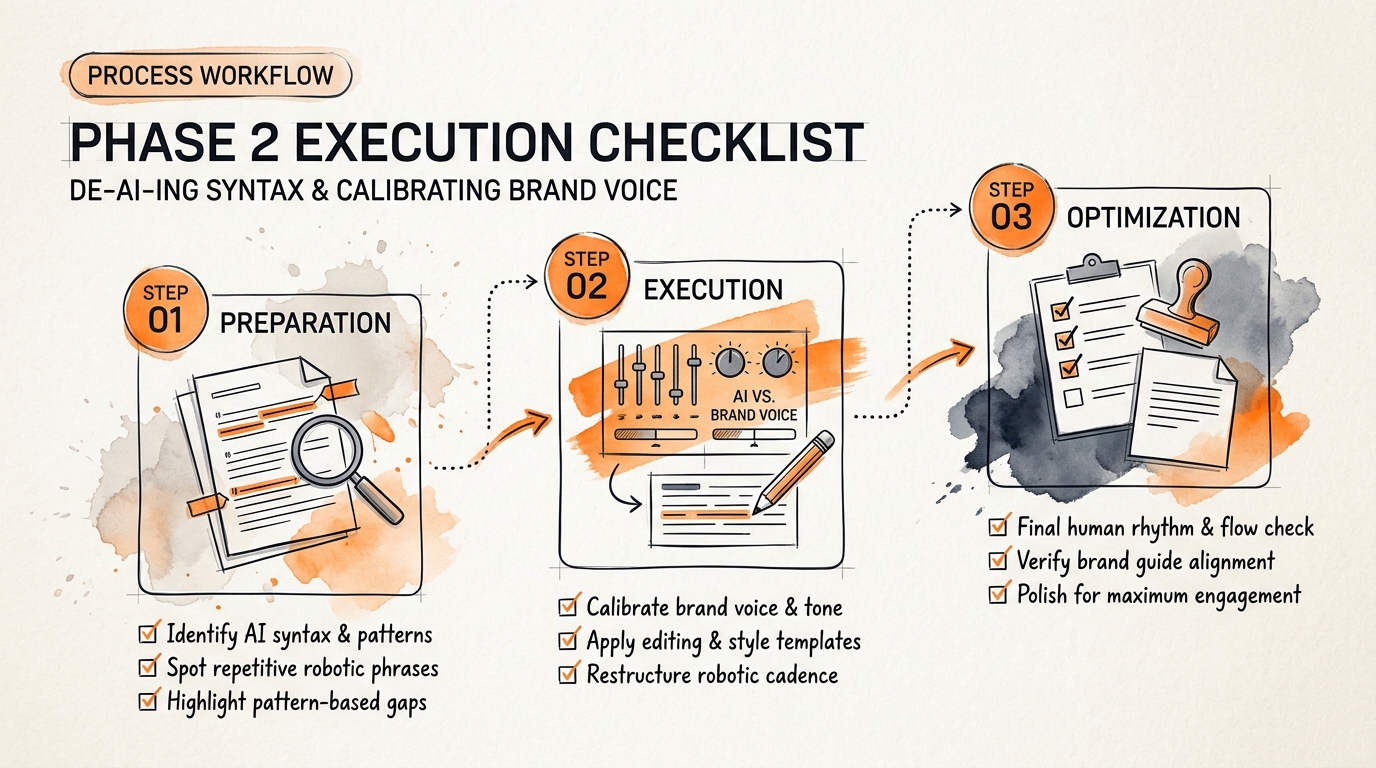
Raw AI drafts rarely sound broken. Instead, they sound eerily clean. Large language models pick the next most likely word based on statistics, which creates a polite, homogenized drone. Sentences march across the page at an unvarying pace of eighteen to twenty-two words. Every paragraph wraps up with a neat little moral bow. Readers sense this artificial sheen immediately, even if they can't pinpoint why.
In a Reddit SaaS discussion on editorial ROI, several founders asked whether cleaning up AI syntax manually is worth the investment compared to hiring human copywriters from the start. The consensus was clear: full manual rewrites burn too much time, but publishing unedited drafts damages brand authority. Phase 2 solves this tension. It targets the mechanical patterns that give away machine-generated text and aligns every line with your team's specific tone.
Stylistic Audit Rules for AI Content Editing Templates
When enterprise teams configure their ai content editing templates, this stylistic audit acts as the frontline defense against robotic monotony. Think of standard AI prose like a metronome clicking at a single tempo. Human writing sounds more like jazz—it speeds up, pauses, riffs, and hits unexpected beats. You must dismantle the machine's predictable cadence before pushing any post live.
Phase 2 Rule of Thumb: If three consecutive sentences contain roughly the same number of syllables, break at least one of them. Short bursts command attention. Longer clauses explain the nuance.
Run your drafts through these specific checkpoints during the stylistic refinement stage:
- Vary sentence length aggressively: Cut long sentences in half. Combine fragments where it makes sense. Follow a 25-word analytical statement with a three-word punch. That contrast resets the reader's attention span.
- Purge dead-weight transitional bridges: Scrub opening qualifiers like "In today's fast-paced digital world," "It's important to remember that," or "When it comes to." Drop the reader directly into the action.
- Flip passive constructions to active verbs: AI leans heavily on passive phrases like "mistakes were made by the team" or "data can be analyzed." Change them to "the team made mistakes" and "analyze your data." Active verbs inject energy and ownership.
- Eradicate hollow AI idioms: Search for pet phrases that models overuse when trying to sound authoritative. If you spot words like "testament," "beacon," "game-changer," or "pivotal," strike them out immediately.
- Introduce proprietary terminology: Replace broad dictionary terms with your company's native vocabulary. If your product team calls your dashboard the "Mission Control Deck," make sure the draft doesn't call it an "administrative interface."
- Claim a definite point of view: AI takes the middle ground on controversial industry topics because it's trained to avoid offending anyone. Strip away wishy-washy language like "Some experts believe X, while others suggest Y." State your brand's firm position.
To speed up this pass without missing subtle voice shifts, many organizations pair their human editors with specialized style-governance software. Here is how the two leading platforms compare for Phase 2 implementation:
| Platform | Core Strength | Primary Limitation | Best Fit |
|---|---|---|---|
| Writer | Custom terminology libraries, automated brand-voice scoring, and banned phrase detection. | Requires dedicated administrative time to build and train company style models. | Enterprise marketing departments managing dozens of internal writers and agencies. |
| Hemingway Editor | Instant color-coded visual alerts for sentence complexity, passive voice, and reading grade level. | Zero automated brand customization; purely a mechanics and rhythm tool. | Individual editors and small content pods needing rapid syntax cleanup. |
Fixing voice and syntax isn't about hiding the fact that you used software to outline or draft an idea. It's about respecting your reader's time. By stripping out algorithmic filler and calibrating the language to your company's real-world expertise, you turn generic output into memorable editorial assets.
How to Build Custom AI Content Editing Templates for Your Brand
Raw machine drafts sound painfully flat. They drift off voice, inject weird corporate jargon, and rely on passive sentence patterns that put people straight to sleep. Without firm guardrails, asking a language model to "edit this draft" gives you unpredictable results every single time. Building tailored ai content editing templates turns your static PDF style manual into an active set of rules your writers and models can follow together.
Content leaders often wonder whether designing bespoke templates is worth the setup hours. In discussions on template setup ROI and consistency, marketing teams report that manual editing alone breaks down once publishing volumes climb past ten articles a week. Bespoke templates eliminate the guesswork. They anchor the software to your specific point of view so your enterprise teams spend time refining ideas instead of fixing sloppy grammar.
Step-by-Step Architecture for AI Content Editing Templates
A good editing template acts like a strict filter. It forces the model to evaluate text through four distinct layers before any human editor lays eyes on the draft.
1. Voice Parameters and Tone Sliders
Computers do not understand abstract advice like "sound punchy" or "write engaging copy." You must translate brand personality into measurable constraints. Think of this step like setting the audio dials on a soundboard:
- Stance: State whether the voice is opinionated or strictly neutral.
- Formality: Give a numeric scale (for instance, 3 out of 10 for conversational B2B, where contractions are mandatory).
- Sentence rhythm: Instruct the prompt to blend short declarations with longer explanatory sentences to keep the prose bouncy.
2. The Negative Prompt Library
Telling a model what to avoid works better than telling it what to do. AI models lean heavily on decorative filler words. Your template must contain an explicit negative library that flags and removes words like "delve," "tapestry," "testament," "game-changer," "pivotal," and "moreover." Instruct the prompt to replace weak passive phrases with direct, active verbs.
3. Target Reading Levels
Clear writing is easy to scan. Most web audiences prefer reading at a 7th to 9th-grade reading level. Include a rule in your template that checks draft scores against formulas like the Flesch-Kincaid Grade Level. Instruct the model to break any sentence longer than 28 words into two clean thoughts.
4. Role-Based Editorial Tiers
Never expect a single prompt to handle every editing task at once. High-performing enterprise editorial teams split the review process into three sequential tiers:
- Tier 1: Mechanical Polish (Automated). The template strips out banned words, fixes syntax quirks, eliminates fluff, and simplifies bloated sentences.
- Tier 2: Brand Alignment (Prompt-Assisted Editor). An internal editor uses a secondary template to confirm product positioning, narrative hooks, and customer pain points.
- Tier 3: Domain Verification (Subject Specialist). A human expert reviews statistics, links original research, and confirms technical accuracy.
"When you treat prompt templates like code modules instead of open-ended creative chats, your editing speed triples without diluting your core brand perspective."
Tool Selection and Platform Trade-Offs
You can run your templates through several commercial tools. Dedicated enterprise platforms like Writer.com offer native styleguide governance, custom term databases, and automated rule enforcement right inside Google Docs and Microsoft Word. Plans start around $18 per seat monthly for small groups, while enterprise tiers include custom data privacy guarantees.
If you have a smaller budget, platforms like Grammarly Business (roughly $15 per member monthly) handle baseline brand tones and snippets. However, Grammarly focuses mainly on line-level edits. It lacks the multi-step prompt reasoning you get from building custom workspaces inside OpenAI Team accounts or Claude Projects ($20 to $30 per user monthly). For lean e-commerce brands, storing your templates in Claude Projects provides the highest level of structural rewriting flexibility without forcing you into expensive annual contracts.
Template Deployment Blueprint
Here is an operational layout you can paste directly into your team's prompt repository or AI workspace:
ROLE & OBJECTIVE:
You are a senior line editor for [Brand Name]. Your job is to edit raw drafts to match our publication standards.

VOICE RULES:
- Tone: Pragmatic, helpful, clear.
- Contractions: Always use them (don't, it's, we've).
- Sentence Rhythm: Alternate short, punchy statements (4-7 words) with explanatory sentences (20-25 words).
- Reading Grade Target: Grade 8 (Flesch-Kincaid).

NEGATIVE CONSTRAINTS (DO NOT USE):
- Banned terms: "delve", "testament", "tapestry", "pivotal", "streamline", "beacon", "furthermore".
- No throat-clearing intro lines (e.g., "In today's fast-paced world").
- No passive voice where an active subject fits naturally.

TASK EXECUTION:
1. Identify and rewrite all sentences exceeding 28 words.
2. Replace all passive verbs with direct action verbs.
3. Remove flagged cliché vocabulary.
4. Output the revised draft followed by a bulleted summary of stylistic fixes made.
Test your templates on at least five distinct draft samples before rolling them out across your department. Run side-by-side reviews with your staff writers. If the model strips away too much unique author personality, soften your sentence-length constraints. Keep the negative vocabulary rules firm. That balance keeps your publishing pipeline fast, accurate, and unmistakably human.
Phase 3 Execution Checklist: Search Intent, Entities, and Generative Engine Optimization
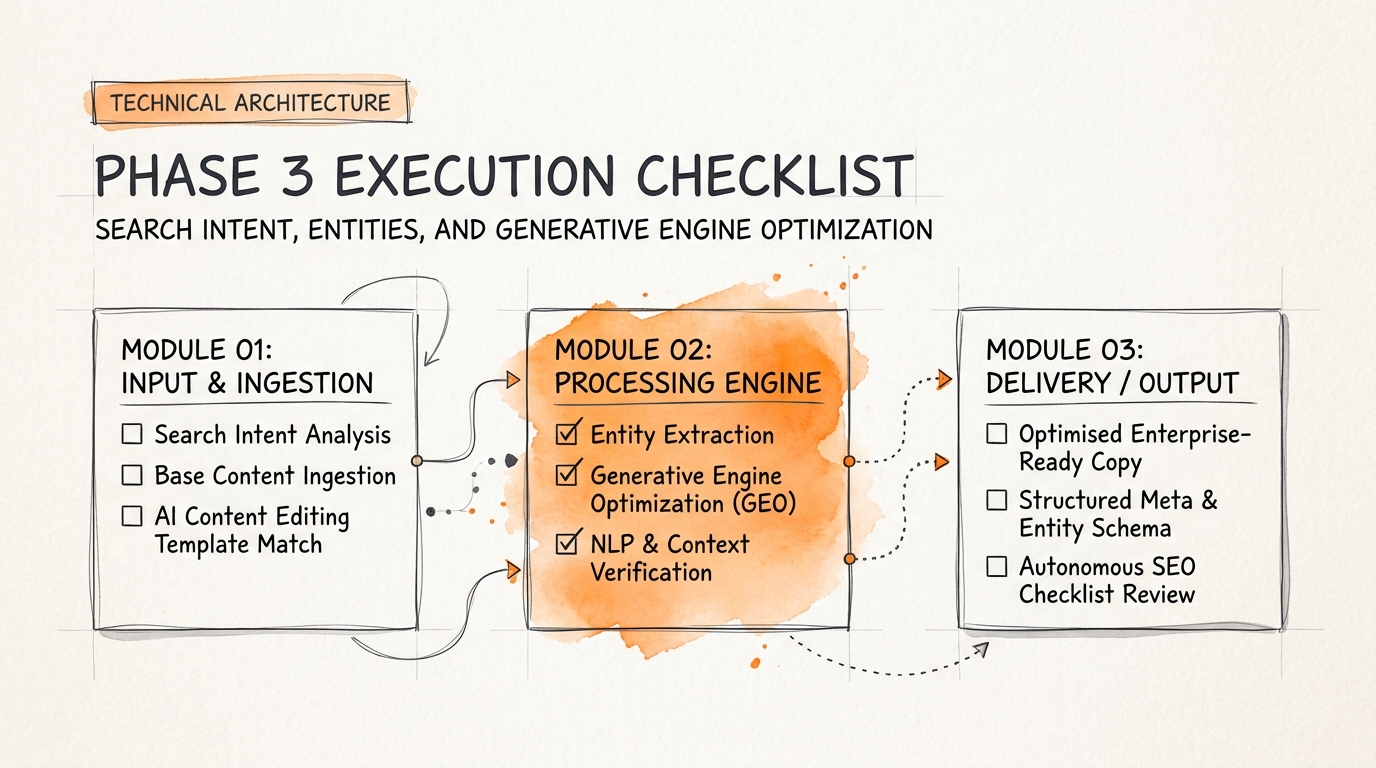
Polishing syntax and fixing hallucinations won't help you if nobody finds the page. Large language models excel at writing grammatically clean copy that says nothing helpful. They ramble, drift away from the reader's real problem, and leave out the exact data points search algorithms want. This phase transforms readable prose into an indexed asset that wins search results and generative answer engines like Perplexity, Gemini, and Google AI Overviews.
Many editors skip this step because they think content optimization stops at proofreading. In editorial quality versus manual workflows across SaaS teams, enterprise managers often debate whether multi-phase editing pays off. The consensus is clear: raw AI text tends to answer adjacent questions rather than the user's explicit problem. You must align your draft with exact search intent, feed machines clear entities, and format answers for instant retrieval.
Calibrating AI Content Editing Templates for Search Intent and Snippets
Search engines want immediate value. When users ask a question, they don't want a warm-up paragraph detailing history. They want the answer right away.
To win featured snippets and answer-engine summaries, use an "answer-first" pattern. Put a direct, 40-to-50-word answer immediately under each subhead before you unpack nuances. AI models often generate transition sentences like "It is important to remember that..." or "When exploring this topic..." at the start of sections. Cut these lines out completely.
Snippet Formula: [Concept] is [clear definition or direct answer] that [primary mechanism or benefit]. Teams achieve this by [action 1], [action 2], and [action 3].
When updating your internal ai content editing templates, add a mandatory check for primary intent alignment. Ask yourself these three simple questions:
- What job is the reader trying to get done? If the intent is procedural, cut out philosophical theory and provide steps.
- Does the copy answer the query in the first two scrolls? Push high-value answers to the top instead of burying them under historical context.
- Did the draft answer secondary questions? Check People Also Ask (PAA) boxes to capture related problems users run into next.
Entity Enrichment and Generative Engine Optimization
Modern search engines don't just match keywords on a page. They map out entities. Think of an entity as a specific pin on a map. A keyword is just a word like "apple," which could mean a fruit, a tech company, or a record label. An entity is the actual person, place, tool, or concept tied to a verified knowledge graph.
AI drafts often produce generic, broad phrasing. An AI might write "our modern platform helps businesses streamline digital work." That sentence carries zero semantic weight. A human editor must replace that vague sentence with specific entities: "Our content management platform uses GraphQL APIs to push structured markdown to static site generators like Next.js." Now the search engine understands the exact software category, technical protocols, and ecosystem integrations.
Two tools stand out for managing this process during content reviews:
- Clearscope: Best for content-level term mapping. It highlights related industry concepts, typical word counts, and search intent clusters based on top-ranking Google results. It tells you which sub-topics you missed.
- InLinks: Built entirely around entity-based SEO and schema architecture. It analyzes your content against Google's Knowledge Graph, finds missing semantic connections, and helps you build internal links based on recognized entities instead of random strings.
Clearscope gives writers an easy grading scale for topical depth. InLinks helps technical SEOs organize sitewide concept associations. Using either platform inside your review steps ensures your enterprise teams don't push shallow, unranked drafts.
The Search and Generative Optimization Checklist
Run your draft through this verification table before marking it ready for staging. Every checkpoint must pass inspection.
| Audit Area | Target Requirement | Why It Matters for LLMs and Crawlers |
|---|---|---|
| Intent Directness | Answer the core H2 query within the first two sentences. | Large language models pull straight-to-the-point answers for summary boxes and chat cards. |
| Entity Density | Replace ambiguous nouns with official product names, standards, and organizations. | Grounds your article within existing topical knowledge graphs. |
| Heading Nesting | Maintain strict H2-to-H3 hierarchy without skipping levels. | Allows screen readers and web crawlers to parse semantic relationships without getting lost. |
| Data Grounding | Pair every claim with a hard metric, date, or primary source link. | Prevents citation engines from penalizing unverified marketing claims. |
Structuring your copy this way does double duty. It guides human readers who skim content on mobile screens, and it gives parsing bots clean, extractable answers they can feature across conversational search surfaces.
How Can Teams Integrate Editing Templates into Operational Publishing Workflows?
A brilliant checklist is useless if your editorial team forgets it exists. When enterprise marketing teams scale production with language models, they quickly run into a grinding traffic jam. The bottleneck isn't draft generation. The real slowdown happens when editors try to review machine-written copy without a unified system. Writers churn out thousands of words in minutes, while editors burn out trying to guess what needs fixing.
Think of your editorial workflow like an airport security checkpoint. If the screeners don't have clear scanners and exact rules for what gets flagged, lines back up out the terminal door. Integrating ai content editing templates directly into your team's publishing stack turns vague quality guidelines into enforceable guardrails. The goal is simple: review faster without letting sloppy writing slip through to your live site.
Embedding AI Content Editing Templates into Daily Production Tools
Your team shouldn't open a separate manual just to edit a draft. If your template lives in a dusty 20-page brand guide, nobody will use it. You must bring the rubric directly into the software your writers and editors already touch every day.
Depending on your current technology stack, here is how leading content teams configure their systems:
- Google Docs via Building Blocks: If your team drafts in Google Docs, turn your editing template into a native custom building block. Editors type
@checklistat the top of every fresh document. A structured table instantly pops up, displaying clear pass/fail checkpoints for hallucination audits, passive voice limits, and brand-term rules. Editors check off boxes right next to the draft text. - Notion Database Templates: Teams running central content hubs can build their template directly into their Notion article database. When a writer creates a new article card, the page automatically loads toggle lists for each editorial phase. It links directly to the specific prompt used, the source research files, and the final metadata fields.
- Project Management Suites (ClickUp and Asana): Treat editing stages as sequential subtasks. A draft cannot jump from "First Pass" to "CMS Staging" until the editor completes required subtask fields. If the editor hasn't verified three external data points, the software blocks the card from moving forward.
Choosing the right setup comes down to your team's current technical comfort and budget. Here is how the most popular platforms stack up for editorial execution:
| Platform | Setup Speed | Enforcement Strength | Best Fit For |
|---|---|---|---|
| Google Docs | Under 10 minutes | Medium (Relies on voluntary editor compliance) | Small teams and freelance-heavy editorial pools |
| Notion | 1 to 2 hours | High (Tied to kanban cards and internal pages) | Agile marketing teams wanting an all-in-one content hub |
| ClickUp / Airtable | Half a day | Strict (Hard task dependencies prevent skipping steps) | Enterprise teams publishing 40+ long-form assets monthly |
Setting Human-in-the-Loop Review Gates
Don't tell an editor to just "make the article sound better." That instruction leads to subjective changes and wasted hours. Instead, establish three distinct gates that every piece must pass before scheduling.
The first gate is pure factual verification. The reviewer scans solely for invented statistics, broken hyperlinks, and fake case studies. The editor doesn't touch sentence structure or commas during this sweep. If a draft fails the sourcing check, it gets bounced back to the drafter immediately.
The second gate targets rhythm and tone. Here, the editor eliminates dead robotic phrases, strips out generic transition words, and breaks up monotone sentence structures. Short sentences add punch. Longer, multi-clause thoughts provide nuance and context. Blending both keeps readers engaged.
The third gate focuses on user intent and structural search value. The reviewer checks whether the content actually answers the primary query in the first two paragraphs. They make sure core entities, step-by-step instructions, and practical takeaways stand out clearly with descriptive subheadings.
"The biggest failure point is compliance drift. When editing templates live outside the daily workspace, reviewers cut corners under deadline pressure, and generic machine phrasing creeps into production."
— Verified user insight from a Reddit discussion on editorial workflow pitfalls
Does setting up these structured gates pay off for smaller teams? Absolutely. You don't need complex enterprise software to make this work. A straightforward database template in Notion costs almost nothing beyond your basic plan. The return shows up in your production calendar. When editors work from a fixed playbook instead of making up their standards on the fly, editing speed doubles while brand consistency stays rock solid.
Mastering Editorial Workflows for Consistent AI-Assisted Publishing
Relying on ad-hoc prompts like "make this sound professional" leads straight to generic fluff. You get inconsistent tone, shallow arguments, and hallucinated claims that slip past tired reviewers. The real operational shift happens when you swap random prompt tweaking for structured, reliable routines. When enterprise teams build standard operating procedures around their writing pipelines, they remove the guesswork from publishing. Treating drafts as raw lumber rather than finished furniture protects your brand's reputation.
Evolving from Chaotic Prompts to Disciplined AI Content Editing Templates
Software can clear surface friction. Platforms like Writer.com and Grammarly Business offer helpful guardrails for terminology, style compliance, and reading levels. Writer excels at enterprise governance by letting teams build custom style guides and rule sets across departments, while Grammarly catches syntax errors and surface tone drift quickly. Neither tool replaces real subject matter expertise. Algorithms predict words based on statistical probability. They don't know your customers, your product's latest bug, or your strategic vision. Human judgment remains your primary moat.
A common hesitation raised in Reddit SaaS community discussions on editorial quality centers on whether template-driven systems actually hold up against manual writing. Creators worry about edge cases, robotic phrasing, and steep setup curves. Standardizing your production line with robust ai content editing templates cuts review cycles by half while raising factual accuracy. Editors stop wasting energy rewriting awkward passive sentences. Instead, they focus on sharpening arguments, verifying sources, and injecting original research.
Speed means nothing if your readers can't trust your words. Use machines to assemble raw outlines and surface starting ideas. Let trained editors turn that material into authoritative guidance that solves real problems. Once your team locks down this discipline, you won't just publish faster. You'll build a lasting library of content that earns real authority and withstands future changes across generative search platforms.
