Why Generic AI Content Fails Information Gain
Publishing teams are producing thousands of articles a week, yet organic visibility is falling off a cliff. When enterprise sites churn out regurgitated summaries, generic ai content fails information gain benchmarks designed to filter out repetitive web noise. Algorithms no longer reward sheer publishing scale. If your pages simply echo what already exists across the index, search systems leave them unindexed or buried in zero-click limbo. The marginal cost of producing text hit zero, and search engines responded by making the bar for visibility significantly higher.
Table of Contents
- The High-Volume Fallacy: Why Scale Alone Won't Win the Search Landscape
- Information Gain Scoring: How Search Engines Spot Repetitive Text
- What Search Patents and Vector Embeddings Reveal About Content Redundancy
- Shifting from Superficial Rephrasing to Novel Data Synthesis
- How to Automate Value-Add Entities and Primary Insights at Scale
- Moving Beyond Commodity Generation to Build Defensible Organic Moats
The math has turned brutal for commodity publishers. Enterprise domains that rolled out programmatic libraries of basic explainers over the past eighteen months are watching their search impressions crater. Crawlers arrive, inspect the page, and quietly drop the URL into the "Discovered – currently not indexed" pile. As highlighted in Frac.tl's research on commodity content, pages that merely duplicate common industry consensus create negative search equity, burning crawl budget without returning a single conversion.
Every major language model learns from the same open web data. When prompt workflows instruct an automated tool to write an ultimate guide, the output is a mathematical average of the top ten search results. It sounds smooth. It reads cleanly. Yet it brings nothing new to the table. Search systems have updated their scoring models specifically because generic ai content fails information gain criteria by recycling familiar talking points without presenting fresh data, counter-narratives, or direct proof.
Think of web indexing like an intelligence briefing. If five scouts return from the field and report the exact same observation, the general does not need to read five separate memos. The first scout provides the intelligence; the other four provide redundant echoes. Search engines evaluate web documents using the same logic. They measure the "information delta"—the exact difference between what a user already read and what a new document contributes. If that delta is flat, the page offers no utility.
This dynamic changes how marketing teams must build organic moats. In a machine-filtered discovery landscape, automated tools cannot just rephrase industry tropes. As digital strategist Jono Alderson notes in his manifesto on machine-mediated markets, recommendation algorithms shift demand without passing traditional click attribution to sources that lack unique authority. Surviving this transition requires moving away from thin generation pipelines toward systems that extract proprietary data, verify uncommon claims, and deliver undeniable new value on every render.
The High-Volume Fallacy: Why Scale Alone Won't Win the Search Landscape
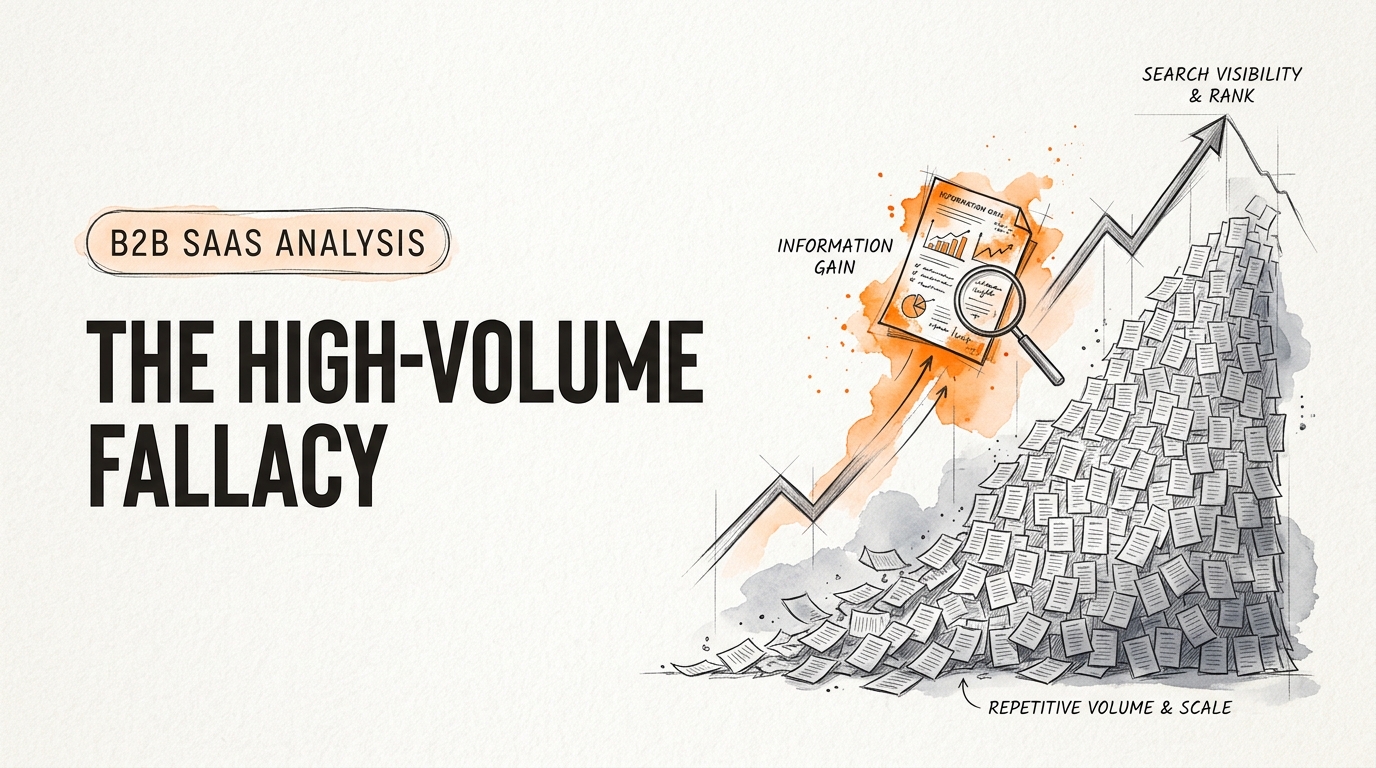
For the past two years, digital marketing teams fell into an easy trap. The playbook looked irresistible: string together a few API prompts, connect an automated pipeline, and generate thousands of articles overnight. Founders and agencies genuinely thought they could drown the search engine results pages with sheer volume. If an established competitor published ten guides a month, they would publish five hundred. It felt like an infinite leverage glitch.
It worked—briefly. But the search landscape changed fast. Teams running massive automated publishing setups now watch their indexing rates drop off a cliff. Pages enter the "Discovered – currently not indexed" graveyard and never leave. Search engines didn't just tweak an arbitrary ranking rule; they ran into cold, hard crawl economics. Crawling, rendering, and evaluating web pages costs millions of dollars in server power and electricity. Search engines won't spend their finite crawl budget on pages that merely mimic what's already sitting in their indexes.
Think of web crawlers like inventory managers at a crowded warehouse. If someone delivers five hundred boxes of identical blue coffee mugs, the manager won't build new shelves to store every single box. They'll keep one or two, and turn the rest away at the loading dock. That warehouse scenario is playing out across millions of automated domains today. As covered in Search Engine Journal's analysis of crawl economics, mass programmatic publishing collapses when it treats search ranking like a mechanical checklist instead of a resource management problem.
How Generic AI Content Fails Information Gain at Scale
The core breakdown traces directly back to how foundational language models work. Standard LLMs predict the next likely word based on public web text they've already ingested. By design, they generate the mathematical average of existing human knowledge. When you use a prompt chain to summarize the top five search results, you aren't producing new ideas. You're just distilling consensus.
This explains why generic ai content fails information gain scores right out of the gate. Information gain measures the fresh data, unique perspectives, or novel findings a document offers over what a searcher has already seen. An automated pipeline that simply restructures existing articles has zero delta. Its net contribution to the web's knowledge base is zero.
Machine learning researchers are talking about these exact boundaries. In community discussions exploring whether LLM capabilities are hitting diminishing returns, practitioners point out that simply throwing more raw tokens at a problem doesn't produce genuine reasoning or original discovery. The same bottleneck applies to search content. More words don't equal more value.
| Publishing Dimension | Commodity Prompt Chaining | Novel Information Synthesis |
|---|---|---|
| Data Sourcing | Scraped top-10 SERP results rephrased via LLM | Proprietary telemetry, user studies, subject-matter interviews |
| Indexation Health | Stalls in crawl queues; high de-indexing rates | Rapid, persistent indexing across topic clusters |
| Marginal Value | Near zero; repeats existing knowledge graphs | High; introduces new entities, metrics, and relationships |
| Algorithmic Durability | Erased by core search updates targeting scaled spam | Builds topical authority and earns natural citations |
When every site uses the same base models to summarize the same top ten results, the entire web turns into an echo chamber. Search engines don't need a thousand echoes. They need the voice that started the sound.
Relying on volume alone was never a viable long-term strategy. It was a temporary arbitrage opportunity born from a mismatch between generative text speeds and search index defenses. That gap has closed. The websites holding their positions today aren't the ones hitting "publish" ten thousand times a month. They're the ones proving each page offers something the search engine cannot find anywhere else.
Why Generic AI Content Fails Information Gain Scoring in Search Engines
Large language models don't generate thoughts. They compute probabilities. When you ask an LLM to outline an article, it scans billions of parameters to calculate the most likely words that should follow your prompt. That math pulls the draft directly toward the center of its training data. The output becomes a statistical average. It gives you what the internet has already said a thousand times, wrapped in clean, spotless grammar.
Search engines don't need another summary. When an algorithm scans a cluster of pages on a single topic, its primary job is finding useful information while conserving server resources. If ten websites already state that regular maintenance extends machine life, an eleventh page saying the exact same thing offers zero marginal value. This algorithmic ceiling is the exact reason generic ai content fails information gain scoring when modern retrieval engines calculate what deserves organic visibility.
The Mathematical Reason Generic AI Content Fails Information Gain
Writers and publishers regularly crash into this wall. In community discussions on evaluating information gain as a ranking mechanism, creators often ask why polished AI drafts lose organic traffic after initial indexing. The frustration makes sense. Teams spend weeks editing prompts, refining tone, and checking facts. Yet their search impressions eventually flatline because the underlying information offers no real delta against the existing index.
Think of search indexing like a patent office. If an inventor presents a blueprint that works exactly like five existing machines, the clerk rejects it immediately. Search engines use vector embeddings to measure semantic distance in a similar way. They map your document against top-ranking URLs in a multi-dimensional space. If your content sits squarely inside the consensus cluster without branching out, its information gain score falls close to zero.
Understanding how retrieval engines analyze queries and reward original sources clarifies this ranking gap. In the video above, creator Wes McDowell breaks down how AI-driven search models filter out redundant content and pick which brands to feature.
Regurgitating SERP Consensus Versus Introducing Novel Entities
Most basic AI workflows scrape the top five results, feed them into a context window, and ask the model to produce a comprehensive guide. This creates a closed feedback loop. The resulting article merely mirrors the SERP consensus. It adopts the same headings, quotes the same public benchmarks, and reaches the same safe conclusions.
| Content Element | Generic AI Baseline (Zero Gain) | High Information Gain Alternative |
|---|---|---|
| Core Evidence | Rephrased definitions and generic claims | Original field metrics, internal tests, edge cases |
| Entity Diversity | Standard high-probability terms and synonyms | Uncommon named entities, specific tools, proprietary data |
| Editorial Angle | Neutral summary designed to avoid mistakes | Contrarian viewpoints rooted in direct experience |
What causes the failure is the missing layer of unique entities. Search platforms map the physical and digital world through discrete entities: specific people, proprietary tools, distinct physical locations, and verified datasets. When software generates text purely from pre-trained weights, it cannot supply new entities that exist outside its historical training set. It lacks recent context and primary observations.
Search engines treat text without new information as an echo. Echoes don't rank when original voices are right beside them.
Overcoming this requires shifting your content pipeline away from simple text generation. Teams seeing real gains combine language models with external extraction frameworks, such as the Entity-First Information Extraction workflow, or query knowledge engines like Diffbot to ground text in structured data. By feeding models first-party survey results, internal product telemetry, and real operational friction points, you stop publishing statistical averages. You start supplying the exact information gain that search engines crave.
What Search Patents and Vector Embeddings Reveal About Content Redundancy
Search engines don't read articles like humans do. They turn text into numbers. Every sentence, paragraph, and page becomes a dense vector—a mathematical coordinate in a multi-dimensional map. When thousands of websites publish articles generated from the same underlying large language models, their coordinates sit directly on top of each other. That mathematical crowding triggers immediate deduplication.
Google laid out the blueprint for this behavior in its landmark patent, US Patent 10922378B2 on contextual information gain. The patent details a system designed to calculate whether a document provides novel information relative to sources a user has already seen. Instead of ranking pages in isolation based purely on keyword relevance, the search engine assigns an "information gain score" to subsequent results. If a user visits a high-ranking page and then returns to the search results, the engine downranks alternate pages that offer identical facts. It elevates pages containing novel entity relationships, fresh data points, or counter-perspectives.
Mathematical Proof: Why Generic AI Content Fails Information Gain in Vector Space
Large language models predict the most probable next word based on internet-scale training data. By definition, a standard AI generation aims for the center of statistical consensus. It says what has already been said millions of times.
When search crawlers ingest this text, embedding models map the content into high-dimensional vector space. Think of this space as a vast galaxy. If your article discusses employee retention, the search engine evaluates where your vectors land relative to existing authoritative pages on the topic. When an AI tool drafts standard tips like "offer competitive salaries" and "conduct exit interviews," its vector lands squarely inside an existing cluster. It adds zero new directional pull.
| Feature Metric | Consensus-Driven AI Text | High Information Gain Content |
|---|---|---|
| Vector Coordinates | Center of high-density consensus clusters | Offset coordinates with distinct sub-clustering |
| Semantic Overlap | 90%+ cosine similarity against existing SERP nodes | Sub-75% similarity with novel entity pairings |
| Information Gain Score | Near zero (pure redundancy) | High (new data, proprietary examples, fresh stats) |
| Index Pipeline Action | Pruned, folded into canonicals, or buried on page 4 | Surfaced in top SERP positions and AI Overviews |
Search systems operate under strict compute constraints. Storing, indexing, and serving billions of web pages costs millions of dollars in server infrastructure. To protect system margins, retrieval engines apply aggressive semantic deduplication.
Technical communities have observed this filtering mechanism firsthand. Practitioners analyzing modern ranking shifts have pointed out that search systems establish a strict conflict radius around core topics. As discussions around Google's algorithmic handling of redundant tokens make clear, the retrieval pipeline actively drops content falling inside an existing semantic boundary. If five articles share the same entity triples and thematic structure, the system selects one representative node and prunes the rest from high-visibility impressions.
This mathematical reality illustrates exactly why generic ai content fails information gain benchmarks across competitive search verticals. When an article rehashes standard knowledge without introducing fresh variables, its cosine similarity to existing indexed documents approaches parity. The algorithm treats the page like a duplicate file on an overloaded hard drive. It doesn't penalize the page out of spite. It simply prunes the redundant node to conserve index efficiency.
Modern discovery platforms reward divergence. To escape the pruning filter, content must deliberately deviate from the statistical center. As outlined in Searchbloom's breakdown of information gain SEO, search engines prioritize articles that introduce unseen metrics, firsthand operational findings, or unique transactional data. When your vectors move outward into unmapped space, the retrieval engine registers net-new value. It grants your URL visibility because you gave the index something it didn't already own.
How Modern Autonomous Engines Must Shift from Rephrasing to Novel Data Synthesis
Most publishing workflows treat large language models like automatic copywriters. Someone types a short prompt, the engine writes eight hundred words, and an editor formats the draft. The prose looks smooth. The grammar is spotless. Yet search engines overlook the piece entirely. Language models generate answers based on probabilistic patterns across historical training sets. As machine learning practitioners often point out on forums like r/ArtificialInteligence, AI follows algorithms and learned patterns rather than formulating independent discoveries. When software only recycles the top ten pages from a search results page, it delivers nothing original.
The Architectural Flaw: Where Generic AI Content Fails Information Gain
Search engines score documents by evaluating novelty against their existing index. When algorithms evaluate a freshly published page, they calculate the statistical difference between its ideas and the text already ranked. If a tool simply rewords the public consensus, generic ai content fails information gain benchmarks because its semantic footprint matches existing documents. It creates noise without utility.
Solving this problem requires an architectural overhaul. Content teams must shift from single-prompt generation to autonomous synthesis engines that treat language models as synthesizers rather than original researchers.
| Workflow Layer | Commodity Prompt Chaining | Autonomous Synthesis Engines |
|---|---|---|
| Input Sources | Public SERP scrapes and broad training weights | Proprietary databases, live APIs, and internal benchmarks |
| Context Control | Manual system prompts and basic text snippets | Brand knowledge graphs with strict entity relationships |
| Drafting Logic | Predictive word matching across shared facts | Contrastive analysis isolating proprietary data deltas |
Modern architectures feed structured internal data into the pipeline before drafting begins. Think of this approach like a trial lawyer presenting evidence. The lawyer does not ask the witness to imagine what happened. They hand the witness physical documents, verified financial records, and concrete timelines to interpret.
Autonomous systems should ground every argument in three distinct foundation layers:
- Proprietary Telemetry: Ingest real product usage data, anonymized customer survey numbers, and hardware performance tests directly from your internal data warehouse.
- Brand Knowledge Graphs: Build a network of connected nodes representing your company's positions, approved definitions, and proprietary frameworks. This aligns with modern strategies for transforming passive data catalogs into active context engines that enforce factual guardrails.
- Differential Search Scans: Parse currently ranking pages to pinpoint unaddressed questions, outdated statistics, and shared blind spots across competitors.
"When an engine only retrieves text it can generate from memory, it never clears the threshold for search visibility. Novelty comes from raw external data."
A synthesis engine compares internal discoveries against indexed web pages. It instructs the language model to write exclusively about the differences. If every competitor says a software setup takes ten minutes, but your internal telemetry shows teams average forty-two minutes, the engine highlights that discrepancy. That divergence creates genuine utility. Search engines detect the unique data point, recognize the new entity associations, and assign a higher score to the page.
Stop asking AI to explain topics it has only read about in public articles. Connect the generation engine directly to unique measurements, let it synthesize your business data, and build documents that no competing model can reproduce.
How to Automate Value-Add Entities and Primary Insights at Scale
If you ask an AI model to generate 500 web pages using a basic prompt template, you get 500 variations of lukewarm oatmeal. The grammar is spotless. The sentence flow looks natural. Search engines still reject it. When search index algorithms compare those documents against pages already in the index, they find zero new mathematical entropy. It's an echo chamber of recycled concepts.
This is where programmatic production lines break down. When workflows scrape the top ten search results and feed them right back into a model prompt, generic ai content fails information gain evaluations by design. Modern search systems do not need another article explaining software architecture with the same three diagrams everyone took from Wikipedia. They reward unindexed facts, fresh entity relationships, and proprietary numbers.
Engineering Workflows When Generic AI Content Fails Information Gain Benchmarks
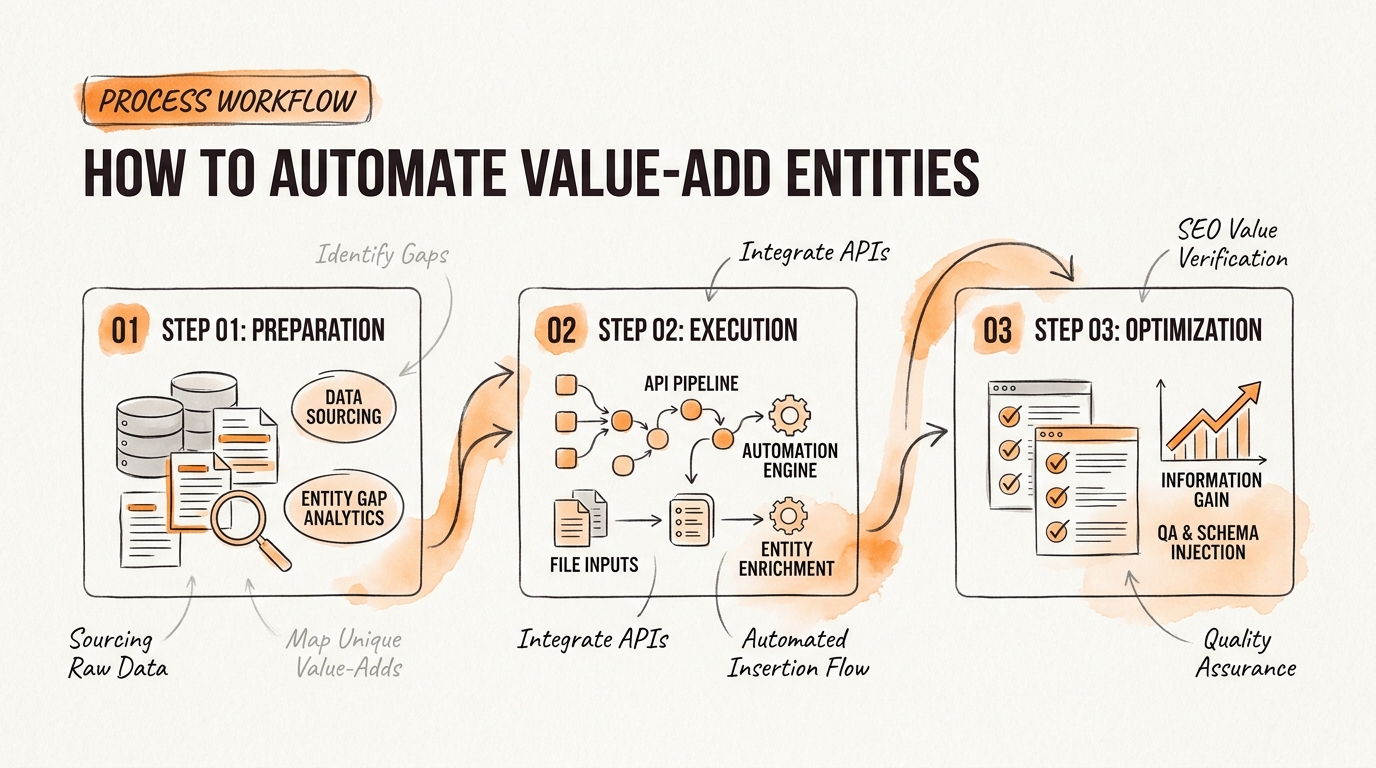
Overcoming this filter requires changing how you build content pipelines. Stop treating the language model as the researcher. Treat the model as a formatter for an internal data stream. You feed the system structured, primary facts; the model simply turns those facts into readable prose.
| Pipeline Layer | Standard Scraping Pipeline | Information Gain Architecture |
|---|---|---|
| Input Source | Top 10 Google search results | Internal databases, warehouse logs, telemetry |
| Entity Handling | Repeats generic, high-level terms | Injects disambiguated, long-tail technical entities |
| Data Points | Recycled third-party statistics | Calculated ratios, internal deltas, live metrics |
| Editorial Angle | Safe, homogenized consensus | Adversarial checks and edge-case exceptions |
When you automate this pipeline, every published piece starts with a proprietary payload. Search engines score information gain by checking whether a URL contains information that does not exist in rival documents. If your page introduces six verified data points found nowhere else, the page clears the threshold.
Tactical Injection Nodes for High-Volume Publishing
To pull this off at scale, engineering teams run incoming topics through four distinct pre-processing nodes before the generation step ever triggers:
- Calculated Ratio Engines: Never output raw counts that anyone can scrape from a public table. Run mathematical operations across multiple internal tables first. As technical teams discover when analyzing operational business models with AI, models struggle to produce sharp insights unless you feed them structured operational ratios upfront. Calculate churn drift, compute infrastructure cost per active session, or benchmark time-to-first-response across quarters. The resulting ratios are completely original to your brand.
- Disambiguated Entity Linking: Generic text leans on vague placeholders like "modern database" or "marketing tool." Your pipeline should query an internal entity graph to swap out abstract words for concrete nouns. Name the precise open-source library, the protocol standard, or the exact query engine version. Crawlers parse those technical entities and map them to their knowledge graphs.
- Contrarian Edge-Case Injectors: Base models favor the most probable answer, which is also the most common answer on the web. Create an adversarial prompt node that runs in parallel. If the main draft suggests an industry standard tactic, the adversarial node checks your incident logs for times when that exact tactic failed. Adding that single failure mode instantly sets the content apart from common advice.
- Support Ticket and Log Ingestion: Connect your warehouse to your generation queue. If you write technical documentation or industry workflows, grab anonymized bug tickets, customer quotes, or deployment notes. A single real-world debugging snippet proves immediate human utility.
Bridging the gap between raw AI tools and genuine business value remains the central challenge across modern digital platforms. This breakdown looks closely at how agencies move past basic hosting and templated AI output to build defensible trust:
Structuring the Pre-Generation Payload
Think of prompt engineering as data ingestion rather than creative writing. Build a script that pulls from your data warehouse and compiles a rich context payload. Here is how that input package looks when passed to your generation step:
{
  "target_topic": "PostgreSQL Connection Pooling Performance",
  "disambiguated_entities": ["PgBouncer", "Transaction Pooling Mode", "AWS Aurora read-replicas"],
  "derived_metrics": {
    "latency_p99_spike": "42ms increase when connections exceed 800",
    "throughput_retention": "88% efficiency under connection-burst testing"
  },
  "contrarian_insight": "Transaction pooling mode silently breaks prepared statements in Node.js ORMs",
  "primary_source_log": "INCIDENT_REF_9918B"
}
Pass that payload into your model with a strict rule: the final copy must present and explain every metric in the JSON object. The model no longer invents facts. It simply acts as an analytical translator.
This workflow solves the core issue cleanly. Without this systematic data layer, generic ai content fails information gain thresholds every time a search engine calculates semantic difference against established competitor URLs. Feed your pipeline fresh data, run the math beforehand, and let the model package your hard-won experience for the reader.
Moving Beyond Commodity Generation to Build Defensible Organic Moats
Volume is a trap.
Publishers spent the last two years racing to see who could publish faster, cheaper, and at staggering scale using off-the-shelf prompts. It didn't work. Churning out hundreds of commodity articles each month looks great on an operations dashboard, but the traffic charts tell a brutal story. When every team has instant access to the same foundational models, average text becomes worthless. Answer engines simply don't retrieve pages that mimic existing web documents. They look for new evidence they can't already predict from their own training weights.
Content teams are feeling this shift across the industry. In an honest discussion on how AI content erodes defensible barriers, practitioners pointed out that flooding the web with synthetic copy strips away the original perspectives that drew audiences in the first place. If your organic strategy relies entirely on prompt chains that scrape and rewrite existing search results, you don't have a moat. You're just renting temporary search rankings until the next index sweep clears the floor.
Why Generic AI Content Fails Information Gain Over Time
Think of information gain like an intelligence briefing for an executive. If five analysts bring you reports with the exact same three talking points, a sixth report covering those identical points adds zero value. You toss it in the bin. Search scoring works the exact same way. Modern scoring models calculate the mathematical difference between your text and everything else already indexed on that topic. If your page sits directly on top of an existing cluster without introducing a new vector of thought, the algorithm skips it. The reality is simple: generic ai content fails information gain tests because it has no delta.
To survive in an automated web, teams need to swap out cheap commodity generation for systems built on true information provenance. You can evaluate this shift by contrasting two very different publishing methods:
- Surface-Level AI Rephrasing: You feed top-ranking URLs into a model and tell it to write an exhaustive overview. It produces clean, readable paragraphs, but every sentence reflects data points the search index already holds. It costs pennies to make, but it attracts zero sustainable search share because it introduces no new entities.
- Telemetry-Backed Data Synthesis: You connect your generation workflows to private internal logs, customer benchmarks, original poll data, or lab experiments. The model structures and explains data that exists nowhere else online. It costs more effort up front, but it produces a durable asset that other writers must cite as a primary source.
"True organic moats are built on what an algorithm cannot invent: first-party telemetry, verifiable field trials, and proprietary data provenance."
Stop measuring your team on raw word count or article volume. Those metrics belong to an era of publishing that is already gone. Sustainable growth over the next decade comes down to algorithmic novelty, clear sourcing, and genuine utility. Use automated tools to speed up your analysis, clean up raw findings, and format complex figures. Just don't let them do the actual thinking for you. If you want search engines and human readers to care about your work, give them something the web hasn't seen before.
