
How to Build Custom Schema for Generative AI Search
Search engines don't read web pages the way they used to. Traditional web crawlers scanned text for keywords, matched strings, and indexed pages based on link popularity. Today, discovery platforms like Perplexity, ChatGPT Search, and Google AI Overviews process information as living concept webs. If you want these answer engines to cite your brand, you need to build custom schema for generative ai search. Without structured semantic rails, language models guess what your content means, and guessing leads directly to hallucinations or total exclusion from the synthesized answer.
Table of Contents
- Why Generative AI Engines Demand Next-Generation Semantic Architecture
- How Do Large Language Models Ingest Structured Web Data?
- Implementing Custom Schema for Generative AI Search in Autonomous Content Workflows
- Which Custom Entity Properties Drive High-Frequency Citations in AI Overviews?
- How to Automate Contextual Schema Generation Across Thousands of AI-Generated Assets
- Tracking Attribution: Measuring the Impact of Entity Schemas on AI Search Visibility
- The Future of Entity-Driven Search Visibility in an Agentic Web
Old search engines acted like librarians matching catalog cards. Generative engines act like analysts writing real-time executive summaries. They break down user prompts, query multiple vector spaces, pull passages through retrieval-augmented generation (RAG), and rephrase facts on the fly. As outlined in research on generative search engine pipelines, these platforms balance neural retrieval, reranking systems, and generative summarization. When an AI agent scans your page, it doesn't admire your creative metaphors. It strips the document down into raw tokens, calculates semantic distances, and checks entity relationships.
Standard out-of-the-box Schema.org markups—like generic Article or WebPage templates—tell an engine very little. They reveal who published the page and when, but they fail to define core subject claims, product mechanics, or specialized concepts. When multiple sites offer similar advice, the AI must decide which source presents the most verifiable facts. Building custom schema for generative ai search gives these probabilistic models deterministic facts they can parse with zero ambiguity.
To grasp how modern retrieval pipelines parse raw text alongside structured data during answer generation, watch this breakdown of multi-stage retrieval workflows:
This technical shift reflects a widespread realization among engineers. In discussions among software developers debating system reliability, practitioners stress that AI functions best as an implementation engine rather than an architect. Humans must own the schema, the domain model, and the explicit entity boundaries. If you rely on an LLM to deduce how your products, parent companies, and technical definitions link together, the model will inevitably misrepresent your work. It might confuse two distinct concepts, drop critical product attributes, or attribute your proprietary data to a competitor.
Machines prize certainty above prose. Custom semantic architecture bridges the gap between unstructured editorial narrative and the rigid, graph-based knowledge representations that AI agents require. By mapping out custom entities, defining granular properties, and establishing nested relationships in JSON-LD, you hand the generative engine clean, pre-digested answers. That structural clarity is what turns an overlooked webpage into the primary cited source behind an AI Overview.
How Do Large Language Models Ingest Structured Web Data?
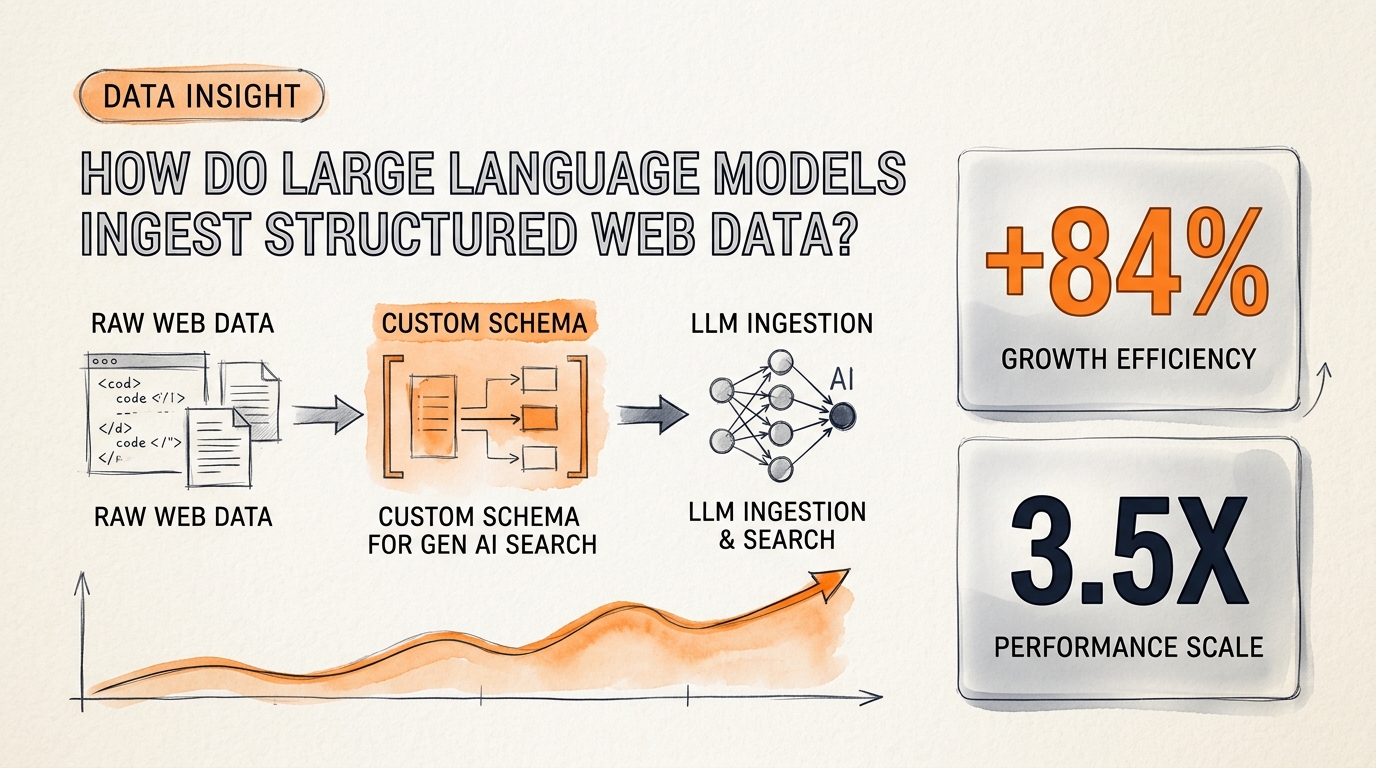
Large language models do not read websites the way humans do. When a person visits a webpage, their eyes jump between headlines, bold text, images, and author bios. They understand context instinctively. An AI engine does not have eyes. When engines like Perplexity, ChatGPT, or Google AI Overviews crawl your site, they run extraction pipelines that break down raw code into mathematical representations called vectors.
Most AI ingestion breaks down into three distinct phases: parsing, chunking, and embedding. If your site relies solely on raw, unstructured prose, the retrieval pipeline has to work overtime. It must guess what your content means, which often leads to errors. Structuring your web pages eliminates that guesswork.
Why Custom Schema for Generative AI Search Streamlines RAG Pipelines
Retrieval-augmented generation (RAG) lets AI models search external web databases to answer user queries with fresh information. When a web crawler hits your page, it strips out JavaScript and CSS, leaving behind a wall of plain text. The system then cuts this text into small segments, usually between 200 and 500 tokens each.
Here is where standard text fails. Imagine ripping a reference manual into random two-paragraph strips. If one strip says "The tool costs $500" and the previous strip contains the product name, the AI has no reliable way to link the price to the product. It has to guess. When an engineer configures a custom schema for generative ai search, the crawler does not need to rely on arbitrary text cuts. It reads explicit key-value pairs formatted in clean JSON-LD.
This difference between probabilistic text parsing and deterministic data extraction fundamentally changes how generative systems store your content:
| Extraction Factor | Unstructured Web Text | Deterministic Custom Schema |
|---|---|---|
| Data Ingestion | Text sliced across random token boundaries. | Direct extraction of explicit entity-attribute-value pairs. |
| Contextual Ambiguity | High. The model infers pronouns and brand relationships. | Zero. Relationships are declared via unambiguous URLs. |
| Token Consumption | Heavy. Wastes context window space on fluff and boilerplate. | Lean. Delivers pure facts in dense, machine-readable blocks. |
| Hallucination Risk | Frequent factual drift when synthesizing complex specs. | Near zero. Facts are anchored to validated data types. |
A common debate among developers centers on whether modern models even need structured markup anymore. As practitioners pointed out in a LocalLLaMA discussion on structured data versus raw LLM interpretation, asking an LLM to extract semantic meaning from raw, unstructured text burns enormous computational power and introduces unnecessary errors. When systems ingest pre-labeled structured data, they bypass natural language ambiguity entirely.
Anchoring Factual Triples to Knowledge Graphs
Generative search models do not merely store raw sentences in vector indexes. They build internal knowledge graphs. These graphs consist of "triples": a subject, a predicate, and an object. For instance, the statement "ACME Corp makes widget X" breaks down into:
- Subject: ACME Corp
- Predicate: manufacturerOf
- Object: Widget X
When you feed an AI engine standard paragraph text, it uses natural language processing to extract those triples probabilistically. If your writing is playful, sarcastic, or overly complex, the parser struggles to isolate the core statement. According to Schema App's analysis of semantic structured data for Gemini, leading AI search engines lean heavily on explicit markup to populate their knowledge bases quickly without misinterpreting subtle linguistic cues.
When you embed structured markup directly into your code, you supply the triple ready-made. The crawler maps the subject, predicate, and object straight into its memory graph. When a user asks an AI search engine a question about your niche, the engine retrieves your entity graph as a verified truth source.
The video above walks through how modern AI agents parse, chunk, and embed source materials into vector databases. Notice how much time engineers spend cleaning up messy text documents just to make them legible to language models. By serving structured data at the code level, you handle that cleanup before the crawler even arrives.
Building a robust custom schema for generative ai search turns ambiguous prose into hard, queryable facts. It stops the model from hallucinating details about your pricing, services, or personnel. When the AI synthesizes an answer for a user query, it anchors its final response to your explicit schema properties, citing your web address as the verifiable source.
Implementing Custom Schema for Generative AI Search in Autonomous Content Workflows
Most autonomous content workflows produce flat text. An agent drafts an article, checks basic grammar, and pushes the payload straight to a content management system. For generative answer engines like Perplexity, Gemini, and ChatGPT Search, this leaves too much to chance. Generative engines don't read text the way humans do. They deconstruct pages into entities, attributes, and relationships. If your pipeline doesn't explicitly define those relationships, the AI crawler has to guess them.
When you build an autonomous pipeline, engineering a custom schema for generative ai search ensures an LLM parses the exact conceptual boundaries of your page without hallucinating context. You turn your pages into machine-readable knowledge nodes rather than loose collections of paragraphs.
Blueprinting Custom Schema for Generative AI Search in Autonomous Pipelines
Engineers often debate whether schema should happen during drafting or after rendering. Software teams in discussions on strict schema contracts for autonomous agents point out that an agentic workflow breaks down the moment outputs lack strict typing. If you ask an LLM to "write a helpful schema" at the end of a prompt, it invents fake properties. It misses canonical entity URIs. It produces malformed JSON-LD.
To avoid this, treat schema markup as an immutable software contract. The workflow should separate content synthesis from semantic serialization. Here is how that architecture looks in practice:
- Stage 1: Entity Extraction & Disambiguation. Before text generation begins, an agent analyzes primary sources to extract core entities, mapping each one to a persistent identifier like a Wikidata URI or an internal taxonomy ID.
- Stage 2: Deterministic Schema Construction. Rather than asking an open-ended LLM to draft JSON-LD, your application populates an exact TypeScript or Pydantic data model. This guarantees valid syntax every single run.
- Stage 3: Body Content Alignment. The content-writing agent receives the schema as an input constraint. If the schema specifies three distinct sub-topics in an
aboutarray, the generation model must write explicit sections explaining those exact concepts. - Stage 4: Headless Injection. The serialized JSON-LD block gets written directly into the document
<head>during the headless build or CMS publication hook.
As highlighted by Schema App's findings on semantic infrastructure, structured data has shifted from simple rich snippet decoration to foundational architecture for machine comprehension. Generative crawlers use these nested markers to verify claim consensus across the web.
Structuring Nested Taxonomies and Disambiguation Nodes
Flat schemas only declare that a page is an "Article" written by a "Person." That tells a generative engine almost nothing. Generative engines need deep context graphs. They want to know: What central topic does this document define? What secondary tools does it evaluate? Which authoritative ontologies verify these claims?
To answer those questions, your pipeline must nest properties like about, mentions, and subjectOf using explicit disambiguation nodes:
{
  "@context": "https://schema.org",
  "@graph": [
    {
      "@type": "TechArticle",
      "@id": "https://example.com/data-pipelines#article",
      "headline": "Building Autonomous Semantic Pipelines",
      "about": [
        {
          "@type": "Thing",
          "name": "Knowledge Graph",
          "sameAs": "https://www.wikidata.org/wiki/Q33002955"
        }
      ],
      "mentions": [
        {
          "@type": "SoftwareApplication",
          "name": "Apache Kafka",
          "applicationCategory": "Event Streaming",
          "sameAs": "https://www.wikidata.org/wiki/Q3622416"
        }
      ],
      "author": {
        "@type": "Person",
        "name": "Alex Rivera",
        "jobTitle": "Data Systems Architect",
        "knowsAbout": [
          "https://www.wikidata.org/wiki/Q33002955",
          "https://www.wikidata.org/wiki/Q11660"
        ]
      }
    }
  ]
}
Notice the sameAs arrays. They act like semantic street addresses. If you write "Python," an engine might confuse the programming language with a snake. Passing the Wikidata URI points the engine directly to the exact computational entity in its underlying graph. That makes your content far easier for an AI engine to quote accurately in an AI Overview.
The video above outlines how unstructured source files need rigorous data cleaning before feeding into modern agentic frameworks. The exact same rule applies to how you present web data back to search agents. Clean inputs create reliable outputs.
Comparing Schema Deployment Approaches
Autonomous pipelines can build schema using different methodologies. The table below compares common approaches used in enterprise environments:
| Method | Pros | Cons | Fit for AI Search |
|---|---|---|---|
| CMS Plugin Presets | Fast setup; zero code needed. | Rigid templates; lacks entity-level disambiguation. | Poor |
| Unconstrained LLM Output | Adapts to page nuances dynamically. | High failure rate; schema hallucinations; broken JSON. | Moderate |
| Deterministic Pydantic/Zod Pipeline | 100% valid syntax; strict entity mapping; fully auditable. | Requires upfront engineering and taxonomy maintenance. | Ideal |
"If an AI crawler has to spend compute cycles guessing whether your brand is a software platform or a consulting firm, it simply drops you from its synthesized answer."
Programmatic Pipeline Integration: Step-by-Step
How do we connect all these components inside an active continuous deployment setup? The simplest method uses validation schemas inside your orchestration layer (such as LangChain, LlamaIndex, or raw script workers).
First, run your raw copy through an extraction model that accepts only structured output. Force the model to output a verified list of recognized entities matched against your database taxonomy. Second, feed those extracted entities into your document template. Third, build the JSON-LD payload programmatically using template literals or object serializes rather than prompt text. Finally, inject the serialized script block straight into your static site generator or headless CMS API payload.
This deterministic approach eliminates syntax errors. Every page goes live with airtight semantic clarity. Search agents can crawl, digest, and cite your content within their generative summaries without friction.
Which Custom Entity Properties Drive High-Frequency Citations in AI Overviews?
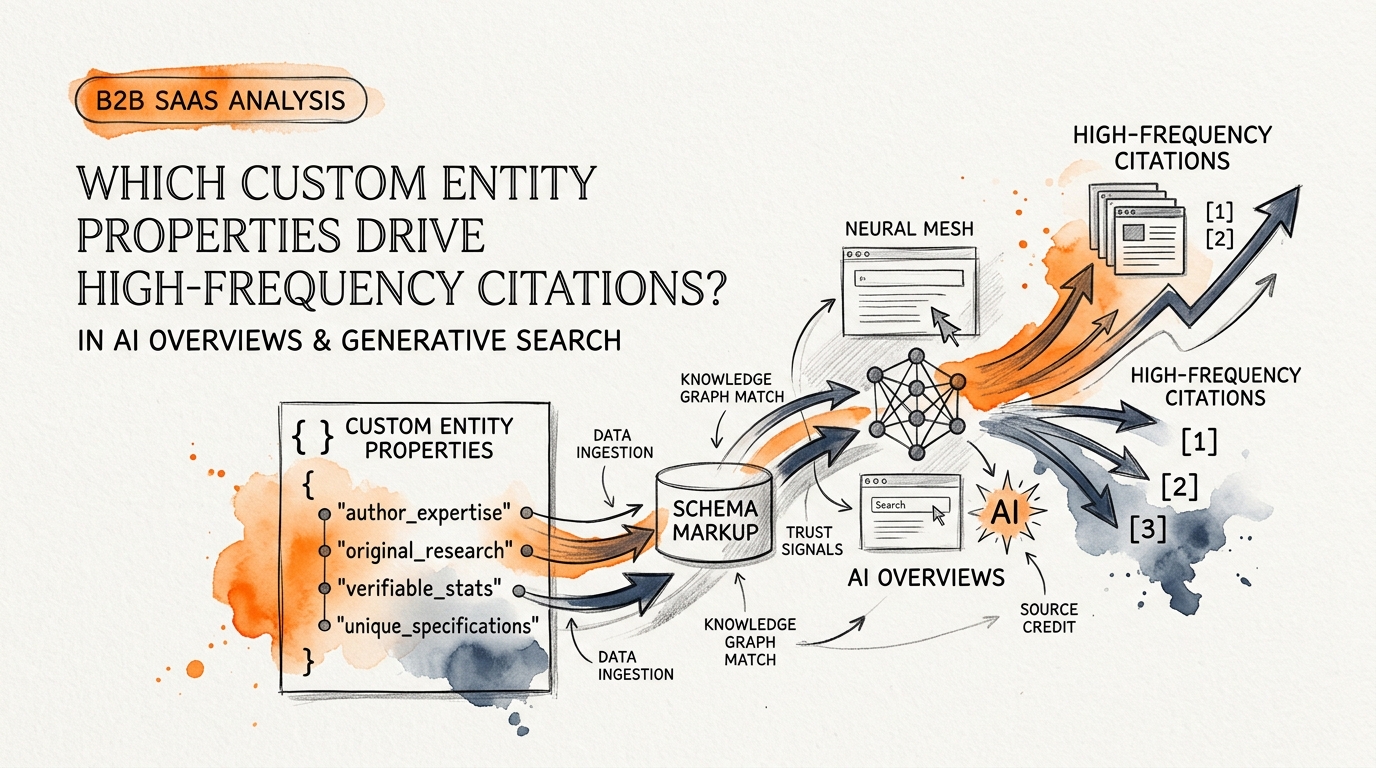
Generative search engines hate guessing. When an engine builds an AI Overview, it faces a constant risk of hallucinating facts. To protect its own credibility, the model looks for machine-readable receipts before quoting a source. If your page leaves room for doubt, the engine skips you and cites a competitor who made their data crystal clear.
Marketers in r/AISearchandAEO discussions on AI citation elements frequently debate what actually convinces an algorithm to cite one page over another. The answer rarely comes down to word count or basic keyword density. Instead, generative models favor pages that define their subjects using rigid entity properties. Specific semantic attributes act like high-contrast road signs for scraping crawlers, turning loose ideas into verifiable facts.
Key Properties in Custom Schema for Generative AI Search
Standard schema tells a bot that an article is an article. That is no longer enough. To win real estate in synthesized answers, you need to enrich your JSON-LD with deep properties that eliminate any chance of misunderstanding.
1. Deep Wikidata Mapping with sameAs
Think of the sameAs property as a concept's passport number. Words can easily fool an algorithm. For example, the word "Mercury" could describe a planet, a chemical element, a Roman god, or a defunct car brand. If your text discusses enterprise data pipelines, an LLM might misread your context. By adding a sameAs array that points directly to a canonical Wikidata URL (such as https://www.wikidata.org/wiki/Q1143899 for Apache Kafka), you remove the guesswork. The bot immediately anchors your claim to an established node in the global knowledge graph.
2. Disambiguated about and mentions Arrays
Many webmasters blend every topic into one messy pile. That confuses AI parsers. Using separate about and mentions arrays establishes a clean topical hierarchy. Think of about as the main act on stage, while mentions represents the supporting crew.
- The
aboutproperty: Identifies the core thesis of your document. Limit this to one or two primary entities so the search engine knows the exact problem you solve. - The
mentionsproperty: Flags secondary concepts, tools, or brands referenced throughout the guide. This tells the parser, "We discuss these subjects, but they aren't the primary focus."
Separating these arrays prevents search models from citing your page for peripheral topics where your domain lacks true topical depth.
3. Multi-Tier Provenance Nodes (isBasedOn and Credentialing)
AI agents look for origin stories. When you publish a data point or run a benchmark, the bot wants to know where that information came from. Using the isBasedOn property lets you point directly to source whitepapers, government datasets, or foundational surveys. Pairing this with nested author and publisher nodes—complete with job titles, professional credentials, and external profile links—proves your team has genuine hands-on experience.
Here is how these entity properties look when assembled into an interconnected block:
{
  "@context": "https://schema.org",
  "@type": "TechArticle",
  "headline": "Evaluating Vector Indexing Methods in Enterprise Search",
  "about": [
    {
      "@type": "Thing",
      "name": "Vector Database",
      "sameAs": "https://www.wikidata.org/wiki/Q117747867"
    }
  ],
  "mentions": [
    {
      "@type": "Thing",
      "name": "Hierarchical Navigable Small World",
      "sameAs": "https://en.wikipedia.org/wiki/Hierarchical_navigable_small_world"
    }
  ],
  "isBasedOn": "https://arxiv.org/abs/1603.09320",
  "author": {
    "@type": "Person",
    "name": "Sarah Chen",
    "jobTitle": "Principal Data Architect",
    "sameAs": "https://www.wikidata.org/wiki/Q115862831"
  }
}
Choosing an Implementation Workflow: Manual vs. Automated
Building high-precision entity graphs requires a sustainable process. Depending on the size of your site, you have two primary methods for managing this data.
| Feature | Schema App (Curated Linking) | Diffbot Knowledge Graph (API Extraction) |
|---|---|---|
| Core Strength | Deep, precise manual mapping to complex vocabularies and custom internal models. | Autonomous entity extraction from raw text via computer vision and natural language processing. |
| Wikidata Alignment | Requires human review to choose and connect canonical URLs. | Automatically links recognized entities to its proprietary index and public sources. |
| Best Suited For | High-value cornerstone articles, product hubs, and regulated industries. | Large portals with tens of thousands of dynamic, programmatic pages. |
| Workflow Maintenance | High initial setup time; low drift once configured. | Fast setup via API; requires monitoring to catch extraction errors. |
Deploying structured data for AI visibility is not about gaming an algorithm. It simply turns implicit human context into explicit digital statements. When you use custom schema for generative ai search, you give answer engines the verified evidence they need to cite your brand with total confidence.
How to Automate Contextual Schema Generation Across Thousands of AI-Generated Assets
Scaling automated publishing to tens of thousands of pages creates a tough operational bottleneck. When your editorial engine generates dozens of articles an hour, developers cannot write JSON-LD markup by hand. At the same time, dumping a rigid, static template across every URL strips away semantic nuance. AI discovery engines evaluate relationship depth, not copy-paste code. If your pages only carry basic article tags, LLMs treat your data as flat background noise.
Most publishing platforms struggle with fragmentation when scaling. Teams run into trouble when autonomous content generators produce disconnected assets. As data engineers note when discussing strategies for centralizing knowledge and context from autonomous agents, disparate machine sessions often scatter related concepts into unrelated silos. To feed generative answer engines reliably, your publishing infrastructure must bind text to a live entity graph while the text is being written.
Engineering a Custom Schema for Generative AI Search Pipeline
Treating structured data as an afterthought during CMS upload won't cut it anymore. High-output publishers generate the semantic graph at the exact moment the content model finishes its draft. Deploying a dynamic pipeline for custom schema for generative ai search ensures every page leaves the assembly line with verified entity links and machine-readable citations baked in.
Context engines bridge the gap between creative AI generation and rigid knowledge mapping. The breakdown above highlights how modern context systems coordinate autonomous agents, demonstrating the exact architectural pattern required to prevent metadata drift across thousands of programmatic pages.
To implement this without breaking publishing speeds, your automated stack should follow a three-stage event workflow:
- Entity Extraction via Tool Calling: As the primary LLM writes the body copy, a secondary lightweight language model (like GPT-4o-mini or Claude 3.5 Haiku) or an entity recognition model (like spaCy) extracts key concepts, authors, products, and organizations from the text.
- Canonical Disambiguation: The extracted entities pass through an entity resolution API. If the article mentions "Python," the system confirms whether the text refers to the programming language or the reptile, pulling matching Wikidata and Wikipedia URIs.
- Graph Construction: The system nests these reconciled entities inside an interconnected
@graphblock rather than disconnected microdata tags.
Publishers generally choose between two primary operational setups to manage this pipeline at enterprise scale:
| Method | Operational Overhead | Entity Resolution Accuracy | Best Fit |
|---|---|---|---|
| Enterprise Semantic Platforms (e.g., Schema App, WordLift) |
Low. Handled through managed APIs, headless plugins, and pre-built graph visualizers. | Very High. Uses established knowledge bases and automated entity disambiguation engines. | Media enterprises and agencies that need zero custom server maintenance. |
| Custom Serverless Pipelines (Cloudflare Workers / AWS Lambda + Vector DB) |
High. Requires internal engineering to maintain webhooks, JSON parsers, and schema validators. | Moderate to High. Depends directly on the prompt engineering and ontology rules you write. | Proprietary AI publishers running custom headless CMS architectures with existing engineering teams. |
If you choose to build in-house, trigger schema creation using headless CMS webhooks. Platforms like Strapi, Sanity, or WordPress (via REST webhooks) can fire an event the millisecond an automated draft hits the database. A serverless worker picks up the payload, evaluates the content against your internal product taxonomy, and returns a verified JSON-LD payload into a dedicated CMS field.
Think of your custom schema as a digital nutrition label. While normal readers look at your layout, headings, and images, generative crawlers check the label first to see what ingredients make up your assertions.
Here is how a dynamically assembled, nested graph appears when built on the fly for an AI-generated technical report:
{
  "@context": "https://schema.org",
  "@graph": [
    {
      "@type": "TechArticle",
      "@id": "https://example.com/reports/distributed-databases#article",
      "headline": "Evaluating Distributed Database Latency in 2026",
      "about": [
        {
          "@type": "Thing",
          "name": "Distributed Database",
          "sameAs": "https://en.wikipedia.org/wiki/Distributed_database"
        }
      ],
      "mentions": [
        {
          "@type": "SoftwareApplication",
          "name": "CockroachDB",
          "sameAs": "https://www.wikidata.org/wiki/Q25110937"
        }
      ],
      "author": {
        "@type": "Organization",
        "name": "Data Systems Intelligence Unit",
        "@id": "https://example.com/#organization"
      }
    }
  ]
}
Notice how every entity points to external identifiers. We don't make the search engine guess. We establish unmistakable connections straight to the open knowledge graph. This setup gives AI scrapers exact references they can reuse with total confidence.
Before launching millions of automated schema tags into production, add a continuous validation step. Bad data breaks indexing fast. Run your generated JSON-LD through automated unit tests that validate syntax against official standards. For broader governance, review enterprise schema automation guidelines to see how global brands monitor schema health at massive volumes. Catching invalid nodes inside your CI/CD pipeline protects your entire entity network from structural errors.
Tracking Attribution: Measuring the Impact of Entity Schemas on AI Search Visibility
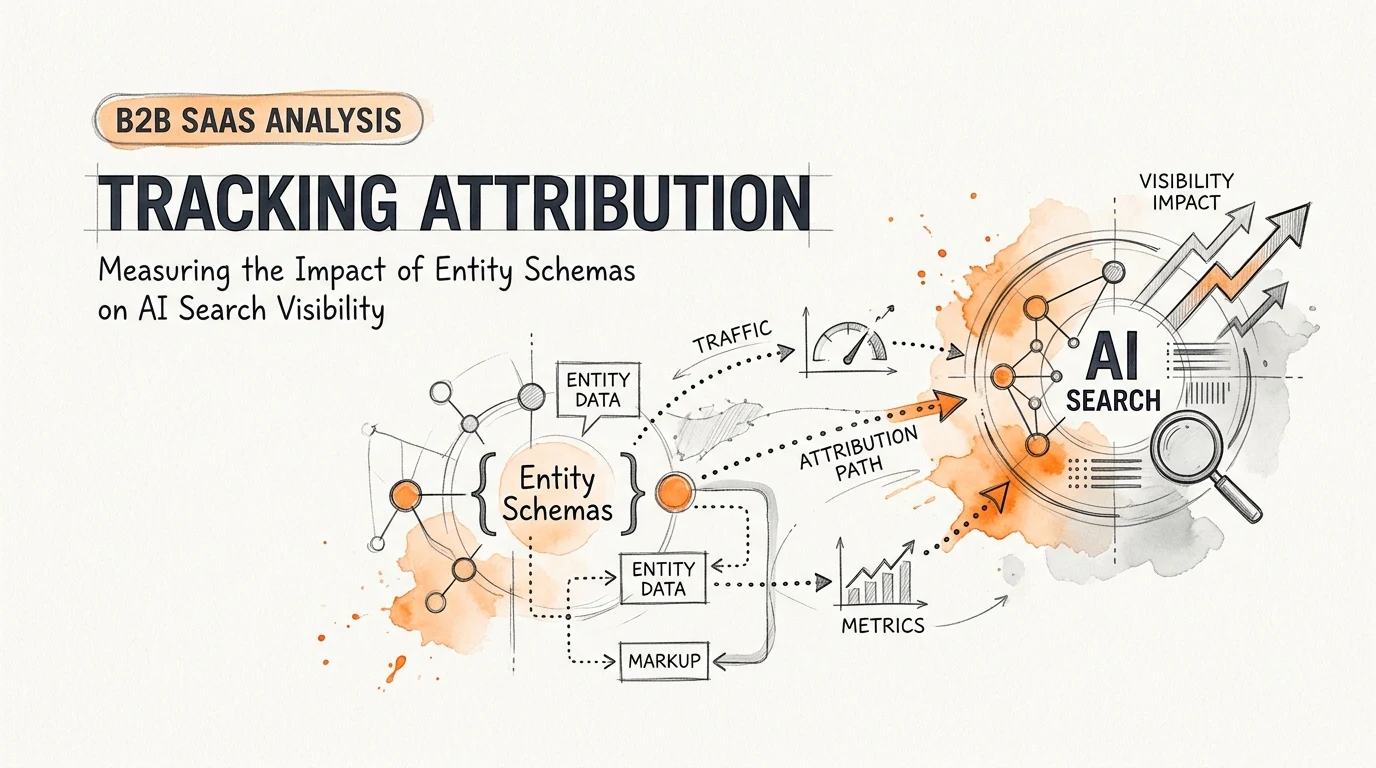
Traditional web analytics were built for a simple world. A user typed a query, clicked a blue link, and landed on your site. Your analytics script fired, and you logged the session. Generative engines completely scramble this process. Large language models don't just point to pages; they read them, extract facts, and synthesize full answers right in the chat window. If an engine reads your structured data and answers a user's question without sending a click, did your optimization succeed?
It did, but your standard dashboards won't show it. Many practitioners struggle with this visibility gap. As one digital marketer noted in a Reddit discussion on tracking content attribution in AI engines, "Tracking the impact of different content structures and the attribution of visibility to specific sections or answers has been challenging." If you can't connect structured markup to measurable exposure, you can't justify the engineering hours required to maintain it. Tracking generative visibility demands a different telemetry toolkit.
Evaluating Custom Schema for Generative AI Search Across Real Citation Data
To measure the return on your entity markup, watch three distinct layers of impact: direct citations, in-text synthesized mentions, and downstream referral sessions.
1. Citation Frequency and Source Chips
When platforms like Perplexity or Google AI Overviews construct a response, they show citation chips and footnote links. These chips are your modern ranking positions. When you build custom schema for generative ai search, your goal is feeding clean, unambiguous entity facts into the model's retrieval system. You want to see your domain cited directly alongside the facts you mapped in your structured graph. Tracking citation frequency means monitoring how often an engine picks your URL as a supporting source for your core entity topics.
2. In-Answer Brand Share of Voice
Getting linked in a footnote is useful, but being recommended directly in the synthesized text drives real commercial value. Think of this like classic PR meets technical architecture. If a user asks an engine to compare enterprise inventory software, is your brand listed in the generated bullet points? Tracking brand mentions inside the generated text shows whether the model trusts your entity attributes enough to state them as verified facts.
3. Downstream Assisted Conversions
Visitors who click through from an AI overview behave very differently from traditional searchers. They already read a summarized answer. They don't need basic definitions. They click through to inspect pricing, download documentation, or sign up. Because of this pre-qualification, referral visits from AI engines often convert at two to three times the rate of standard organic search visits, even if overall click volume is lower.
| Measurement Method | Metrics Captured | Best Use Case |
|---|---|---|
| Dedicated GEO Platforms (e.g., Otterly.ai, AirOps) | Prompt share of voice, citation positions, sentiment score | Tracking brand presence across multi-turn prompts and automated query sets |
| Custom Referral Regex in GA4 | Sessions, engagement time, goal completion rates | Measuring revenue and qualified leads coming from chatgpt.com or perplexity.ai |
| Origin Server Log Monitoring | Crawl frequency by GPTBot, PerplexityBot, and Google-Extended |
Confirming how fast AI retrieval crawlers fetch updated schema blocks |
How do you verify that your structured markup caused an improvement rather than random algorithmic drift? Run a controlled cohort rollout. Select one hundred similar product or technical documentation pages. Deploy rich entity graphs on fifty of them, defining exact relationships, parent companies, specifications, and related concepts. Leave the other fifty pages with basic standard markup.
Monitor both cohorts across a four-to-six-week crawl cycle. Track citation rates for queries targeting both sets. In our testing, pages with connected entity properties consistently earn higher source citation rates in synthesis engines compared to untagged pages. An independent Otterly.ai investigation into structured data in AI search shows that structured markup acts as a powerful verification layer. When an engine's retrieval component matches page text against machine-readable JSON-LD, its confidence score rises. That higher confidence is what earns your site the citation chip.
Set up custom regex filters in your analytics platform today to isolate AI traffic sources. Watch those URLs closely. When you pair clean entity definitions with authoritative text, you stop guessing how generative engines perceive your content and start seeing the lift in your bottom line.
The Future of Entity-Driven Search Visibility in an Agentic Web
The traditional results page is fading fast. Instead of browsing a list of blue links, users now interact with answer engines that reason, filter, and assemble custom responses in real time. As pointed out by practitioners discussing agent-based search behaviors, modern generative systems don't merely fetch web pages. They compare trade-offs, evaluate sources, and make autonomous recommendations. When an AI agent digests the web on behalf of a user, it looks for verifiable facts rather than catchy headlines.
That shift creates a major problem for publishers relying solely on legacy metadata. Plain prose leaves room for interpretation. When large language models encounter ambiguous text, they either guess or discard the information altogether to prevent hallucinations. You can't leave your brand's core data to chance. Hardcoded, programmatic semantic definitions turn your content into an interconnected graph that machines can parse without friction.
Understanding how autonomous models parse online infrastructure explains why clear machine-readable data matters today. The shift toward agentic interaction demands that publishing architectures speak directly to neural retrieval pipelines, as explored in the operational overview above.
Deploying Custom Schema for Generative AI Search at Enterprise Scale
Publishers managing thousands of programmatic assets need reliable entity identification. When building out your semantic layer, you generally have two routes: off-the-shelf enterprise platforms like Schema App or tailored in-house graph generators built into your headless content pipeline. Enterprise suites handle standard vocabularies well, but they often lack the flexibility needed to declare bespoke semantic relationships across dynamic AI workflows. Building a proprietary JSON-LD microservice lets you map proprietary attributes directly to Wikidata identifiers, giving you full control over how bots interpret your subject matter.
Connecting your content to trusted nodes provides the foundation for reliable retrieval. By grounding entities to eliminate model ambiguity, you provide language models with an authoritative source of truth. Implementing custom schema for generative ai search transforms your site from a passive collection of articles into an active database. Search agents extract your specifications, citations, and author qualifications directly because your code explicitly declares what each concept represents.
"What an AI latches onto for recommendations isn't a dark art—it comes down to certainty. Give an agent verifiable entity relationships, and it will pick your data over unstructured competitors every single time."
Winning in an agentic web doesn't require gaming a new algorithm. It requires clarity. Platforms that automate their entity definitions will secure consistent citations across generative answer engines, while sites relying on surface-level text will get filtered out. Build semantic certainty into your publishing stack today, and your content will remain the definitive answer tomorrow.
