
10 Information Gain Prompts for Niche Content - information gain prompts niche content
Search engines are drowning in synthetic, regurgitated summaries. If your editorial pipeline only recycles top search results, your organic impressions will eventually tank. Modern algorithms no longer reward long articles that merely rephrase existing consensus. Winning in specialized verticals demands deploying structured information gain prompts niche content workflows to isolate what the web index is missing. We must stop asking language models to simply draft articles; we must instruct them to surface unique search differentials.
Table of Contents
- Why Search Engines Discard the AI Consensus
- 1. The First-Party Data Injection Prompt: Extracting Proprietary Benchmarks
- 2. The SERP Consensus Inversion Prompt: Challenging Outdated Niche Dogma
- 3. How to Build Information Gain Prompts Niche Content Engines Need for Generative Search Dominance
- 4. The Edge-Case Extraction Prompt: Surfacing Hyper-Specific Technical Failure Modes
- 5. The Practitioner Trade-Off Prompt: Simulating Real-World Execution Constraints
- 6. The Semantic Gap-Filling Prompt: Mapping Uncovered Entity Relationships
- The Future of Autonomous Publishing: Securing Defensible Organic Moats
Every major search engine now uses vector embeddings to map topical coverage across the web. When Google crawls a new page, it plots the text against documents it has already indexed for that query cluster. Under Google's information gain patent (US Patent 10,754,929), the ranking engine estimates the net utility a user receives after reading your piece versus what they read on previous pages. If your content sits directly in the statistical center of the current index—sharing the same entity relationships, examples, and conclusions—its calculated information gain score approaches zero.
Think of it like visiting three different mechanics for a strange engine rattle. If the second and third mechanics recite the exact same generic troubleshooting list from the owner's manual, those extra consultations give you zero value. The third mechanic only earns your business if they identify a faulty tensioner bolt that the factory manual never mentions. Search engines use this exact logic. They prioritize sources that deliver an unread chapter rather than another carbon copy.
Raw text generation is now a commodity. Seasoned developers and prompt engineers frequently point out in workflow discussions on Claude prompt engineering that genuine output value doesn't stem from hands-off automation. Real utility comes from configuring AI models as contrarian agents designed to aggressively challenge assumptions and stress-test common ideas. If you treat generative models like basic typists, they will churn out the most mathematically probable—and therefore least novel—phrasing possible.
SEO professionals, independent publishers, and digital agency owners must abandon generalized generative workflows. To protect organic rankings against index pruning and AI summary overviews, you need systematic delta frameworks. These workflows measure the concrete difference between what the web index already knows and what your brand brings to the table, an approach analyzed closely in recent breakdowns of consensus and information gain for search visibility. Implementing targeted information gain prompts niche content systems turns your content operation into a defensible asset by consistently delivering novel facts, proprietary numbers, and field-tested solutions.
1. The First-Party Data Injection Prompt: Extracting Proprietary Benchmarks
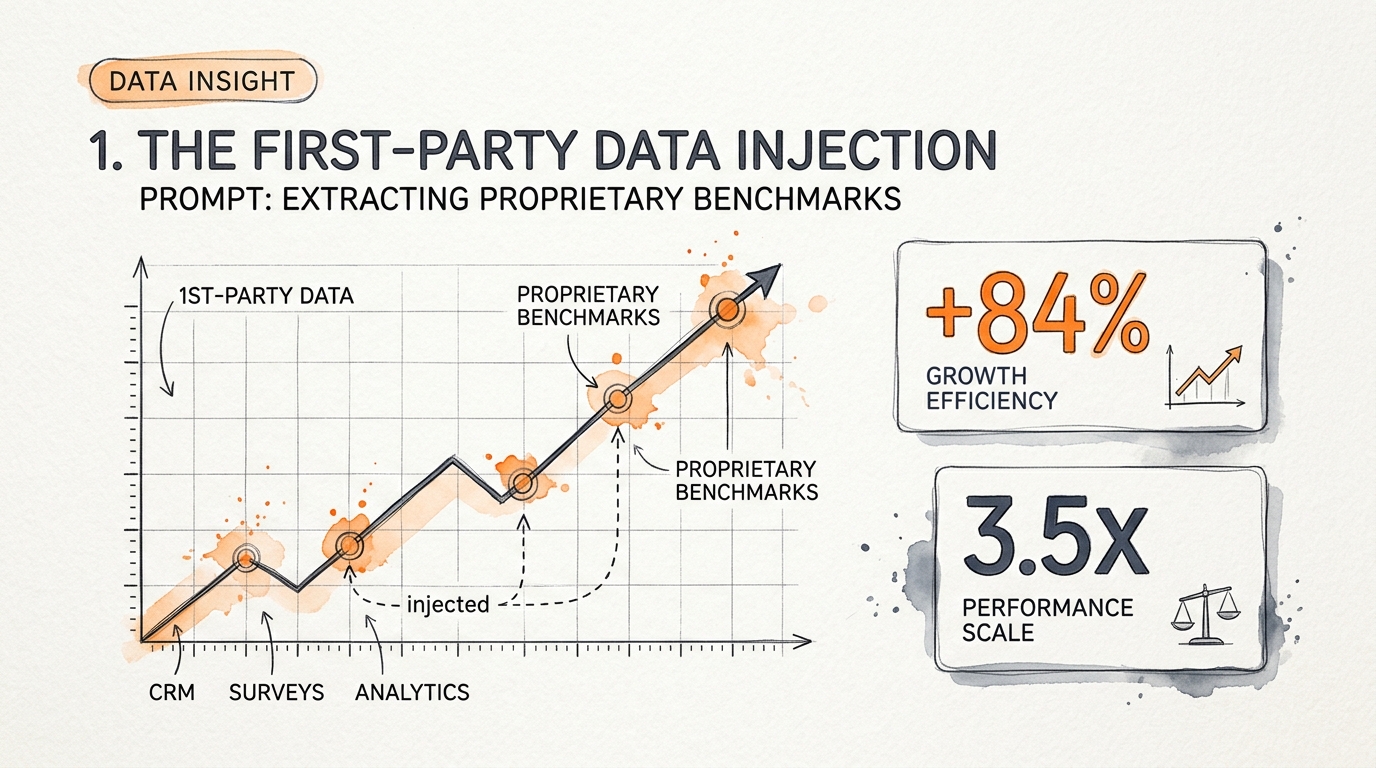
Most content pipelines suffer from an echo chamber problem. When you prompt a standard large language model to write about server latency benchmarks or customer churn rates, it scrapes its internal memory and returns the average of the internet. It hands you the exact same 5% to 7% annual churn statistic that five hundred other software blogs published this morning. Search engines recognize this instantly. They don't need another rephrased consensus piece; they prioritize material that introduces fresh, unindexed facts.
When running autonomous publishing workflows, deploying information gain prompts niche content engines rely on allows you to turn raw internal telemetry into defensible benchmarks. Instead of asking the model what the industry looks like, you hand it your actual database exports. It acts like an in-house statistician inspecting raw bank statements instead of an amateur guessing average grocery bills.
The video above walks through structural prompt frameworks that force language models into deterministic, analytical thinking patterns. Setting strict constraints prevents the model from lapsing into its default conversational style, which is essential when you need precise mathematical evaluation over generic summaries.
Deploying Information Gain Prompts for Niche Content Data Pipelines
Autonomous generation systems should never give the language model free rein to pull facts out of thin air. You must isolate the model inside your dataset. If you send messy product logs to an LLM without guardrails, it will smooth over the rough edges. It might round off anomalies or inject common industry stats to fill perceived gaps. As practitioners frequently note in Reddit data engineering communities discussing LLM extraction challenges, models love to guess missing values unless you strictly forbid assumptions.
To extract genuine search differentials, your prompt must force four specific behaviors:
- Boundary Isolation: Direct the model to discard public knowledge bases and answer solely from the injected array.
- Calculated Differentials: Demand that the model compute mathematical spreads, ratios, and interquartile ranges across your events.
- Outlier Identification: Force the model to flag the top 1% and bottom 5% deviations rather than averaging everything out.
- Contrarian Framing: Instruct the AI to explicitly name the prevailing industry rule of thumb and contrast it with the numbers in your data.
The Benchmark Extraction Directive
You are an empirical data researcher analyzing first-party product telemetry. DATASET INJECTION: """ [Insert JSON or CSV export of 5,000+ anonymous usage sessions / transaction logs] """ DIRECTIVES: 1. Treat the injected dataset as the single source of truth. Do not cite external benchmarks or general web estimates. 2. Calculate the true median, p90, and p99 values for [TARGET METRIC, e.g., API response times during failover]. 3. Identify three statistical anomalies where user behavior directly contradicts conventional best practices. 4. For each anomaly, calculate the exact percentage variance from the sample average. 5. Structure the output into three distinct sections: - "The Common Assumption" (What typical industry guides advise) - "The Observed Reality" (What our telemetry revealed with exact numbers) - "The Operational Impact" (Why this difference matters to an on-the-ground engineer) 6. Tone: Analytical, direct, and zero fluff. If a metric cannot be calculated directly from the rows, output 'DATA_NOT_FOUND' instead of estimating.
Running this directive changes the nature of your automated articles. Instead of publishing a fluff piece titled "How to Optimize Database Queries," your pipeline produces an empirical study: "Why 84% of Postgres Queries in Our 10,000-App Sample Failed on Index Scans." That is pure information gain. It gives search engines new entities, new measurements, and original relationships that didn't exist in the search index before.
| Prompt Factor | Generic Content Prompt | First-Party Injection Prompt |
|---|---|---|
| Data Source | Parametric training weights (web scrapes) | Isolated telemetry or internal warehouse tables |
| Search Engine Value | Zero (repeats prevailing SERP consensus) | High (creates new statistical facts) |
| Handling Outliers | Erases anomalies to sound sensible | Surfaces anomalies to explain friction points |
| Audience Trust | Low; reads like an entry-level overview | High; reads like an original engineering tear-down |
Pairing structured telemetry files with rigid system prompts turns your publishing engine into a research lab. You don't have to hire twenty consultants to survey thousands of companies. You already have real numbers hidden in your production logs, sales records, and support queues. Passing those raw numbers through focused prompts gives your articles the unique data edge they need to stand out.
2. The SERP Consensus Inversion Prompt: Challenging Outdated Niche Dogma
Most search results sound identical. Run a query for any specialized niche problem, and the top five results recycle the same three recommendations. When you automate content creation using standard scrapers, you inherit those identical conclusions. Large language models naturally drift toward the statistical mean. They predict the safest, most common answer based on their training data. That is catastrophic for organic visibility. Independent findings from Ahrefs' analysis of information gain show that modern search algorithms actively devalue pages that simply repeat existing search results along a user's research path. If your automated pipeline feeds top-ranking summaries directly into a standard drafting prompt, your page adds zero marginal value. It's just search engine clutter.
| Pipeline Dimension | Standard SERP Emulation | Consensus Inversion Pipeline |
|---|---|---|
| Input Ingestion | Extracts common headings and keywords to copy existing structure. | Scrapes top 10 results to isolate shared assumptions, blind spots, and stale methods. |
| System Prompt Goal | Synthesizes consensus advice into a broad, comprehensive guide. | Stress-tests consensus points against edge cases to build an evidence-backed antithesis. |
| Algorithm Response | Classified as redundant; achieves low visibility or gets dropped from AI snapshots. | Awarded high information gain; cited as a unique, complementary viewpoint. |
Executing Information Gain Prompts Niche Content Workflows Require
Breaking this consensus trap requires intentional prompting. In community forums exploring generative agents, such as r/NarrativeDynamics discussions on fictive scaffolding, practitioners note that language models cling tightly to established narratives unless explicitly ordered to break them. Models prefer harmony over tension. To surface genuine breakthroughs, your prompt must force the model out of its agreeable baseline.
Here is a field-tested prompt structure designed for ingestion-and-inversion workflows:
System Role: You are a principal technical auditor and contrarian researcher in [Insert Niche Discipline]. Your task is to critique prevailing industry advice that breaks down under pressure or fails to deliver real-world ROI.
Input Data: Below are summaries of the current top-ranking pages for the focus topic [Target Query]:
{{SERP_SUMMARIES}}Execution Directives:
1. Identify the three core assumptions that all input summaries accept without questioning (the "SERP Echo Chamber").
2. For each assumption, isolate a real-world scenario where following this advice causes operational bottlenecks, unexpected costs, or technical failure.
3. Construct a defensible alternative thesis that directly contradicts the mainstream consensus using technical first principles.
4. Provide clear compensatory steps: explain how a practitioner should navigate the trade-offs of using this non-consensus approach.Tone Constraints: Write with cold, measured authority. Avoid hyperbolic clickbait or contrarianism for its own sake. Every counter-argument must stand up to rigorous scrutiny by domain specialists.
Never ask the model to disagree just to be provocative. Sensational claims without technical merit destroy your site's authority. Ground every inversion in boundary conditions instead. Think of standard advice like driving on a flat, dry highway. It works well until a snowstorm hits. If every competitor says "Tool X is the most scalable choice," they almost always ignore what happens when query complexity triples or when API limits choke latency. That boundary condition is your competitive edge.
Programmatic pipelines handle this best when you split the workflow into two distinct steps. Rather than generating an entire article in one call, run a preliminary script via LangChain, LlamaIndex, or lightweight API scripts to extract the consensus profile first. Review or parse those extracted assumptions, then pipe them into the inversion step. This gives the model dedicated reasoning tokens to stress-test each claim before drafting final copy.
By implementing calculated information gain prompts niche content workflows stop repeating stale search results and start establishing original benchmarks. The search engine encounters distinct conceptual associations, unique examples, and novel trade-offs that do not exist elsewhere in its index. That original perspective builds an organic advantage that copycat competitors cannot easily steal.
3. How to Build Information Gain Prompts Niche Content Engines Need for Generative Search Dominance
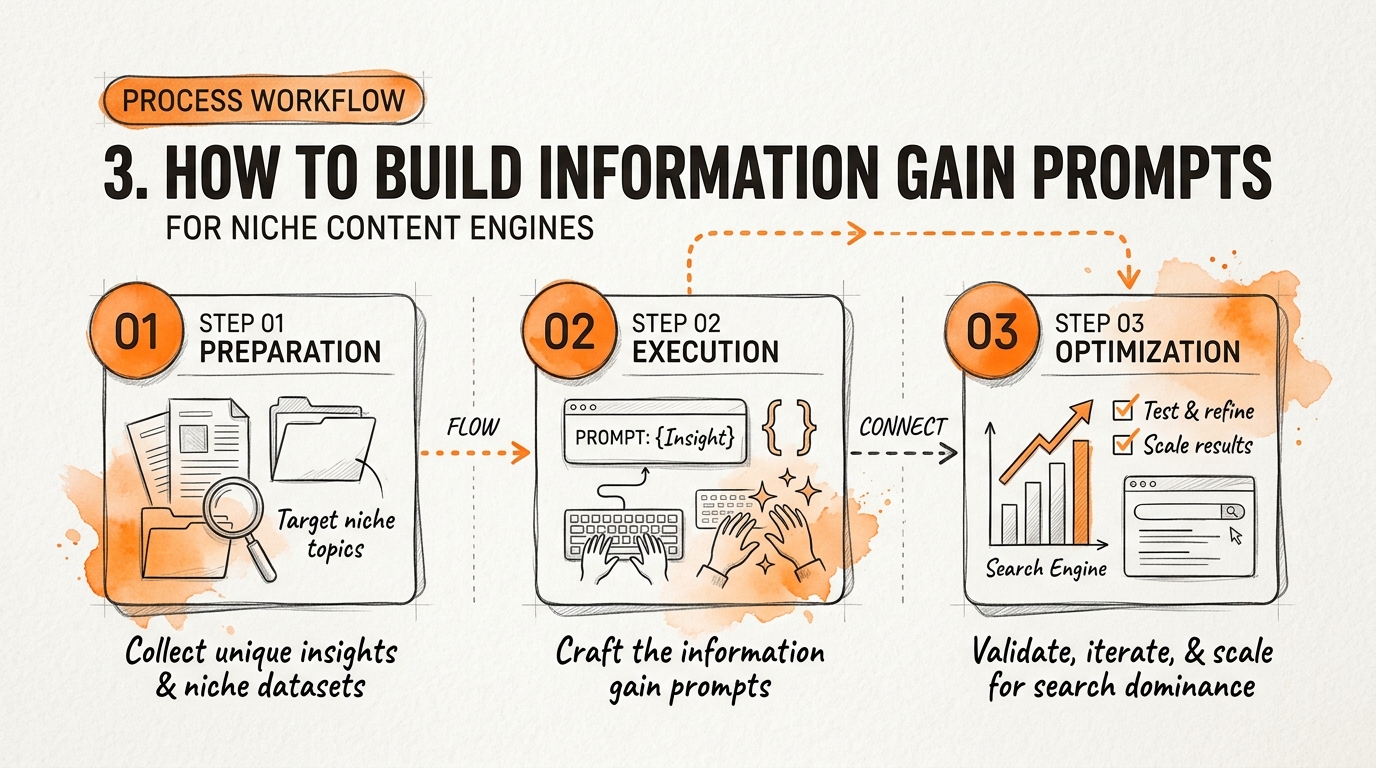
Most autonomous publishing setups fail because they ask an LLM to "write a comprehensive guide." That single command creates repetitive, consensus-heavy fluff. Generative search engines don't reward pages that repeat the common consensus. They reward the differential. If your engine doesn't inject net-new facts, AI engines treat your page as redundant noise.
Recent discussions on Generative Engine Optimization research reveal that AI answer engines prioritize content offering unique information over redundant summaries. Winning citations requires a deliberate pipeline. You have to feed models rare data and force them to connect distant concepts.
Engineering Information Gain Prompts Niche Content Engines Need
Designing information gain prompts niche content engines can scale requires moving away from the single "mega-prompt" myth. You cannot squeeze true originality out of a solitary, massive set of instructions. High-value generation relies on three interconnected mechanics:
- Programmatic Context Injection: Automatically pulling real-world database records, API logs, or user tickets into the prompt before generation begins.
- Variable-Chain Prompting: Passing output from an analytical prompt directly into a drafting prompt, rather than forcing the model to analyze and write simultaneously.
- Multi-Hop Reasoning: Forcing the AI to connect two separate, unlinked truths to create a novel conclusion your competitors haven't published.
Think of multi-hop reasoning like detective work. If you ask a rookie detective, "Who did it?", you'll get a guess based on surface clichés. If you break the investigation into hops—"Find every discrepancy in the train schedule," then "Match those gaps against employee shift logs"—the truth surfaces naturally. In niche publishing, multi-hop prompts force the model to pair your private system data with public industry conventions to reveal hidden friction points.
The agent architecture outlined above shows why autonomous execution matters. When moving toward enterprise scale, teams often debate between heavyweight frameworks like LangChain and lightweight custom Python scripts. While LangChain provides pre-built agent wrappers, custom Python orchestrators give technical teams tighter programmatic control over token budgets, raw API payloads, and prompt variables.
The Three-Stage Variable Chain
Autonomous systems should never write content on the first pass. Instead, run your generation through a strict sequential chain where each prompt accomplishes one focused task.
Stage 1: SERP Baseline Extraction
"Review the top three competitor summaries below. Extract their five primary shared claims. List what they omit regarding operational failure rates in high-throughput environments."
Stage 1 establishes the negative space. It maps what everyone else is saying so the engine knows what to avoid repeating. Without this guardrail, the model defaults to the mathematical middle of its training data.
Stage 2: Context Injection & Cross-Examination
"Take the extracted consensus omissions from Stage 1. Cross-reference them with the raw telemetry logs injected here: [DATABASE_PAYLOAD]. Identify the single largest operational bottleneck that contradicts the public consensus."
This is where information gain actually happens. The engine binds unindexed first-party context to the topical void identified in Stage 1. As noted in Similarweb's analysis on generative search scoring, the pages that secure persistent citations are those that supply measurable differentiation rather than standard rewrites.
Stage 3: Practitioner Synthesis
"Using the bottleneck discovered in Stage 2, draft a technical breakdown showing why standard implementations fail under load. Provide the precise configuration adjustments needed to bypass this constraint."
This final step converts raw analytical deductions into consumable, practitioner-grade editorial content. The output doesn't sound like a generic overview because it was never prompted to be one. It functions as an answer to a problem that existing search results haven't solved yet.
| Generation Strategy | Output Character | Generative Engine Value |
|---|---|---|
| Single Mega-Prompt | Aggregated consensus summaries | Low (Filtered as redundant) |
| Variable-Chained Injection | Defensible, data-backed anomalies | High (Indexed as novel citation) |
Building information gain prompts niche content platforms need isn't about finding clever phrasing or magical adjectives. It comes down to system design. Build deterministic pipelines that force models to evaluate real, private data against public claims, and your autonomous system will consistently outrank competitor clusters.
4. The Edge-Case Extraction Prompt: Surfacing Hyper-Specific Technical Failure Modes
Most top-ranking technical guides describe a world that doesn't exist. They paint a sunny picture where webhooks always fire on time, environment variables never collide, and third-party APIs process payloads instantly. When an engineer encounters silent thread pool exhaustion or unhandled socket timeouts, generic documentation leaves them stranded. Search engines know this. When every article on page one provides the exact same happy-path tutorial, the page that documents the messy failure modes wins.
Large language models naturally drift toward consensus. If you prompt an agent to write a deployment guide for Apache Kafka on Kubernetes, it will spit out standard YAML manifests copied from public repositories. It skips the memory leaks during partition rebalancing. It ignores volume detach errors that take down clusters during rolling updates. Digital publishers who want real organic authority must force their tools to hunt down these exact failure points.
Engineering Information Gain Prompts: Niche Content Edge Cases
Autonomous agents won't surface obscure bottlenecks unless you strip away their tendency to please the average user. Members of the prompt engineering community discussion on ChatGPT directives often emphasize eliminating conversational filler and using blunt, restrictive commands. You have to tell the model to actively break things.
Using disciplined information gain prompts niche content workflows requires a dedicated red-team agent. One agent creates the baseline guide, while a second agent acts as an aggressive systems auditor. The auditor's entire job is to poke holes, spot unhandled exceptions, and surface edge cases that typical search results ignore.
"Act as a Principal Infrastructure SRE. Review this deployment procedure for [Specific Software / Configuration]. Ignore basic setup commands. Identify the top three silent failure modes that produce no direct error codes but corrupt state or throttle throughput under heavy load. Detail the exact misconfigurations, memory pressure thresholds, and upstream dependency bugs that cause these failures."
This approach flips the agent's generative bias. Instead of summarizing the manual, the agent interrogates the system design. It extracts friction points that only seasoned practitioners usually know.
In this presentation on demand-driven context, Raj Navakoti illustrates how feeding agents real operational problems and studying where they break produces much sharper technical reasoning. Rather than feeding broad summaries, providing granular operational constraints forces the model to stop hallucinating generic fluff.
To see how this changes the resulting editorial output, consider how common B2B topics look before and after applying an edge-case extraction pass:
| Technical Topic | Generic Top-Ranking Content | Edge-Case Extraction Output |
|---|---|---|
| PostgreSQL Connection Pooling | How to install PgBouncer and set max_client_conn parameters. |
Transaction-level locking issues when combining prepared statements with session pooling modes. |
| HIPAA-Compliant Cloud Logging | List of AWS services covered under a standard Business Associate Agreement (BAA). | Accidental ePHI leakage via unmasked query strings in Elastic Load Balancer access logs. |
| Stripe Webhook Synchronization | Setting up a basic endpoint to receive invoice payment success events. | Handling out-of-order delivery during network partitions using idempotent Redis locks. |
The differences are night and day. The generic column tells readers what they already know from the first page of the vendor docs. The edge-case column saves an engineering team three days of debugging. That is the exact mechanism behind meaningful search differentiation.
Building high-performing publishing engines depends on feeding autonomous models the right friction points. When you apply multi-agent prompting techniques—as demonstrated in recent AI community experiments on multi-agent debate—you turn routine content production into an active discovery engine. One model generates the technical framework, another attacks it with weird failure cases, and the final output answers questions your competitors didn't even think to ask.
By forcing autonomous workflows to isolate silent bugs, configuration drift, and regulatory blind spots, your site turns into an indispensable reference. Readers bookmark the page because it solved their real-world mess, and algorithms reward the piece for contributing net-new value to the topic graph.
5. The Practitioner Trade-Off Prompt: Simulating Real-World Execution Constraints
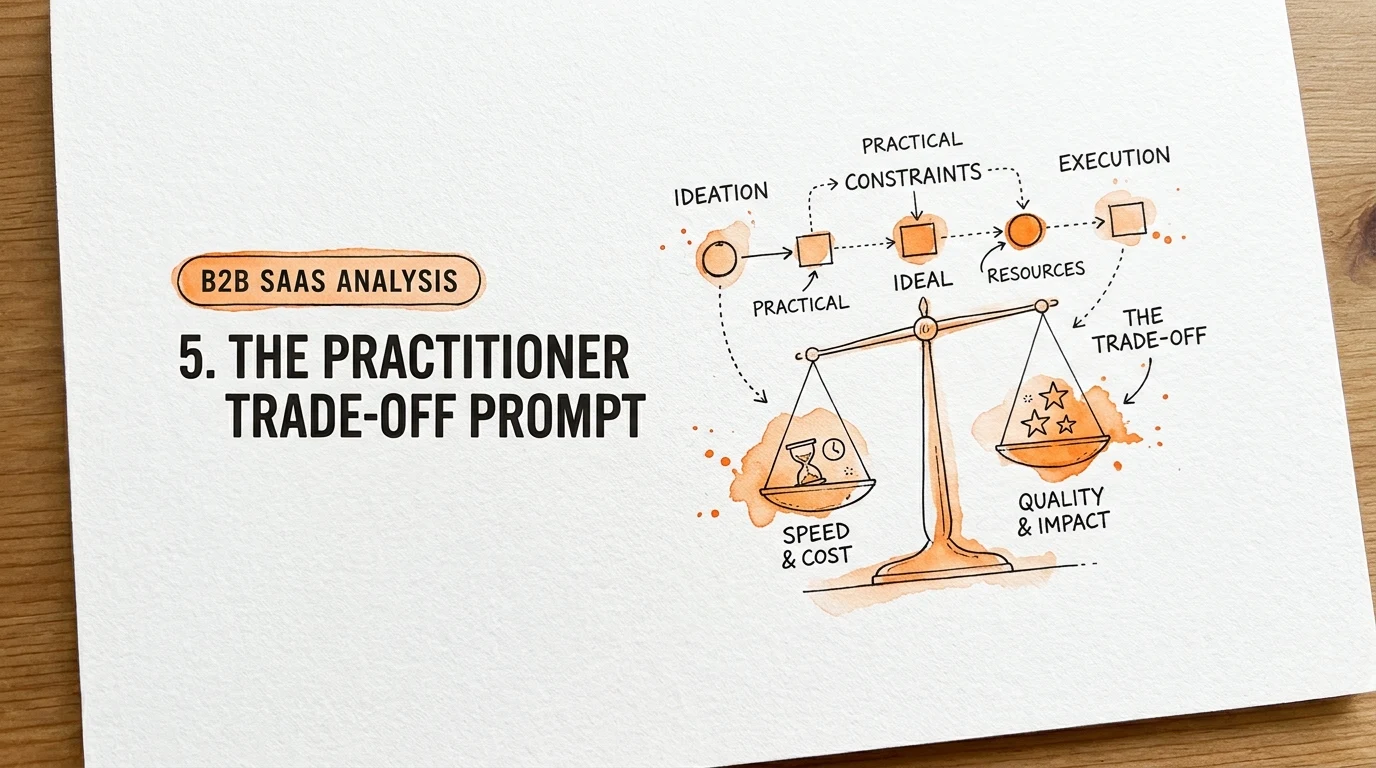
Standard language models live in a utopian bubble. Ask an AI how to scale enterprise data pipelines or migrate identity management systems, and it hands you an idealized playbook. It assumes you have unlimited capital, perfect cross-department teamwork, and clean greenfield architecture. In the real world, projects hit messy roadblocks immediately.
Every senior practitioner knows that actual execution is a balancing act of compromises. You pick between tool costs and engineering hours. You weigh lightning-fast delivery against strict compliance audits. If your articles only share textbook advice, seasoned operators bounce immediately because they can spot theoretical fluff from a mile away. As engineers pointed out in a community debate on role prompt limitations, telling a model to simply "act like an expert" yields hollow suggestions unless you force it to own the risks, negative outcomes, and limits of its recommendations.
Designing Information Gain Prompts Niche Content Demands for Complex Workflows
To produce undeniable authority, your prompts must shatter the illusion of frictionless deployment. You need a system prompt that models realistic friction: shrinking budgets, legacy codebases, and pushback from internal stakeholders. We call this the Practitioner Trade-Off framework.
When you feed these real-world pressures into your workflow, the output instantly shifts from shallow summaries to field-tested tactics. Search engines reward this original perspective, while readers get real answers to hard implementation problems.
Understanding these foundational constraints turns standard model queries into production-grade systems, as explained in this breakdown of prompt engineering fundamentals. By asking your models to balance real constraints, you unlock operational nuances that surface-level prompts simply skip.
The Anatomy of a Trade-Off Simulation Prompt
To ground your generation in real operational environments, structure your instructions around three conflicting boundaries:
- Hard Resource Caps: Cap the operational budget, tooling licenses, or developer hours. This stops the model from always suggesting high-ticket SaaS tools.
- Compliance and Security Guardrails: Introduce non-negotiable barriers, such as SOC 2, HIPAA, data isolation rules, or strict bans on third-party API data sharing.
- Organizational Pushback: Simulate real friction, like security teams stalling software procurement or sales teams rejecting complex interface updates.
Structuring your prompt with declarative XML tags forces the language model to systematically evaluate competing priorities, an approach highlighted in modern structured prompt engineering techniques.
Example Prompt Template:
<context>
You are advising a Lead Cloud Architect at a 400-person fintech firm migrating payment event logs to an audit-ready store.
</context>
<constraints>
- Total infrastructure expansion budget cannot exceed $1,800/month.
- Data cannot leave VPC boundaries; third-party managed SaaS collectors are strictly vetoed by InfoSec.
- The solution must be maintained by two junior DevOps engineers without dedicated SRE support.
</constraints>
<task>
Provide three viable architectural choices. For every option, describe what we sacrifice in performance or developer speed, explicitly state where the design breaks under heavy load, and explain why the security team might still object.
</task>
Notice the change in perspective. Instead of receiving a boilerplate pitch to buy Snowflake or Datadog, you get an honest look at running lightweight vector queues, local ClickHouse clusters, or cold S3 storage pools.
Comparing Output Depth: Theory Versus Grounded Reality
The difference between standard text generation and a constraint-driven response is immediate. One reads like a generic software brochure; the other sounds like a battle-tested post-mortem written by someone who has lived through the deployment.
| Evaluation Vector | Standard Role Prompt | Practitioner Trade-Off Prompt |
|---|---|---|
| Vendor Selection | Recommends market leaders without asking about price or vendor lock-in. | Weighs self-hosted open-source tools against managed services, highlighting maintenance overhead. |
| Risk Analysis | Lists generic risks like "ensure staff are properly trained." | Identifies specific breaking points, like data bottlenecks during morning traffic spikes. |
| Implementation Steps | Offers high-level linear checklists that assume zero friction. | Details rollback strategies, phased runbooks, and ways to handle team disputes. |
Applying genuine limits forces language models to share trade-offs that web scrapers routinely miss. Crafting systematic information gain prompts niche content engines require doesn't mean writing longer instructions. It means setting real-world boundaries that strip away fluff and leave only practical, authoritative advice.
6. The Semantic Gap-Filling Prompt: Mapping Uncovered Entity Relationships
Most pages ranking on Google say the exact same thing using slightly different words. When five competing guides all explain how to service an industrial air compressor, they mention the exact same terms: oil levels, air filters, belt tension, and power switches. They stay on the well-trodden path. If your automated pipeline simply rewrites those top ten results, it delivers zero new value to a reader or a search engine.
You can break this cycle by mapping semantic gaps. Think of a niche topic as a subway system. The top-ranking competitors always visit the five central stations. A domain knowledge graph, however, shows dozens of outer stations and transfer tracks that competitors skipped completely. By cross-referencing SERP entity coverage against an authoritative knowledge graph, your system can identify missing connection points—known as semantic nodes—and force the writer to link them.
Engineering Information Gain Prompts for Niche Content Gaps
When autonomous pipelines rely on standard prompting, language models default to majority consensus. They predict the most statistically probable words, which naturally yields the same vanilla content as everyone else. Using targeted information gain prompts niche content workflows can systematically connect underreported technical relationships that generalist writers overlook.
A frequent hurdle for builders is making these abstract connections clear. As community members noted in n8n automation threads on Reddit, identifying why an answer engine cites one competitor over another comes down to running a systematic semantic gap analysis. Without a clear map of what entities are missing, the generator has no instructions to build those bridges.
To automate this, your system needs to extract entities across two different datasets before generating any copy:
- The SERP Baseline: Scrape the top five organic competitors and run their text through an entity extraction model to pull out all recognized technical components, standards, and vendor names.
- The Domain Knowledge Graph: Query an external knowledge base like Diffbot Knowledge Graph or open repositories like Wikidata to retrieve the full web of related entities (parents, children, and attributes) tied to your primary subject.
Subtracting the SERP baseline from the domain graph reveals the semantic gap: real, verified entities that zero competing articles bother to explain.
Translating Node Gaps into Execution Directives
Once you locate missing entities, you don't just dump them into a keyword list. You need to prompt the AI to explain the exact functional relationship between those orphaned nodes and the central topic. Here is how that translates into a production prompt block:
System Role: Technical Domain Specialist
Input Context: Primary Topic: Industrial Screw Compressor Thermal Tripping.
Competitor Baseline Entities: [Oil cooler, ambient temperature, thermostat valve, airflow blockage].
Target Semantic Gap Entities: [Varnish deposit formation, ISO VG 46 degradation, thermal imaging thermography].Generation Rule: The draft must directly connect at least two Target Semantic Gap Entities to a failure state described in the Baseline. Explain the chemical or physical mechanism causing this connection. Do not mention that these terms were missing from competitors; integrate them as essential operational troubleshooting steps.
When choosing an extraction backend, evaluate the depth of your niche. The Google Knowledge Graph Search API works well for general business entities and high-level concepts, while specialized tools like Diffbot excel at extracting unorganized web data into clean relationship pairs without manual schema cleaning.
By using structured information gain prompts niche content engines move past surface-level summaries. Your content earns higher organic visibility because it provides search engines with fresh entity relationships they cannot find anywhere else on page one.
The Future of Autonomous Publishing: Securing Defensible Organic Moats
The web is drowning in machine regurgitation. Baseline language models read from the exact same open-web training data, producing smooth, interchangeable articles that state the obvious. Zero-click search updates aren't an accident. They're the natural endpoint when fifty different blogs answer a query using the exact same generic phrasing. If your autonomous publishing setup only reorganizes common knowledge, you're building on quicksand.
Real authority comes from what happens away from public scraping bots. In a recent community discussion on defensible AI strategy, practitioners pointed out that contextual, first-party data is the single most defensible barrier against generic generative outputs. Algorithmic systems must feed on real-world friction. That means pulling from support tickets, proprietary performance telemetry, failed implementations, and contrarian test results. Without those inputs, autonomous systems trap themselves in a feedback loop, endlessly summarizing summaries.
Operationalizing Information Gain Prompts Niche Content Workflows
Publishing teams have to look past basic prompt engineering. You need automated discovery loops built directly into your production pipelines. Embedding algorithmic information gain prompts niche content engines rely on transforms autonomous publishing from a risky volume play into a defensible moat. Instead of telling a model to produce a complete guide, your retrieval architecture forces it to isolate negative constraints, surface counter-intuitive edge cases, and run sanity checks against live search results before drafting a paragraph.
Compare standard bulk generation tools with differential evaluation platforms. Workflows utilizing Inscribe's algorithmic gain scoring model evaluate new drafts against top-ranking SERP documents to calculate the delta of net-new information prior to indexing. Pairing differential scoring with local, retrieval-augmented prompt sequences prevents automated systems from publishing derivative filler. If a draft doesn't inject new evidence or challenge an outdated industry assumption, the workflow flags it for revision. You don't waste crawl budget on consensus answers.
The road ahead requires technical discipline. Raw volume won't save you. Winning agencies won't be the ones running hundreds of uncalibrated scraper sites. The market will reward focused operators who treat their autonomous pipelines as investigative filters rather than automated printing presses. By hardcoding information gain prompts niche content systems into everyday workflows, digital publishers turn everyday field experience into permanent search visibility. Generative search engines won't be able to bypass your pages, because they'll need your data points to complete their answers.
