KoalaWriter vs Agility Writer: Which Tool Is Better?
The days of manual prompt gymnastics inside generic chatbots are over. Digital publishers and niche site builders face an unforgiving search landscape where thin drafts get crushed. In the head-to-head battle of KoalaWriter vs Agility Writer, webmasters want to know which tool is better at delivering hands-off rankings without sacrificing editorial quality. You need software that can research the live web, cite current data, and build comprehensive articles without making up facts.
That creates a real headache for site owners. As creators pointed out in Reddit discussions on search ranking risks with AI content, unvetted outputs often invent fake details that wreck your domain's credibility. The AI boom didn't kill good publishing; it made average articles cheap and common. When your drafts sound identical to thousands of competing blogs, search engines simply ignore them. Today's competitive niches demand real-time web analysis, semantic entity coverage, and automated internal links that mimic human editorial standards.
Both platforms promise an autonomous content pipeline, yet their underlying philosophies take different paths. KoalaWriter focuses on speed, clean user experience, and one-click integrations that push finished posts straight to WordPress or Shopify. Agility Writer approaches the task with deep algorithmic control, giving you advanced outline customization, surgical SERP scraping, and dedicated multi-source research modes. Choosing between them isn't about finding a magic button. It's about matching your editorial workflow to the right automation style.
To see how these two platforms handle real-world workflow setups and content generation, check out this hands-on video comparison:
Evaluating KoalaWriter vs Agility Writer requires peeling back the marketing claims to inspect actual token economics, entity density, and factual reliability. Whether you run a high-volume affiliate network or manage client growth at a digital agency, picking the right engine sets your publishing ceiling for the year ahead.
Table of Contents
- Core Architectural and Methodological Differences
- Real-Time SERP Scraping and Fact-Checking: How Both Engines Prevent Hallucinations
- Content Depth and Entity Optimization: Analyzing On-Page Semantic Relevance
- Automation at Scale: Comparing Bulk Mode, Internal Linking, and Direct CMS Publishing
- Credit Consumption and Pricing Efficiency: Calculating True Cost Per Long-Form Article
- Which Tool Fits Your Workflow? Matching Publishing Models to the Right Engine
- Final Verdict: Choosing the Optimal Autonomous Content Engine for Organic Traffic
KoalaWriter vs Agility Writer: Core Architectural and Methodological Differences
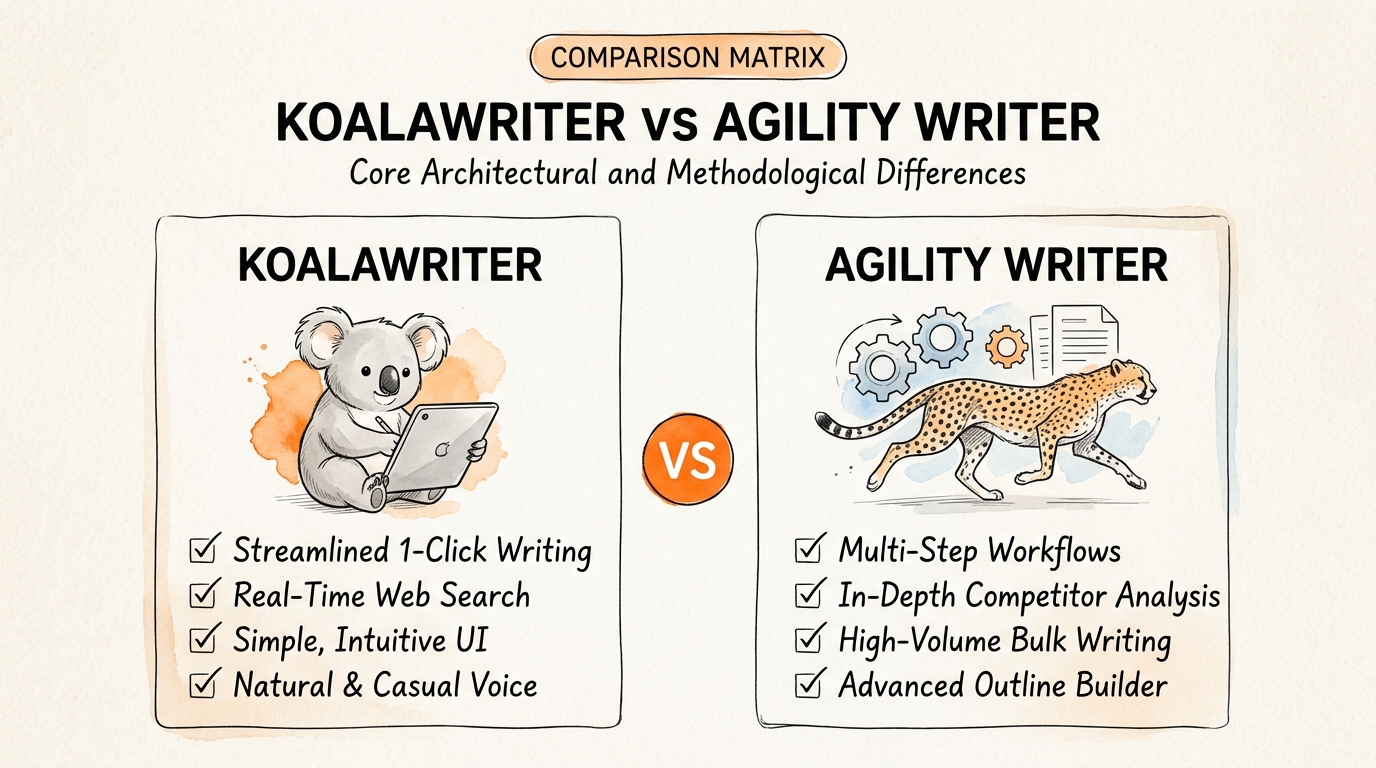
Every software platform carries the DNA of its creator's philosophy. When you pit KoalaWriter vs Agility Writer, you aren't just comparing two text generators that call language model APIs. You are choosing between two wildly different software designs. One treats article creation as a fast, single-pass sprint. The other treats it like a multi-stage manufacturing line.
This contrast mirrors the classic creative debate between "architects" and "gardeners," a topic often highlighted in the Reddit debate on architect versus gardener writing approaches. Architects plan every steel beam before pouring concrete. Gardeners plant seeds and prune as things grow. KoalaWriter gives you the speed and fluidity of a gardener. Agility Writer forces you into the rigid, metric-driven drafting room of an architect.
KoalaWriter vs Agility Writer: The Pipeline Architecture Breakdown
KoalaWriter was built to eliminate friction. Its interface is clean, minimal, and linear. Under the hood, Koala uses a streamlined execution pipeline. You enter a target keyword, pick your AI model, select a few toggle switches for point of view and real-time search, and hit generate.
The system maps your prompt against a pre-tuned template, queries the web if enabled, drafts a logical heading structure, and streams the output directly to your screen. The whole cycle runs in a single continuous process. It feels fast because it is fast. You don't get bogged down in twenty configuration menus before seeing your first sentence.
Agility Writer takes the exact opposite engineering stance. It avoids single-pass generation completely. Instead, it uses an asynchronous, multi-step pipeline built to assemble data-heavy pages section by section. When you request an article in Agility Writer, the engine does not just start writing. It fires off multiple independent micro-tasks:
- SERP Scraping & Entity Extraction: The platform inspects the top twenty search results for your term, pulling common subtopics, search intent signals, and latent semantic terms.
- Modular Outline Synthesis: It presents a dense structural canvas where you can swap, add, or customize individual headings based on competitor data.
- Chained Prompt Generation: Rather than feeding a massive prompt into a single API call, Agility Writer loops through headings one at a time. It feeds distinct context, token limits, and entity requirements into each individual section before stitching them into a unified draft.
The video above walks through the interface differences between both engines, highlighting how their workflows diverge from the very first click.
Single-Pass Stream vs. Asynchronous Workflows
The visual experience of using both platforms highlights their structural differences. In KoalaWriter, you experience immediate gratification. Text streams onto the canvas live, much like interacting with ChatGPT or Claude. If you see a heading you don't like, you can edit it immediately or pause the generation. It suits publishers who produce volume quickly and prefer editing the final draft inside their content management system.
Agility Writer runs silently in the background. Because it performs several web scrapers and chained API calls for every heading, it doesn't stream live text. You submit your project to a generation queue, step away to grab a coffee, and wait for the platform to process the multi-stage pipeline. It takes anywhere from five to fifteen minutes per article depending on your settings.
| Feature | KoalaWriter | Agility Writer |
|---|---|---|
| Generation Pipeline | Single-pass, streaming API execution | Modular, multi-step asynchronous batching |
| Time to Output | 60 to 120 seconds | 5 to 15 minutes |
| User Control Level | High-level macro toggles (tone, POV, model) | Granular micro-tuning (per-heading parameters) |
| Ideal User Mindset | Agile editor who wants fast baseline drafts | Systematic publisher who wants exhaustive outlines |
Workflow Friction: How Much Control Do You Actually Need?
The battle between these two philosophies comes down to where you want to spend your time. Do you want to configure the article before it's written, or clean it up after it's produced?
Agility Writer appeals to technical site builders who distrust AI when left to its own devices. By breaking down the generation into smaller chunks, the software keeps the language model focused on specific sub-questions. This cuts down on repetitive phrasing across sections. If an article needs eighty specific product specs or exact semantic entities, Agility's modular assembly guarantees they end up in the text.
The downside? Cognitive fatigue. Setting up an advanced article run in Agility Writer requires clicking through multiple drop-downs, competitor lists, and factual toggles. For publishers running lean teams, that extra friction slows down publishing velocity.
KoalaWriter trades deep configuration for raw speed and natural cadence. By letting the model handle the broader narrative arc in one continuous prompt, the prose often flows better. Transitions between paragraphs feel less robotic because the system sees the entire context in a single active window. It gives up some fine-grained heading control to give you an intuitive, stress-free writing experience.
Real-Time SERP Scraping and Fact-Checking: How Both Engines Prevent Hallucinations
AI models love to pretend. If an algorithm doesn't know the exact battery life of a camera released last Tuesday, it simply invents a believable number. That habit ruins credibility. When you publish affiliate roundups or breaking industry news, inaccurate facts destroy visitor trust and burn affiliate commissions. Both platforms tackle this flaw by anchoring their language models to live web data.
Instead of relying purely on static training weights, both engines use live search retrieval. Think of this process like giving a student an open-book test instead of forcing them to memorize an entire library. The software queries search engines, reads top-ranking pages, extracts relevant snippets, and feeds those facts directly into the prompt context.
To see how these scraping workflows play out in real time across actual rank-tracking campaigns, the side-by-side test above shows how both tools pull information under competitive search conditions.
Live Data Scraping: KoalaWriter vs Agility Writer in Action
The technical differences between these two engines become obvious when you examine how they gather information. When comparing KoalaWriter vs Agility Writer on factual research, you are looking at two distinct architectural philosophies for search retrieval.
KoalaWriter uses a lightweight, agile approach. When you toggle on its real-time search feature, it performs targeted Google queries in the background. It quickly scans the top results, extracts matching factual blurbs, and weaves them straight into the article draft. The process is remarkably fast. You can publish a 2,500-word guide in minutes with fresh news, current event dates, and newly released product names. However, because Koala prioritizes speed, it occasionally skims over granular technical specifications tucked deep inside complex comparison charts.
Agility Writer takes the opposite route by operating like an exhaustive research assistant. It crawls the top search engine results page (SERP) competitors deeply, scraping headers, content bodies, and product data across as many as 20 distinct URLs. An independent analysis from WordsAtScale highlighted that Agility Writer's web scraping engine excels on research-heavy articles where technical precision is non-negotiable. It pulls exact dimensions, port types, pricing tiers, and release dates straight into structured comparison tables.
| Scraping & Verification Capability | KoalaWriter | Agility Writer |
|---|---|---|
| SERP Depth | Fetches key snippets from top search hits | Deep scrapes up to 10–20 competitor pages |
| Generation Speed | Extremely fast (1 to 3 minutes) | Deliberate and slower (5 to 12 minutes) |
| Source Citing | Contextual links and trailing source list | In-text citations and exact reference anchors |
| Hallucination Defense | Strong for general facts and fresh news | Elite for product specs, pricing, and tables |
Many publishers turn to automated generation because manual scraping is tedious. But search engines frequently flag generic AI text that gets basic facts wrong. On online forums, content creators regularly vent that raw search summaries often break down when answering detailed product queries without manual intervention. Agility Writer combats this by grounding its outline generation inside verifiable competitor data before drafting a single sentence.
Source attribution is another area where the platforms diverge. KoalaWriter provides a simple switch to enable source links. It adds external markdown links to prominent claims, giving readers a pathway to check your statements. It also bundles a clean source list at the bottom of the article if you want full transparency.
Agility Writer treats citations as an on-page authority signal. Its "Factual Data" toggle forces the model to cite the exact competitor domains it gathered the information from. If it states that a software subscription costs $49 per month, it anchors that number directly to a working URL. You don't have to spend thirty minutes opening multiple browser tabs to confirm whether the software actually has an export button or a dark mode toggle. The engine leaves an audit trail right in your CMS draft.
If your editorial calendar centers on lifestyle essays, digital marketing concepts, or general informational guides, KoalaWriter gathers plenty of context without slowing down your production flow. If you build affiliate roundups comparing complex hardware, enterprise software, or supplement formulations, Agility Writer provides the deeper data buffer needed to stop embarrassing factual blunders before they reach your site.
Content Depth and Entity Optimization: Analyzing On-Page Semantic Relevance
Search engines don't read articles like raw lists of keywords anymore. They treat topics like interconnected webs of facts, names, and concepts called entities. Think of an entity like a guest at a dinner party. You don't just repeat their name; you talk about their job, where they live, and the friends they brought along. If an AI writer drops your target keyword twenty times without mentioning related terms, search engines know the piece lacks real substance.
Agility Writer takes a structured, computational approach to this problem. When you submit a topic, it scrapes up to twenty top-ranking competitor pages to extract search terms, relevant questions, and natural language processing (NLP) entities. It builds dense heading structures that cascade through H2, H3, and H4 tags to ensure every semantic angle is covered. The result is an expansive long-form draft—often running between 3,500 and 5,000 words—that scores exceptionally well in on-page content optimization tools straight out of the gate.
KoalaWriter approaches semantic relevance through a different philosophy. Through Koala's automated search analysis, the platform inspects live search results to pull related entities, but it balances those terms against human readability. It weaves concepts into fluid paragraphs rather than forcing them into awkward list items. The draft reads like an experienced blogger wrote it. However, because it prioritizes readability, drafts usually land closer to 2,000 to 2,500 words and might skip secondary sub-entities unless you manually add them to your outline.
Semantic Footprints: KoalaWriter vs Agility Writer in NLP Coverage
In a direct assessment of KoalaWriter vs Agility Writer, your choice comes down to whether you prefer automated depth or natural phrasing. Both platforms handle search signals well, but they require different types of post-generation cleanup.
| Optimization Factor | KoalaWriter | Agility Writer |
|---|---|---|
| Entity Extraction Method | Analyzes top SERP results and blends primary entities into standard conversational flow. | Scrapes 10–20 competitors, pulling comprehensive NLP entity lists and question clusters. |
| Heading Architecture | Lean, targeted H2/H3 structures tailored to immediate user intent. | Deep, multi-layered H2, H3, and H4 hierarchies designed for exhaustive topic coverage. |
| Average Raw Word Count | 1,800 – 2,800 words | 3,500 – 5,500+ words |
| Primary Post-Editing Need | Injecting missing micro-entities and expanding secondary sub-topics. | Trimming repetitive sections and smoothing robotic keyword phrasing. |
As practitioners noted in a Reddit discussion on semantic entity mapping, modern algorithms care about how well you answer search intent, not just how many words you dump on a page. When using Agility Writer, you get unmatched topical completeness. It covers rare edge cases and competitor questions automatically. The catch is voice. Sentences can feel stiff because the engine works hard to clear an entity quota. You'll spend editing time cutting fluff and making sentences sound natural.
With KoalaWriter, the editing phase is reversed. The text sounds engaging on page one. You won't have to rewrite clunky paragraphs or fix odd sentence structures. Instead, you'll need to double-check your content score against your target keyword list. If your topic demands deep coverage of obscure technical specs, you must manually guide Koala's outline editor beforehand so it doesn't leave those entities behind.
Heading Hierarchies and Search Intent Resolution
Heading depth dictates whether your article actually solves the user's problem. Agility Writer builds outlines with an encyclopedic approach. If you ask it to produce a buying guide, it generates product roundups, side-by-side spec tables, testing criteria, pros and cons lists, and comprehensive buyer FAQs. It anticipates every potential question a user might have before they bounce back to the search results.
Agility Writer focuses on breadth and structural completeness out of the box, while KoalaWriter zeroes in on direct, conversational answers that satisfy specific search queries quickly.
KoalaWriter focuses heavily on immediate intent. If someone searches for a step-by-step troubleshooting guide, Koala gets straight to the solution. It skips tedious background history and answers the query directly, which makes it particularly effective for capturing Google featured snippets. For broad commercial queries where top-ranking pages must cover dozens of sub-angles, Agility Writer provides superior structural depth without requiring you to manually build out the skeleton first.
Automation at Scale: Comparing Bulk Mode, Internal Linking, and Direct CMS Publishing
Publishing fifty articles a month by hand wears you out. When you run content sites at scale, the real bottleneck isn't typing words. It's the tedious setup: pasting drafts into your editor, hunting for relevant internal links, uploading images, and tweaking metadata. A high-volume AI generator needs to handle the heavy lifting while you focus on editorial review.
When measuring KoalaWriter vs Agility Writer on raw operational plumbing, both platforms offer automated pipelines, but they approach high-volume output with very different philosophies.
To see how the user interfaces handle queueing and article setup in real time, this walkthrough contrasts the operational speed and layout between both platforms.
Bulk Workflow Efficiency: KoalaWriter vs Agility Writer in Action
Bulk generation turns keyword spreadsheets into live web pages. If a system crashes mid-batch or requires thirty clicks per article, running mass campaigns falls apart.
KoalaWriter treats bulk generation like an assembly line. You paste a list of target queries, pick your base model (such as GPT-4o or Claude 3.5 Sonnet), select article length, and hit start. The platform queues the articles in the cloud and writes them concurrently. A batch of twenty articles often finishes in under fifteen minutes. It's clean, fast, and rarely requires you to fiddle with individual outlines unless you want manual control.
Agility Writer approaches bulk mode with an obsession for granular structure. Instead of running a quick pass, its bulk mode lets you upload a CSV with specific titles, custom target headings, siloing directions, and anchor texts. Because Agility Writer scrapes search results in multi-stage cycles for each heading, generating a large batch takes considerably longer. You get dense, research-heavy drafts, but you trade away raw turnaround speed.
Solving the Internal Linking Headache at Scale
Manual internal linking is often the first process to break as a website grows. Site builders frequently turn to forums asking the exact same question found in this TechSEO community discussion on internal linking workflows: how can you connect articles automatically without messy plugins slowing down the site?
KoalaWriter solves this through direct sitemap integration and custom URL lists. You give KoalaWriter your domain's XML sitemap or paste a list of existing post URLs. As the engine writes the draft, it scans for natural contextual opportunities to link out to those targets. The anchor texts feel conversational rather than forced, inserting links directly into body paragraphs where they fit the reading flow.
Agility Writer uses a hierarchical siloing algorithm. Rather than scanning an entire sitemap and picking targets freely, it lets you map out parent-child relationships before writing begins. If you are building a strict topic cluster, Agility ensures supporting posts link upward to pillar content and laterally to related sub-topics. As highlighted in Agility Writer's platform comparison breakdown, this structural rigor mirrors manual site-architecture planning, keeping link equity confined within relevant silos.
| Capability | KoalaWriter | Agility Writer |
|---|---|---|
| Batch Generation Input | Keyword lists, presets, bulk prompts | CSV imports, custom heading templates |
| Linking Strategy | Sitemap scraping, contextual text matching | Strict cluster siloing, mapped parent-child rules |
| Native CMS Destinations | WordPress, Shopify, Ghost, Webhooks | WordPress (REST API & Plugin), Webhooks |
| Generation Speed per Batch | Rapid parallel processing (minutes) | Staged sequential processing (slower, deeper) |
Direct CMS Publishing and Hands-Free Scheduling
Generating content doesn't help if articles stay trapped inside the tool's dashboard. A truly autonomous content pipeline must push finished drafts directly into your content management system with proper styling, images, and category assignments.
KoalaWriter connects natively to WordPress and Shopify, along with Ghost and custom endpoints via webhooks. When publishing to WordPress, you can tell Koala to set posts as drafts or schedule them out across specific intervals. It auto-assigns tags, picks categories, and inserts AI-created featured images directly into the WordPress media library with descriptive alt tags.
"The ideal automation pipeline runs so quietly that your only editorial task is opening WordPress drafts to confirm factual flow before hitting publish."
Agility Writer focuses its native integration heavily on WordPress. It pushes formatted headings, tables, YouTube video embeds, and generated featured images straight to your install. It also lets you set publishing cadence rules, staggering post dates so fifty bulk-generated articles drip into your archive over several weeks instead of flooding the index all at once.
If your sites live strictly on WordPress and demand rigid topic-silo linking, Agility Writer provides the deeper structural framework. If you run multiple properties across WordPress and Shopify and need lightning-fast batch production with automated sitemap linking, KoalaWriter delivers the smoother, lower-friction workflow.
Credit Consumption and Pricing Efficiency: Calculating True Cost Per Long-Form Article
Sticker prices in the AI content space rarely tell the whole truth. When looking at KoalaWriter vs Agility Writer, evaluating nominal sticker prices without factoring in underlying compute usage gives a distorted picture of production costs. A platform might advertise tens of thousands of words for pocket change, but hidden multipliers quickly eat into that pool once you turn on web crawling and premium reasoning models.
Every publisher needs a clear picture of what a finished, publish-ready draft actually costs. If you run a high-volume site, a discrepancy of two dollars per post balloons into thousands over a single quarter.
The breakdown video above highlights the economic realities of running automated writing platforms at production scale. Let's look under the hood at how both tools meter compute resources.
Token Expenditure and Credit Rules in KoalaWriter vs Agility Writer
KoalaWriter bills users based on generated word counts, but that count shifts depending on the engine you select. If you stick with basic settings using GPT-4o mini, one word equals one word deducted from your quota. The moment you switch to GPT-4o or Claude 3.5 Sonnet to secure natural phrasing, Koala applies a heavy consumption multiplier. Running Claude 3.5 Sonnet with deep web search enabled can drain between 2.5 and 5 times the base word rate.
Agility Writer abandons the word-counting model entirely, opting for fixed task credits. A simple short-form run costs a single credit, while their Advanced Mode and Smart Outline workflows consume anywhere from 2 to 4 credits. These higher-tier modes perform real-time SERP extraction, scrape competitor headings, and run multi-step prompt chains.
"When a platform lets you toggle between foundational models, you aren't just paying for text. You're funding recursive prompt iterations and live data retrieval cycles behind the scenes."
As users frequently point out in the Reddit debate on AI subscription subsidies, heavy API utilization carries steep token charges that SaaS platforms must pass down. Agility Writer absorbs that complexity by charging a flat credit fee for an entire generation workflow, regardless of whether the final output lands at 2,200 words or 3,100 words.
Rollover Terms and Burn-Rate Volatility
Billing mechanics dictate how much cash you lose during quiet weeks. What happens to your balance if you take time off from publishing?
- KoalaWriter: Standard subscription allowances reset on every billing cycle. If you buy a plan with 100,000 words and only produce three articles, the unused balance vanishes at month's end. To build a permanent reservoir, you must buy separate pay-as-you-go credit packs at higher unit rates.
- Agility Writer: Subscriptions feature full credit rollover policies. As reported in official Agility Writer comparison data, any unused credits stay in your account as long as you keep your plan active. This rollover eliminates the pressure to publish artificial filler merely to preserve your monthly quota.
If your editorial calendar runs in bursts, Agility Writer provides a financial cushion. You bank credits during research phases and spend them when you're ready to deploy clusters. KoalaWriter operates more like a gym membership: you must use your full allocation every thirty days to maintain a sensible cost per word.
True Unit Economics: The 2,500-Word Ranking-Ready Post
To establish true parity, we measured the cost of generating a 2,500-word comprehensive informational article. We configured both tools with maximum research depth: SERP scraping active, factual citations enabled, and top-tier frontier models (Claude 3.5 Sonnet or GPT-4o) running the prompts.
| Metric / Variable | KoalaWriter (Claude 3.5 Sonnet) | Agility Writer (Advanced Mode) |
|---|---|---|
| Entry Tier Starting Price | $9 / month (15,000 base words) | $28 / month (40 credits) |
| Standard Unit Deduction | ~7,500 to 10,000 words (due to 3x–4x multiplier) | 3 to 4 credits (fixed per run) |
| Cost on Mid-Tier Plan (~$80-$90/mo) | ~$3.20 to $4.50 per article | ~$1.65 to $2.20 per article |
| Credit Preservation | Resets monthly | Rolls over indefinitely with active sub |
Agility Writer yields lower per-unit costs when building long, research-heavy guides. Because it does not penalize you for word count overages within an advanced run, long-form content benefits from fixed credit costs. KoalaWriter remains budget-friendly for small test projects thanks to its $9 entry door, but heavy editorial teams quickly feel the pinch of word multipliers on flagship models.
Which Tool Fits Your Workflow? Matching Publishing Models to the Right Engine
Choosing software is not just about comparing feature checklists. It comes down to how your team pushes drafts to production every week. Think of it like picking work vehicles. A city courier needs a nimble scooter that darts through alleyways and parks anywhere. A commercial framing crew needs a heavy flatbed truck with winches and tie-downs. Both move cargo from point A to point B, but using the wrong one ruins your workday.
Before matching your operational model to an engine, see how both platforms handle real-world content assembly:
Deciding Between KoalaWriter vs Agility Writer Across Publishing Models
Every publisher balances speed, control, and editorial labor differently. Here is how both platforms hold up across four common publishing models:
| Publishing Model | Recommended Tool | Deciding Factor | Primary Advantage |
|---|---|---|---|
| Lean Programmatic & Ad Sites | KoalaWriter | Rapid bulk queue with minimal setup | Cuts out fiddly prompt engineering |
| High-Authority Niche Sites | Agility Writer | Deep outline scaffolding and entity density | Prevents shallow, generic topic coverage |
| Agency Client Deliverables | Agility Writer | Strict section controls and built-in styling | Minimizes time spent manually editing drafts |
| Rapid MVP Content Testing | KoalaWriter | Instant single-click generation with live search | Validates new niche demand in hours |
Lean Programmatic and Monetized Content Sites
Volume matters when you run high-output blogs or sites monetized through programmatic ad networks. You don't have twenty minutes to fine-tune every heading. You need steady, readable drafts that answer common user queries without manual babysitting.
KoalaWriter works best in this lane. Its interface stays lean. You drop your keywords into the queue, pick your target audience, set your tone, and turn the engine loose. As practitioners highlight in SEO workflow discussions on Reddit, light tools beat bloated multi-step setups when your main objective is fast topical coverage across hundreds of long-tail queries. KoalaWriter creates natural transitions and handles bulk exports directly to WordPress without breaking your operational stride.
High-Authority Niche Networks
Flagship sites play a different game. Thin, generic text gets spotted quickly by readers and ignored by search bots. If your goal is building a brand asset that commands top organic rankings for years, depth wins.
Agility Writer shines when you need layered semantic structure. It doesn't rush. The platform lets you scrape top competitors, inject specific entities, craft detailed outlines, and insert data tables before spending a single credit. According to Agility Writer's comparative benchmark data, the tool focuses heavily on long-form outline depth and semantic relevance to compete directly against enterprise search optimization suites. It feels less like an auto-blogging script and more like a modular assembly line for thorough guides.
Agency Client Deliverables
Client work brings brutal editorial scrutiny. Marketing managers spot lazy, repetitive AI filler in seconds. When weighing KoalaWriter vs Agility Writer for client accounts, Agility Writer provides better guardrails for factual precision and custom formatting.
Agility Writer lets you dictate exact subheadings, upload custom product sheets, and style elements like pros-and-cons callouts directly in the draft. That granular control reduces the time your human editors spend cleaning up drafts before delivering them to a client. KoalaWriter produces friendly, highly engaging copy, but you'll spend more manual time structuring technical briefs to match strict corporate guidelines.
Rapid MVP Content Deployment
Launching a brand-new experimental domain? Don't waste days configuring advanced topical blueprints for an untested niche. Your job is validating search traction as cheaply and quickly as possible.
KoalaWriter is built for this exact sprint. You can spin up thirty targeted, research-backed posts across a weekend. It fetches fresh search data, weaves in timely facts, and formats clean markdown in under two minutes per article. Once impressions pop up in your analytics dashboard, you can always go back and expand winning pages with more exhaustive manual research.
Final Verdict: Choosing the Optimal Autonomous Content Engine for Organic Traffic
Organic search today punishes sloppy shortcuts. Ranking content isn't just about pumping thousands of words onto a web page anymore. Search engines want clear answers, verified facts, and natural entity coverage. The real battle between these two platforms comes down to how much hands-on control you want over the output.
Strategic Recommendation: KoalaWriter vs Agility Writer for Sustainable Growth
Choosing between these two engines depends on how you run your publishing pipeline. Think of KoalaWriter like an electric commuter car. You get in, press a button, and it takes you straight to your destination with zero fuss. Agility Writer works more like a track car. You have to tweak the suspension, set the fuel mixture, and handle the steering yourself, but you get far more grip on tricky roads.
If your business model focuses on rapid volume, broad topical authority, and automated publishing workflows, KoalaWriter is the better fit. It turns keyword lists into clean, readable blog posts in minutes. You get automatic formatting, relevant images, and immediate WordPress publishing without needing to babysit every single outline. Publishers building affiliate sites or lifestyle blogs will appreciate the speed and predictable credit costs.
Agility Writer shines when you're targeting cutthroat search terms where generic content falls flat. Its deep SERP scraping pulls semantic entities and structural cues directly from the top-ranking competitors. You get surgical control over every heading, sub-heading, and data point before the AI writes a single paragraph. This extra step takes more time, but the structural depth gives your content far better durability against algorithm updates.
As creators building a scalable autonomous SEO distribution engine often point out, purely hands-off automation can create heavy technical debt if you don't audit the information. Agility Writer helps solve that challenge by building out factual outlines upfront, reducing the need for heavy line-editing later.
Setting up your generation parameters properly makes all the difference in what kind of prose comes out. The breakdown above walks through how dialing in Agility Writer's advanced settings produces natural phrasing and tight factual grounding.
Here is how to make your final choice based on daily workflow:
- Choose KoalaWriter if: You want an intuitive interface, fast bulk drafts, built-in AI images, and direct-to-CMS publishing. It excels at delivering high output velocity with solid factual accuracy straight out of the box.
- Choose Agility Writer if: You compete in difficult commercial niches where outline structure, entity density, and deep research make or break rankings. It costs slightly more per credit and demands more planning, but the technical control pays off.
Both platforms deliver immense value when matched with the right strategy. Test both on a small batch of five target keywords. See which draft matches your editorial voice best, evaluate how much manual polishing you need, and commit to the platform that lets you publish consistently without sacrificing quality.
