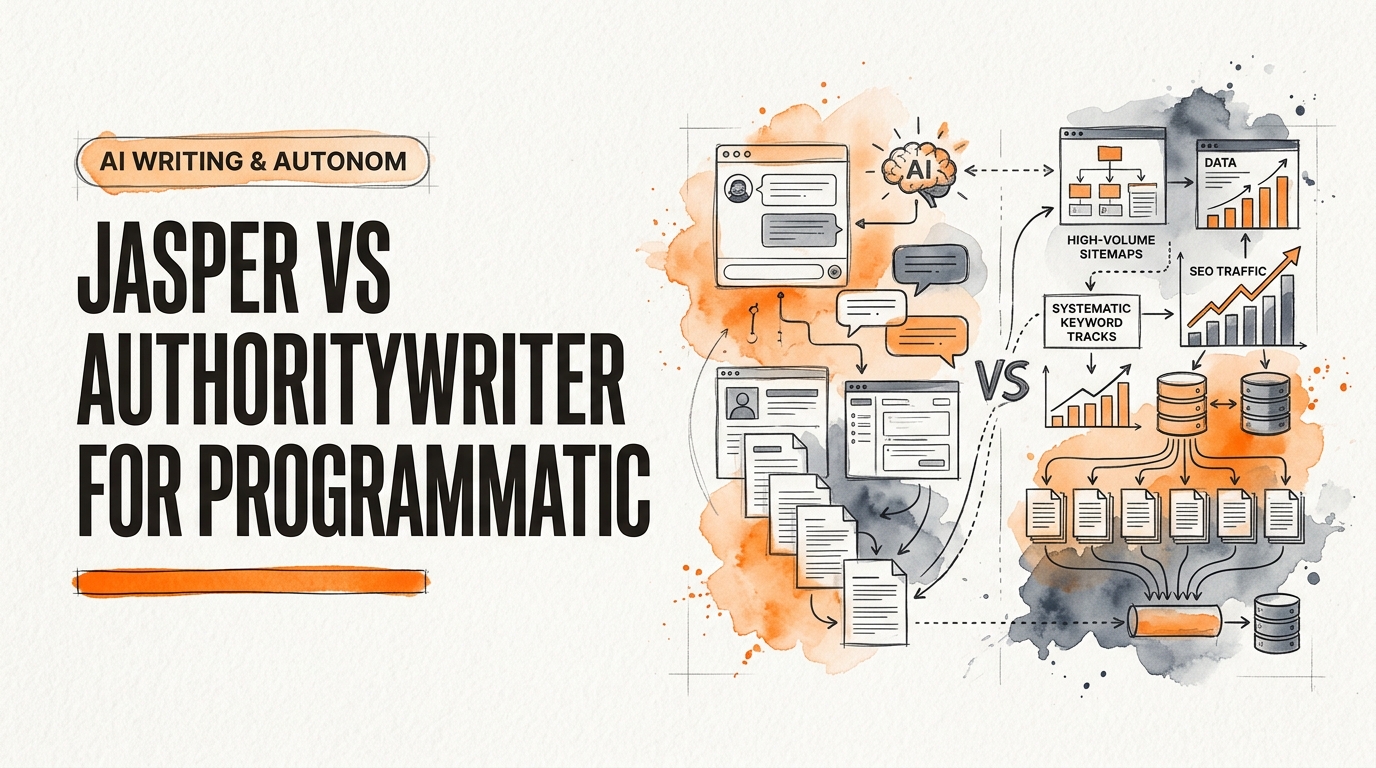
Jasper vs AuthorityWriter for Programmatic Content - jasper vs authoritywriter programmatic
Pumping out thousands of bare-bones articles overnight used to work. Today, search engines ruthlessly prune thin text. If you're weighing jasper vs authoritywriter programmatic approaches, you already know the stakes. Growth teams no longer ask how fast they can generate drafts. They ask how deeply those pages solve searcher intent across an entire topic cluster. Jasper gives your team self-serve generative AI tools, while AuthorityWriter delivers a managed, end-to-end programmatic framework built for durable authority.
Table of Contents
- Scale vs Precision: The Evolution of Programmatic Content Generation
- Core Operational Models: Self-Serve AI Platform vs Managed Programmatic Execution
- Data Architecture and Topical Authority: How Do They Handle Large-Scale Entity Mapping?
- Content Quality and Editorial Guardrails: Automated Generation vs Human-Engineered Depth
- Jasper vs AuthorityWriter Programmatic: Speed, Scalability, and Total Cost of Ownership
- Which Strategy Fits Your Growth Goals: In-House AI Stack or Done-For-You Programmatic Scale?
- The Strategic Horizon for Scaled Organic Growth
Publishing at scale once meant running spreadsheet templates through simple text spinners. That era is dead. Search algorithms easily identify cookie-cutter pages that say nothing new. Modern ranking systems look for real entity relationships, verified facts, and comprehensive topical coverage. If your site publishes fifty variations of a page without genuine value, search engines will simply drop your indexing rates. Precision matters far more than raw volume.
Teams often hit a brutal operational wall when scaling in-house. As seen in practitioner discussions on programmatic content quality, a major hurdle is keeping standards high without burning out your staff. When teams rely purely on basic generative workflows, human editors spend days fixing hallucinated data and repetitive phrasing. The initial speed advantage disappears quickly under the weight of quality control.
This dynamic reveals a major split in how companies approach organic growth. On one side stands Jasper, a self-serve platform that gives your writers prompt-driven generation capabilities. It accelerates creation, but your team must design the data schemas, run the QA checks, and build the page architecture. On the other side sits AuthorityWriter, an engineered programmatic framework that turns topical research and structured datasets into production-ready publishing assets. Deciding between a DIY tool and a managed programmatic strategy determines how quickly you scale and how much internal overhead you carry.
Core Operational Models: Self-Serve AI Platform vs Managed Programmatic Execution
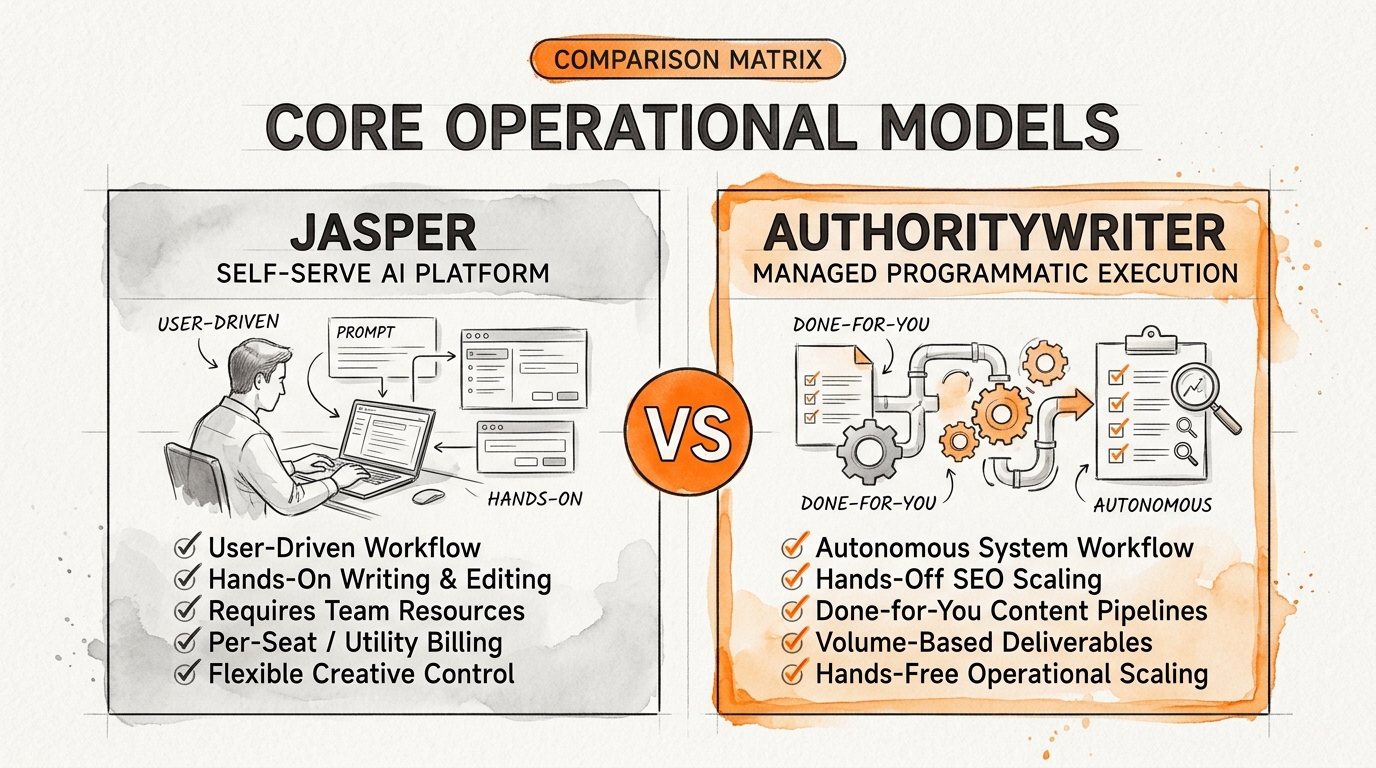
Buying enterprise software is not the same thing as executing a successful growth strategy. When teams look to generate hundreds of high-value pages, they often confuse buying an engine with hiring a driver. That distinction forms the core difference between these two operational paths.
Jasper operates as a self-serve platform. You log in, configure your brand voice, connect external integrations, and direct the generation process yourself. AuthorityWriter functions as a managed programmatic service. You outline your business targets, and an expert team designs, builds, and delivers finished, search-ready content assets directly to your ecosystem.
Architectural Realities of Jasper vs AuthorityWriter Programmatic Workflows
Choosing Jasper means committing to building an internal production assembly line. Think of it like leasing commercial-grade woodworking machinery. You get state-of-the-art power tools, templates, and generative capabilities. You still need skilled operators on your payroll to run the machines, feed raw data into the intake, and inspect every finished joint for splinters.
When running Jasper at scale, your internal engineering or marketing ops team carries the operational load:
- Data Pipeline Setup: Connecting internal product catalogs, spreadsheets, or Airtable bases to generative templates via webhooks and workflow builders.
- Prompt Architecture: Constantly tweaking prompt rules to prevent robotic repetition, hallucinated facts, and repetitive sentence structures across thousands of programmatic variations.
- Human Review Queues: Staffing in-house copy editors to clean up drafts, correct factual drifts, and format output before anything goes live.
- Tool Maintenance: Updating workflows whenever the underlying language models change or internal product specifications shift.
A recent discussion around marketing workflow edge cases on Reddit revealed how quickly internal teams burn out when managing this technical stack. Teams often buy a tool thinking it will save time, only to realize they spent three months acting as software engineers and data janitors instead of driving strategy.
"We spent forty hours building a multi-step generation workflow, only to have the underlying model update break our variable formatting. We saved money on freelance writers but lost twice as much in engineering hours."
AuthorityWriter strips out this internal friction by delivering managed execution rather than software access. Instead of handing your team another dashboard, they operate as an end-to-end partner. They build the programmatic data architecture, establish contextual entity maps, run multi-stage generative models, and run human editorial passes before handing you the completed pages. You do not touch prompt logic. You do not build middleware. You receive production-ready assets tailored to your market positioning.
| Operational Dimension | Jasper (Self-Serve Engine) | AuthorityWriter (Managed Execution) |
|---|---|---|
| Primary Delivery Format | SaaS software access and user seats | Turnkey, fully edited programmatic campaigns |
| Internal Resource Drain | Heavy (requires prompt engineers, ops, and copy editors) | Minimal (requires occasional executive sign-off) |
| Data Schema Design | Built and maintained by your team | Engineered by external programmatic specialists |
| Quality Control Layer | In-house manual review before publishing | Pre-delivery editorial verification and fact-checking |
| Speed to Market | Slow setup curve (weeks of testing and workflow building) | Fast deployment directly mapped to strategy |
When sizing up jasper vs authoritywriter programmatic solutions, the real decision comes down to where you want to spend your internal hours. If your company already employs technical content managers, data scientists, and full-time copy editors who want hands-on control over every prompt parameter, a self-serve platform gives you that raw sandbox. But if your goal is organic market capture without turning your team into a software integration shop, managed execution cuts out the operational drag.
Data Architecture and Topical Authority: How Do They Handle Large-Scale Entity Mapping?
Search engines do not just read keywords anymore. They look for entities—people, places, products, and ideas—and trace how those concepts connect. Think of an entity like an address on a city map. Knowing a single house number is useless if you do not understand the streets, neighborhoods, and transit lines connecting it to downtown. When you publish thousands of pages, your data architecture decides whether you build a thriving metropolis or an abandoned ghost town.
When comparing jasper vs authoritywriter programmatic strategies, the true dividing line isn't writing speed. It's how the underlying data connects. Jasper offers a toolbox to assemble pages using prompts. AuthorityWriter approaches the challenge as an engineering discipline, building structured topical webs from the ground up.
Evaluating Jasper vs AuthorityWriter Programmatic Data Structures
Jasper operates as a generative engine designed to produce copy on command. When teams use Jasper to publish programmatic content at scale, they typically connect its API to a database or spreadsheet. You design a template, chain together sequential prompts, and pass field values like City, Price, or Industry into the prompts. It is fast and flexible. You can generate hundreds of articles in an afternoon.
Isolation remains the hidden trap here. Jasper evaluates prompts in a vacuum. When the API drafts page 450, it has no memory of what it wrote on page 12. Unless your in-house developers write custom scripts to pull cross-page context, each URL sits on an isolated island. In a Reddit SaaS discussion on entity mapping workflows, practitioners frequently point out that automated template pipelines often create repetitive, orphaned content that struggles to index because the pages lack relational depth.
AuthorityWriter bypasses prompt chaining by using managed programmatic execution built around knowledge graphs. Instead of firing prompt triggers across a flat spreadsheet, the framework begins with top-down entity mapping. It identifies every sub-concept, parent category, and lateral topic before a single sentence gets generated. Topics are organized into distinct contextual clusters where parent hubs support child pages, and child pages reference semantic peers.
| Architecture Dimension | Jasper (API & Prompt Chains) | AuthorityWriter (Managed Execution) |
|---|---|---|
| Entity Mapping | Isolated API requests; entities exist only inside individual prompt prompts. | Comprehensive knowledge graph connecting parent topics to lateral entities across the entire site. |
| Clustering Logic | Flat architecture by default. Clustering requires external engineering and custom database design. | Contextual taxonomy designed before publishing to establish search-engine recognized authority. |
| Internal Link Routing | Manual link templates or static post-generation insertion rules. | Dynamic, multi-tier indexing paths that pass link equity between related conceptual nodes. |
| Data Dependencies | Relies on raw client-supplied spreadsheets or simple webhook feeds. | Curated datasets cross-referenced against search intent models and entity registries. |
Look at how both systems handle programmatic internal linking. With Jasper, your engineers must program the link logic manually. If they forget to map out related categories, your programmatic directory will feature thousands of pages that never link to one another in a natural way. Google views these unlinked islands with suspicion.
AuthorityWriter builds internal linking into its multi-tier programmatic indexing engine. The framework groups assets into clear hierarchy levels: Tier 1 parent hubs, Tier 2 category branches, and Tier 3 long-tail entity pages. Breadcrumbs, in-content links, and contextual callouts are routed automatically across siblings in the same cluster. That structure tells search crawlers exactly which page serves as the definitive authority for each sub-topic.
A pile of bricks is not a house, and a folder of AI-generated articles is not a topical cluster. Search engines reward the blueprint, not just the raw materials.
Which setup makes sense for your operational reality?
If you have an in-house engineering squad that loves wrangling databases, vector stores, and custom Python scrapers, building on Jasper's API lets you retain absolute control over your code base. You supply the architecture, and Jasper supplies the words. If you lack dedicated data architects, building custom entity webs via prompt chains will drain your engineering bandwidth fast. AuthorityWriter removes that burden by managing the data relationships, taxonomy mapping, and indexing pipelines for you, ensuring every URL reinforces the topical authority of the entire domain.
Content Quality and Editorial Guardrails: Automated Generation vs Human-Engineered Depth
Publishing five hundred pages with a single click sounds like a dream. Then you actually read page twelve. It invents a pricing tier your client doesn't offer, cites a study from 1984 as breaking news, and repeats the same generic introductory sentence four times. When you produce content at volume, speed is easy. Accuracy is the real challenge.
Every business wants fast output, but search engines and real buyers demand substance. If your content library reads like generic software documentation generated in seconds, visitors leave. When evaluating jasper vs authoritywriter programmatic capabilities, you are really weighing raw software automation against an engineered, authority-first production system.
Editorial Guardrails: Jasper vs AuthorityWriter Programmatic Output
Raw generative AI platforms operate on statistical probability. Think of an engine like Jasper as a hyper-creative autocomplete tool. It doesn't "know" facts; it predicts the most likely next word in a sentence based on its training. If you ask it to describe a complex workflow across hundreds of programmatic pages, it will happily invent details when it hits a gap in knowledge.
This creates hallucinations. A hallucination is simply an AI lying with absolute confidence. In self-serve tools, your only defenses are prompt instructions and custom knowledge bases. These help, but they don't stop the model from drifting over a 500-page batch run. As highlighted in Reddit discussions on scaled AI edge cases, marketing teams often find themselves trapped in endless "clean-up duty." If an internal editor must spend twenty minutes fixing every article Jasper outputs, your cost savings disappear instantly.
AuthorityWriter takes a fundamentally different operational approach. It doesn't treat programmatic content as a prompt-and-pray exercise. Instead of letting an algorithm invent paragraphs out of thin air, AuthorityWriter uses structured, human-engineered programmatic pipelines. Data points—like pricing metrics, product attributes, and regulatory specifics—are pulled from verified, deterministic sources. The generation layer is strictly locked down to prevent deviations. Then, human editorial specialists review the content to verify claims, polish tone, and ensure actual topical depth before a page ever touches your CMS.
| Quality Factor | Jasper (Self-Serve AI Platform) | AuthorityWriter (Managed Programmatic) |
|---|---|---|
| Hallucination Defense | Relies on user-written system prompts and standard RAG databases. Edge cases frequently invent facts. | Strict programmatic guardrails inject verified data into locked structures. Zero unchecked extrapolation. |
| Information Gain | Moderate to low. Rehashes common web knowledge without adding original data points or insights. | High. Pages are engineered around proprietary datasets, practical comparisons, and distinct user intent. |
| Editorial Oversight | 100% internal responsibility. Your team must proofread, fact-check, and format every single run. | Managed quality control. Content engineers and editors vet drafts before delivery. |
| Tone & Structure Drift | Common across long documents. Sentence rhythms become repetitive and monotone over hundreds of pages. | Minimal. Custom-engineered blueprints maintain distinct section pacing and brand voice consistency. |
Adhering to Search Engine Quality Standards
Google doesn't penalize content simply because it was created with code. Search systems do, however, penalize unhelpful content that exists only to manipulate search results. Modern ranking systems look for what engineers call "Information Gain"—the presence of novel insights, unique data, or clear real-world experience that isn't already repeated across ten other search results.
When you spin up dozens of pages using a standard SaaS tool, the output tends to collapse into surface-level summaries. The text sounds polite, clean, and completely empty. There are no proprietary benchmarks, no unexpected examples, and no distinct viewpoints. Search raters and algorithmic quality classifiers easily spot these footprints. Pages get indexed, linger for a few weeks, and then quietly drop out of search results during the next core update.
Programmatic scale without editorial engineering is just automated spam. If a human wouldn't bother to read past the first three paragraphs, a search engine won't bother keeping it on page one.
Deep programmatic production bypasses this trap by engineering actual value into the content architecture. AuthorityWriter designs each programmatic page around a clear utility. If you are building comparison pages, the page doesn't just restate feature lists. It walks through trade-offs, shows real usage scenarios, and surfaces data points users can't find elsewhere. You get the vast scale of programmatic coverage paired with the editorial authority of custom journalism. That balance is what keeps rankings stable over years instead of months.
Jasper vs AuthorityWriter Programmatic: Speed, Scalability, and Total Cost of Ownership
Comparing an AI writing platform to a managed execution service is like comparing a commercial power tool to an entire construction crew. Jasper provides the digital engine for your in-house team to craft text. AuthorityWriter provides the managed framework that builds, audits, and deploys programmatic pages for you. Looking at sticker prices alone hides the real investment.
When you weigh jasper vs authoritywriter programmatic approaches, you must consider speed, labor costs, and long-term search performance. If your team cannot review and publish output quickly, cheap tools become expensive bottlenecks.
Publishing velocity: jasper vs authoritywriter programmatic workflows
Jasper generates thousands of words in seconds. You feed it a prompt, adjust your brand voice settings, and watch text appear on your screen. That speed is impressive inside an isolated document editor. But raw text generation is only the first mile of programmatic scaling.
To turn Jasper's drafts into live programmatic pages, your team has to handle the heavy lifting. Someone has to connect database fields, map dynamic variables, format tables, check internal links, and push everything through your content management system. A batch of 300 location pages or product comparisons can sit in a backlog for weeks waiting for developer resources.
AuthorityWriter bypasses the staging bottleneck. Because it functions as a managed programmatic service rather than a standalone dashboard, publishing speed includes delivery and deployment. You hand off the core business goals and data sets. The service handles data extraction, page generation, quality validation, and final publishing. The clock stops when pages are live on your site, not when an AI finishes filling out a text field.
"We realized raw generation speed means nothing if our editors take 45 minutes to clean up every single automated page before hitting publish."
The labor tax: Internal editorial overhead
The biggest hidden expense in self-serve AI is human labor. AI copy looks polished at a glance. But under closer inspection, small errors slip through. Self-serve models often repeat phrasing, hallucinate product features, or lose track of programmatic variables across large catalogs.
As marketing teams noted in a Reddit SaaS community thread on scaling content workflows, internal editor burnout becomes a major obstacle. Editors hired to write creative campaigns get stuck doing tedious cleanup on hundreds of templated drafts. If a junior editor spends 30 minutes cleaning each Jasper-generated draft across a 500-page campaign, that adds 250 hours of internal payroll to your software subscription.
AuthorityWriter integrates editorial quality controls directly into its production pipeline. Content is checked for factual consistency, topical depth, and search intent before it reaches your site. Your internal team stays focused on core company priorities instead of running manual spell-checks across hundreds of database rows.
| Operational Metric | Jasper (In-House AI Stack) | AuthorityWriter (Managed Service) |
|---|---|---|
| Platform Model | Self-serve software license | Done-for-you programmatic execution |
| Internal Labor Required | High (prompt engineers, editors, web developers) | Low (review and strategic sign-off) |
| Data Integration | Manual CSV uploads or custom API builds | Custom-built entity models and data pipelines |
| Deployment Bottleneck | CMS formatting, styling, and staging | Zero internal deployment burden |
| Cost Predictability | Low (software subscription + unpredictable payroll hours) | High (fixed project or retainer investment) |
Calculating total cost of ownership and sustained organic ROI
Software subscriptions feel safe because they carry a low monthly cost. A business tier for Jasper costs a predictable monthly fee. But that number represents only a fraction of your real investment. Add two full-time content editors, a fractional web developer to manage programmatic templates, and the internal time spent fixing indexing issues. Your true operational expense rises quickly.
Managed execution carries a higher upfront line item, but it acts as a consolidated cost. You trade fragmented SaaS tools, developer hours, and editorial wages for a single performance-driven partner. You know exactly what each published page costs from ideation to live indexing.
Long-term return on investment depends on ranking stability. Search engines regularly strip thin, templated AI copy from search results. When you use self-serve tools without custom data sets, you risk publishing generic copy that sounds identical to your competitors. AuthorityWriter ties every page to rich, structured entity maps. The resulting content answers search queries with unique data points, protecting your organic traffic from sudden quality updates.
Which Strategy Fits Your Growth Goals: In-House AI Stack or Done-For-You Programmatic Scale?
Scaling organic content always runs into a simple fork in the road: do you build the machinery yourself, or do you hire an experienced team that already owns the factory? For SEO directors, marketing heads, and enterprise growth leads, this choice dictates where budgets, staff hours, and operational focus go for quarters to come.
The self-serve software route lets your team sit in the driver's seat. You license a writing tool, connect spreadsheets, write custom prompts, and run the pipeline internally. On the other hand, a done-for-you programmatic model shifts the heavy lifting. Instead of building infrastructure, you pay for complete, indexed, and conversion-ready pages managed by dedicated programmatic operators.
Deciding Between Jasper vs AuthorityWriter Programmatic Models
When analyzing jasper vs authoritywriter programmatic workflows, SEO directors must look past simple subscription costs. The true cost of any content initiative includes software seats, engineering sprints, prompt debugging, and manual editorial passes. A self-serve tool looks cheap on paper until you realize your senior strategist spends 20 hours a week fixing spreadsheet formulas and reviewing generic AI outputs.
In community forums, marketing teams detailing production edge cases warn that internal programmatic builds frequently stall. Pipelines break when APIs update. Tone drifts when custom instructions clash. Quality sinks without continuous editorial guardrails.
| Strategic Variable | In-House AI Stack (Jasper) | Done-For-You Partner (AuthorityWriter) |
|---|---|---|
| Core Operational Asset | Software platform and writing assistant | Turnkey programmatic publishing service |
| Setup Time | 2 to 6 weeks to build templates and databases | Immediate kickoff; pipelines are pre-built |
| Internal Labor Required | High: requires prompt engineers, QA editors, and developers | Minimal: requires occasional strategy approvals |
| Consistency Control | Manual checks per batch; relies on internal QA | Built-in human-in-the-loop review and entity mapping |
| Primary Risk | Tool fatigue, template drift, and workflow bottlenecks | Less direct control over daily prompt tweaks |
Which path makes sense for your operational capacity? Answer three core questions to find the right fit for your team.
Do you have dedicated technical builders on your team?
If you have in-house automation engineers, web developers, and prompt specialists, building an in-house stack gives you total creative control. You can wire the API into your CMS, tweak system prompts whenever you want, and build custom validation steps. If your content team consists of two writers and a busy content manager, building an in-house engine will overwhelm them. They will spend their days troubleshooting workflows instead of publishing content.
How quickly do you need production scale?
Building an in-house engine is like building a car before you can drive it. You have to design the frame, install the engine, and test the brakes. If your growth plan gives you six months to experiment and launch your first batch of 500 pages, the internal path works fine. If your leadership team expects 1,000 high-authority category pages ranking before next quarter ends, a managed execution partner gets you across the finish line without operational delays.
"The biggest mistake enterprise teams make is treating programmatic content as just a writing problem. It's a data architecture and quality assurance problem. If you don't have the people to run the machine, the machine runs you."
Can your brand afford publishing errors?
Unchecked AI generation leads to hallucinations, repetitive phrasing, and thin pages that invite search engine penalties. Running an in-house stack means your internal team takes full responsibility for editorial safety. With a managed programmatic service like AuthorityWriter, human-engineered depth and entity-level checks come standard before anything goes live. You protect your brand equity without turning your staff into full-time proofreaders.
Choosing between these two models comes down to your core strengths. If your goal is to build long-term internal software assets and you have the engineering muscle to support it, an in-house AI stack fits your roadmap. If your priority is driving search revenue, dominating topic clusters, and scaling organic foot traffic without ballooning payroll, a done-for-you programmatic partnership delivers the clearest return on investment.
The Strategic Horizon for Scaled Organic Growth
Future-Proofing Your Brand: Jasper vs AuthorityWriter Programmatic Methodologies
Search engines don't penalize automation. They penalize laziness. Search algorithms care about whether a page solves a searcher's problem quickly, accurately, and thoroughly. If you blast thousands of generic AI summaries across thin programmatic templates, your traffic will collapse during the next core algorithm update. Quality always beats raw volume.
Building a defensible content moat requires structured data, unique topical entities, and continuous editorial guardrails. Real operators often warn about these traps in marketing discussions on programmatic scaling pitfalls. Common issues like repetitive phrasing, unverified assertions, and mismatched search intent can ruin your site's reputation overnight. Manual writing takes too long. Raw generative prompts lack editorial discipline. You need a process that combines database efficiency with human judgment.
That balance defines the core choice in the jasper vs authoritywriter programmatic debate. An in-house platform like Jasper gives you high-speed drafting tools and flexible templates. You own every prompt and setting. You also absorb every hidden expense: hiring prompt engineers, cleaning messy data tables, building custom publishing pipelines, and reviewing thousands of drafts by hand. When internal teams underestimate that labor, publishing stalls and costs multiply.
Managed programmatic models flip that equation. A managed partner like AuthorityWriter approaches scaled publishing as an engineering problem rather than a basic drafting task. They connect clean entity mapping, automated dataset structuring, and professional editorial review into a single pipeline. That frees your marketing team from running a full-time publishing assembly line while ensuring every indexable URL delivers authentic depth and clear value.
Here is how you should evaluate your path forward:
- Build internally with Jasper if your company already maintains dedicated content operations, proprietary datasets, and full-time technical editors who can supervise output quality at scale.
- Deploy AuthorityWriter's managed programmatic model if you want algorithm-resistant organic search assets without building expensive internal publishing infrastructure from scratch.
Winning search traffic over the next decade won't come from pushing an AI button and hoping for rankings. It belongs to brands that treat programmatic architecture as a vehicle for genuine utility. Pick the model that matches your operational bandwidth, protect your editorial standards, and turn your domain into an authoritative category leader.
