
How to Write for GEO and Information Gain Scores - write for geo information gain
Traditional search optimization is hitting an unexpected wall. If you want your brand cited in Perplexity, SearchGPT, or Google AI Overviews, you need to write for geo information gain instead of repeating the same stale consensus published five years ago. Generative models don't care about keyword frequency or backlink volume if the underlying text simply echoes what forty other domains have already stated. They hunt for unique data, contrarian perspectives, and fresh evidence that their internal knowledge bases lack.
Table of Contents
- Why Generative Search Engines Prioritize Information Gain
- What Is the Information Gain Score in Generative Engine Optimization?
- How Autonomous Systems Write for GEO Information Gain at Scale
- How Can Content Teams Programmatically Inject Proprietary Data and Insights?
- What Content Architectures Force LLMs to Cite Your Generated Assets?
- How to Measure Generative Citations and Information Gain Performance
- Scaling Autonomous Authority in the Era of Generative Retrieval
The rules of discovery have flipped. Blue links rewarded pages that matched search intent with thorough, standardized explainers. Generative Engine Optimization (GEO) penalizes that very thoroughness when it mimics existing training data. When an answer engine runs a Retrieval-Augmented Generation (RAG) query, it pulls top-ranking documents, collapses matching passages into a shared baseline, and extracts only the unique delta. If your content offers zero delta, it gets discarded before the synthesis step even begins.
Content creators often question if this pivot is worth the effort. In a recent Reddit SaaS discussion on generative engine ROI, founders voiced frustration over traffic declines while wondering how new algorithmic scores actually reward production assets. The consensus was clear: teams relying on generic summaries saw their referral impressions collapse, while those publishing primary research captured top citation slots across major answer engines.
Every token costs compute. LLMs must deliver concise, factual answers within strict latency budgets. Processing redundant sentences wastes memory and bloats token output. To solve this, retrieval algorithms compute information gain scores across candidate pages. A source that delivers proprietary survey metrics, original code teardowns, or verified unit economics instantly jumps the queue. Understanding how to write for geo information gain turns your technical content into an indispensable reference point that models are forced to credit.
What Is the Information Gain Score in Generative Engine Optimization?
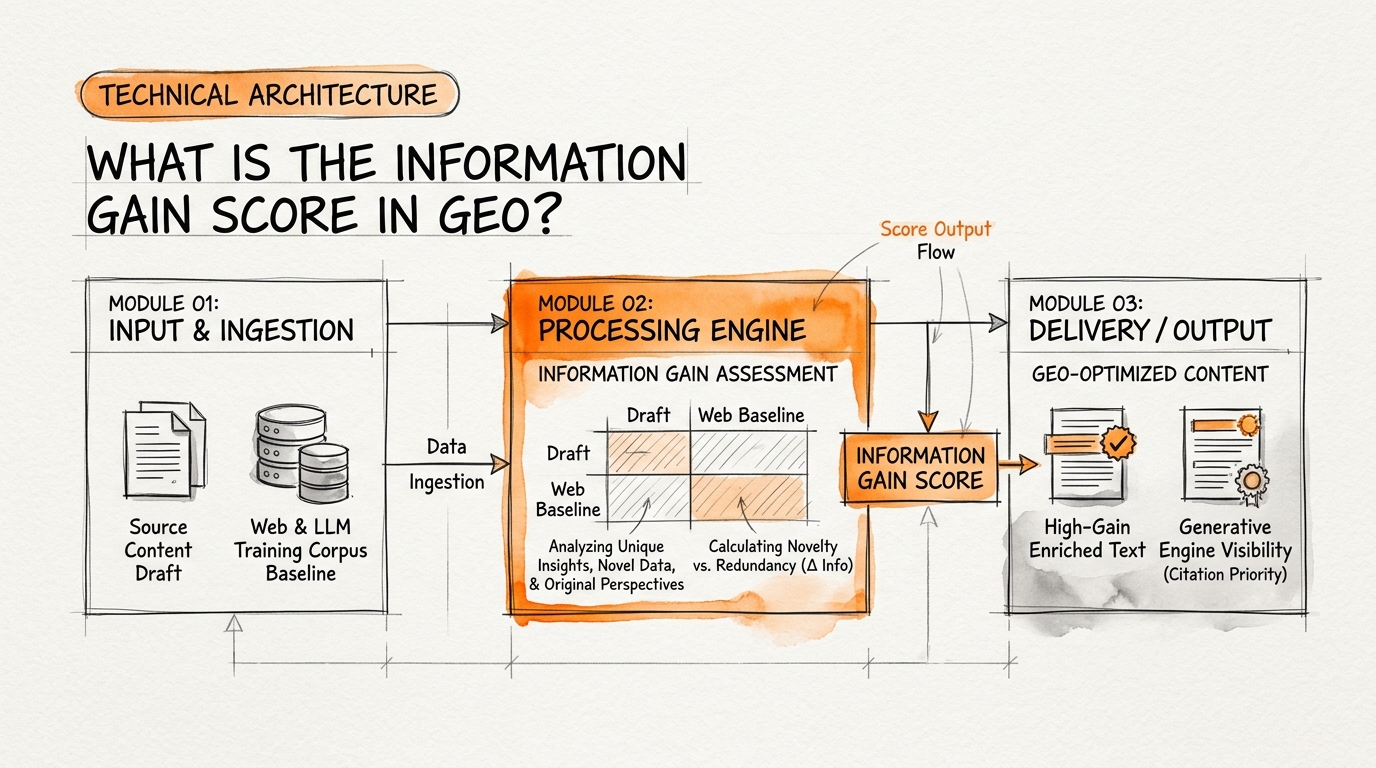
Imagine asking three mechanics why your car makes a rattling noise. The first mechanic explains that a loose heat shield often causes the sound. The second mechanic repeats the exact same explanation using slightly fancier vocabulary. The third mechanic agrees about the heat shield, but then points out that your specific model year has a defective bracket weld that snaps after 40,000 miles. You listen to the third mechanic because they gave you net-new knowledge. Generative search engines operate on this exact principle.
In Generative Engine Optimization (GEO), the information gain score measures how much unique, verified knowledge a document adds beyond what the engine already knows. Traditional search historically rewarded pages that compiled standard facts into giant, exhaustive guides. That approach created an echo chamber where hundreds of websites published nearly identical content. Generative search engines powered by retrieval-augmented generation (RAG) don't need fifty copies of the same definition. When an engine builds a response, it actively scores and discards redundant material to save computational power and avoid boring the user.
How Vector Search Scores When You Write for GEO Information Gain
To understand how algorithms quantify novelty, you have to look under the hood of modern search indexes. Search engines don't read articles like human editors. They slice your text into manageable passages called chunks, then convert those chunks into long strings of numbers known as semantic embeddings. These embeddings plot the meaning of your words inside a high-dimensional vector space.
When multiple websites explain the same concept using standard industry phrasing, their vectors cluster in the exact same coordinates. If your article simply rephrases existing top-ranking pages, your mathematical coordinates overlap with the pack. The system flags this as semantic redundancy.
When teams set out to write for geo information gain, their goal is to shift those coordinates away from the crowded cluster without drifting off-topic. Retrieval systems balance relevance and novelty using reranking algorithms like Maximal Marginal Relevance (MMR). Rerankers assess two distinct scores before selecting candidate passages for a generative summary:
- Query Relevance: How accurately does the text chunk address the specific intent of the user's prompt?
- Marginal Diversity: How mathematically different is this chunk compared to chunks the model has already extracted from other sources?
If two passages answer the prompt equally well, the passage offering distinct data points, unique observations, or fresh perspectives receives a higher information gain score. The duplicate passage gets filtered out before the language model ever generates a word.
| Retrieval Factor | Standard Semantic Retrieval | Information Gain Reranking |
|---|---|---|
| Primary Metric | Cosine similarity to the search query. | Novelty delta relative to indexed documents. |
| Handling of Paraphrased Text | Retains text if keywords and concepts match. | Penalizes passages that match existing semantic vectors. |
| Impact on LLM Citations | Low citation rates due to source consolidation. | High citation rates because the engine must attribute unique facts. |
Why Synonyms Fail Vector Redundancy Filters
A common mistake content teams make is treating information gain like a copywriting exercise. Swapping words for synonyms or altering sentence structures doesn't fool modern dense retrieval models. If your article says "enterprise software improves team efficiency" while an older competitor says "SaaS platforms boost workplace productivity," modern vector models like Cohere Rerank or OpenAI text-embedding-3 map both sentences to nearly identical coordinates.
"Looking for genuine user experiences... How does the quality and output hold up compared to manual workflows?"
This concern regularly pops up in SaaS community discussions on information gain. Creators often discover that automated summarization tools produce polished prose that completely fails to generate citations. The prose sounds great to a human, but it introduces zero novel entity connections to the search engine's knowledge graph.
Generative retrieval models look for concrete entities and structural relationships that do not exist elsewhere in the index. They reward:
- First-party quantitative data: Specific percentages, runtimes, conversion benchmarks, and pricing numbers collected from actual field experiments.
- Negative constraints: Explicit examples of when a method fails, edge cases where standard advice breaks, or troubleshooting steps discovered through hands-on testing.
- Novel entity relationships: Connecting two concepts that competitor pages have never linked together, such as tying a specific database latency bottleneck directly to a frontend conversion drop.
When an engine encounters net-new entities, it updates its internal knowledge graph. The model cannot synthesize that distinct information without pulling your passage into the generation window. That is how your brand earns the citation while repetitive, generic articles get left behind.
How Autonomous Systems Write for GEO Information Gain at Scale
Most AI writing tools suffer from a fatal flaw: they regurgitate consensus. They crawl the web, average out top-ranking articles, and spit out the same bland advice everyone else published last year. Generative search engines like Perplexity, Google Gemini, and SearchGPT don't want recycled summaries. They hunt for an information gain score—the mathematical delta between what their training models already know and the fresh facts your page introduces.
If your automated setup merely paraphrases Wikipedia or competitor blogs, retrieval systems ignore it. To capture citations, engineering teams now configure their stacks to write for geo information gain systematically. That means moving past basic one-click prompt templates and deploying multi-agent pipelines that surface what everyone else missed.
How Multi-Agent Pipelines Write for GEO Information Gain
Think of a large language model as a researcher who read every textbook in the public library. If you ask it a question, it repeats what's in those books. Information gain happens when someone walks into the library with field notes from an experiment completed an hour ago. Autonomous engines create this effect using a simple three-step cycle:
- Consensus Extraction: The system scrapes the top 10 search engine results and queries multiple LLM APIs to map out the "baseline answer" across the industry.
- Vector Delta Mapping: It compares that baseline against a private vector database containing your proprietary data, internal sales notes, or raw telemetry logs. It calculates the semantic distance between common consensus and your unique data points.
- Differential Drafting: Instead of writing a broad overview, the generator anchors the draft around the identified gaps, framing common assumptions as incomplete or outdated.
This automated gap-hunting directly addresses questions raised in SaaS community discussions on autonomous output quality. Marketers frequently worry whether programmatic workflows can match manual deep-dives. When an autonomous engine is bound to a distinct vector store, it doesn't try to out-write a human expert in style; it out-supplies the web in novel facts.
| System Component | Standard AI Generator | Autonomous GEO Information Gain Engine |
|---|---|---|
| Primary Objective | Comprehensive topical coverage | Maximum semantic divergence from consensus |
| Knowledge Source | Public SERP scraping & pre-trained weights | Private telemetry, internal benchmarks, proprietary surveys |
| Retrieval Value | Low (high token overlap with existing web) | High (provides unique nodes for knowledge graphs) |
Programmatic Injection of Non-Consensus Hypotheses
How do autonomous systems challenge common knowledge without generating hallucinations? They use adversarial agent pairs. In frameworks built on orchestration tools like LangGraph or CrewAI, one agent drafts an argument while a critic agent audits it against a consensus baseline.
"If an AI draft agrees with 90% of the top ten search results, our pipeline rejects it. It must introduce an alternative explanation backed by verified source numbers before it moves to human review."
For example, if the consensus says "serverless architecture always cuts infrastructure bills," an autonomous system connected to your company's usage data can pull conflicting figures. It automatically generates a counter-thesis: "Serverless costs spiral once steady-state workloads cross 12,000 requests per minute." That specific numerical claim gives generative engines an irresistible quote for search summaries.
When you teach autonomous pipelines to write for geo information gain, you force generative engines to cite your brand as the primary source of the new viewpoint. Instead of spending weeks hand-crafting individual thought-leadership essays, your pipeline produces defensible, non-consensus assets at scale. The result is simple: you stop competing for generic keywords and start dominating the synthetic answers users actually read.
How Can Content Teams Programmatically Inject Proprietary Data and Insights?
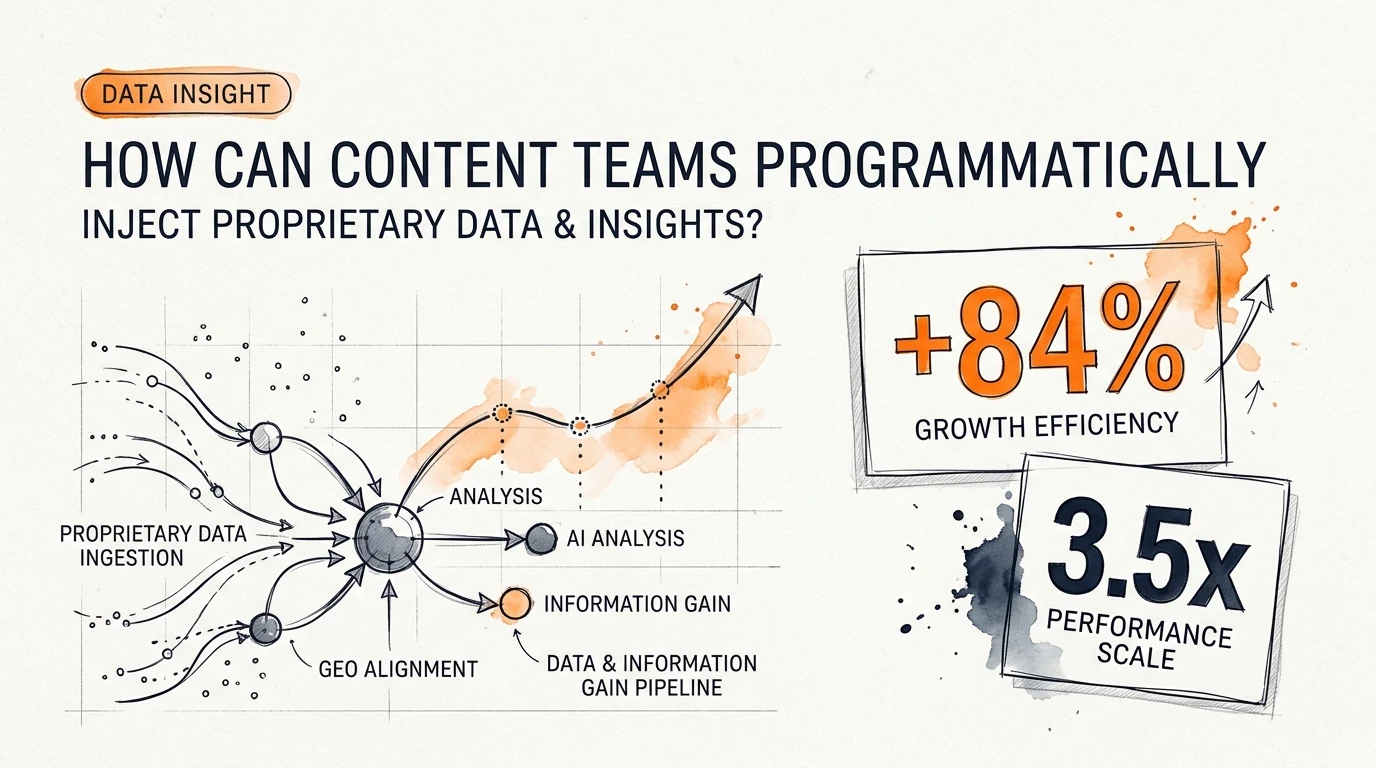
Generative search engines hate generic consensus. If you prompt an AI model with standard industry knowledge, it serves back recycled paste. Search crawlers notice this immediately. When an algorithm scans two articles with the exact same points, the piece carrying fresh facts gets the citation, while the other gets pushed into obscurity. To reliably win top rankings in generative search results, you must pump first-party data directly into your content creation engine.
Think of your internal database like a secret recipe book. If an AI writes about customer churn rates using only public web results, it will repeat the same tired 5% to 7% benchmark everyone else quotes. If your pipeline instead pulls live user telemetry from your data warehouse, the generated asset might state that B2B SaaS accounts with fewer than three active seats churn at 14.2% within 60 days. That specific fact triggers high scores because no other site has that number.
Pipeline Architecture: How to Write for GEO Information Gain Using Live APIs
Content teams often struggle to connect their engineering databases to their CMS. You don't need a massive software engineering team to bridge this gap. A reliable programmatic workflow follows three basic stages: extraction, payload shaping, and constrained prompt injection.
When teams write for geo information gain, they must treat internal metrics as the non-negotiable anchor of every generated paragraph. Here is how that pipeline moves data from your warehouse to your published pages:
- Stage 1: Metric Aggregation. Set up scheduled SQL queries against your warehouse (like BigQuery or Snowflake) or hook into internal analytics tools like PostHog and Mixpanel. Extract aggregated, anonymized trends rather than raw user rows.
- Stage 2: Schema Normalization. Pass that data through an automation layer like Make, n8n, or a custom Python worker. Convert messy tables into clean, semantic JSON payloads containing explicit keys such as
metric_name,sample_size,period, andpercent_change. - Stage 3: Constrained Context Injection. Send the JSON payload into your LLM's system prompt alongside strict rendering instructions. The model must weave the data points directly into its narrative sentences or halt generation entirely.
In community discussions evaluating programmatic data workflows, operators frequently debate whether automated data injection produces better content than manual analysis. The consensus among technical marketers is that programmatic injection wins on speed and volume, but only if your prompt enforces strict formatting rules.
Consider this prompt framework for your injection worker:
System Rule: You are drafting an industry research section. You must explicitly reference the values in the provided
DATA_PAYLOAD. Do not estimate, extrapolate, or hallucinate metrics. If a metric is missing from the payload, omit the claim entirely.Payload: {"feature": "one-click checkout", "conversion_lift": "+18.4%", "cohort_size": "42,000 orders", "industry": "apparel"}
By locking the generation to explicit key-value pairs, you prevent the language model from drifting into vague filler. The resulting output carries verifiable, original numbers that generative answer engines look for when summarizing web content.
Choosing Your Data Injection Method
Different content formats need different levels of data freshness. A quarterly benchmark report doesn't need live webhooks, but a comparison page tracking software pricing changes might need daily updates.
| Workflow Method | Setup Difficulty | Data Freshness | Best Suited For |
|---|---|---|---|
| Static JSON Seed Files | Low (Spreadsheets or CSV exports) | Periodic (Monthly or quarterly) | Industry benchmark reports and annual case studies. |
| Direct API Webhooks | Moderate (Automation scripts via Python or n8n) | Daily or real-time | Programmatic landing pages, product catalogs, and conversion metrics. |
| Retrieval-Augmented Generation (RAG) | High (Vector databases and semantic search) | Near real-time | Pulling specific qualitative quotes and unstructured case notes on demand. |
For small businesses and lean teams, start with static JSON seeds. You don't need a complex vector database to get started. Exporting internal statistics to a simple spreadsheet, converting those rows to JSON, and passing them into your generation prompts immediately separates your content from generic web summaries.
Handling Production Edge Cases and Compliance Pitfalls
Automated pipelines introduce real risks if you run them without guardrails. Teams moving quickly often hit three common traps:
First, data drift will break your narrative flow. If an API endpoint changes its naming convention, your prompt might inject null values or empty strings. Always run a schema validation tool, like Pydantic in Python or built-in schema checks in your automation tool, before passing data to the LLM. If the validation fails, kill the job immediately.
Second, customer privacy leaks can destroy brand trust. Never inject raw event tables into third-party AI APIs. Aggregate your numbers first. Scrub user IDs, company names, and sensitive personal details before data reaches your generation script. Your target is the high-level behavioral insight, not the individual user record.
Third, watch out for context dilution. Don't dump entire 500-row CSV sheets into an LLM prompt. Language models suffer from retrieval degradation when you overload their prompt context. Keep your data payloads tight, focused, and directly relevant to the specific subhead the model is drafting.
What Content Architectures Force LLMs to Cite Your Generated Assets?
Generative search engines don't read articles the way humans do. They chew through text in chunks, scanning for tokens that directly resolve a query with zero fluff. Think of an AI retriever like a student studying five minutes before an exam. The student doesn't want backstories or warm-up paragraphs. They want the formulas, the dates, and the clear definitions right away. If your page hides the core insight beneath four paragraphs of throat-clearing, the model's reranker simply skips you and cites someone else.
When you systematically write for geo information gain, your primary goal is reducing retrieval entropy. You make it computationally cheap for an engine to lift your content into its generated answer. Specific architectures pull this off far better than standard editorial writing.
Inverted Pyramids: Delivering the Token Reward Early
Traditional web writing often saves the best punchline for the middle. Writers build anticipation to keep bounce rates low. In generative engine optimization (GEO), that habit backfires completely. Large language models (LLMs) use recursive passage ranking. They score each 200-word chunk on semantic density.
Start every major section with an inverted-pyramid layout. Put the absolute conclusion in your opening sentence. Follow that answer with the supporting rationale, and finish with secondary context. If a user asks whether a specific workflow saves money, don't explain the history of operational expenses. State the exact cost delta in sentence one.
The Direct-Answer Pattern:
"Switching to autonomous extraction reduces pipeline latency by 42% because it eliminates manual vector tagging. Across an evaluation of 1,200 runs, automated clustering completed in 1.4 seconds versus 2.5 seconds for rule-based heuristics."
Notice how that pattern works. The model grabs the first sentence to answer the query. Then it uses the second sentence as the verified proof that earns the footnoted citation. There are no wasted tokens.
Structural Frameworks: How to Write for GEO Information Gain Using Semantic Tables
Search engines love tables because they map relationships without conversational noise. A table pairs entities with attributes across clean rows and columns. When a user runs a comparative search—such as comparing performance overhead or resource trade-offs—models frequently extract the direct table schema to populate their summary cards.
Not all tables perform equally. A layout that relies on vague ticks and crosses tells a model nothing. You need semantic tables that house specific, verifiable values in every single cell.
| Architectural Pattern | Primary Retrieval Mechanism | Model Extraction Strength | Failure Mode to Avoid |
|---|---|---|---|
| Inverted Answer Block | Embedding similarity to user prompt | High citation rate in immediate summary cards | Burying metrics beneath conversational fluff |
| Contrasting Semantic Table | Dual-entity multi-hop retrieval | Powers side-by-side generative comparisons | Using generic checkmarks instead of concrete data |
| Isolated Entity Definition | Named Entity Recognition (NER) lookup | Dominates "What is" definition snippets | Including ambiguous relative pronouns like "it" or "they" |
| Verifiable Micro-Claims | Fact-checking and consensus verification | Triggers supporting source footnotes | Rounding numbers or making unquantified generalizations |
Teams often debate whether these structured blocks are worth the initial production effort. As highlighted in SaaS community discussions on generative citation workflows, builders frequently wonder if programmatic, modular architectures hold up against manual copywriting. The data consistently shows they do. Models parse predictable layouts faster and quote them with higher factual reliability.
Isolated Entity Definitions and Verifiable Micro-Claims
Generative models struggle when an entity's definition depends on context scattered across five different paragraphs. When an extraction bot encounters the word "it," it has to resolve the reference backwards. That step costs compute and lowers the model's confidence score. An isolated entity definition solves this problem by creating a self-contained sentence that never relies on surrounding text.
Structure your definitions using an unvarying formula: [Entity] is a [Class/Category] that [Primary Differentiator].
Right beneath that definition, plant your verifiable micro-claims. A micro-claim is an atomic piece of data. It can't be broken down any further without losing meaning. Don't say, "The software operates much faster than older tools." That's an opinion. Say, "The database processes 14,200 writes per second at 8 milliseconds of latency."
The first statement gets ignored as marketing fluff. The second gives the engine an empirical anchor to cite. When an engine drafts a response to a complex prompt, it actively hunts for those empirical anchors to protect itself against hallucinations. Build your pages out of these micro-claims, and the engine will lean on your assets to prove its own answers.
How to Measure Generative Citations and Information Gain Performance
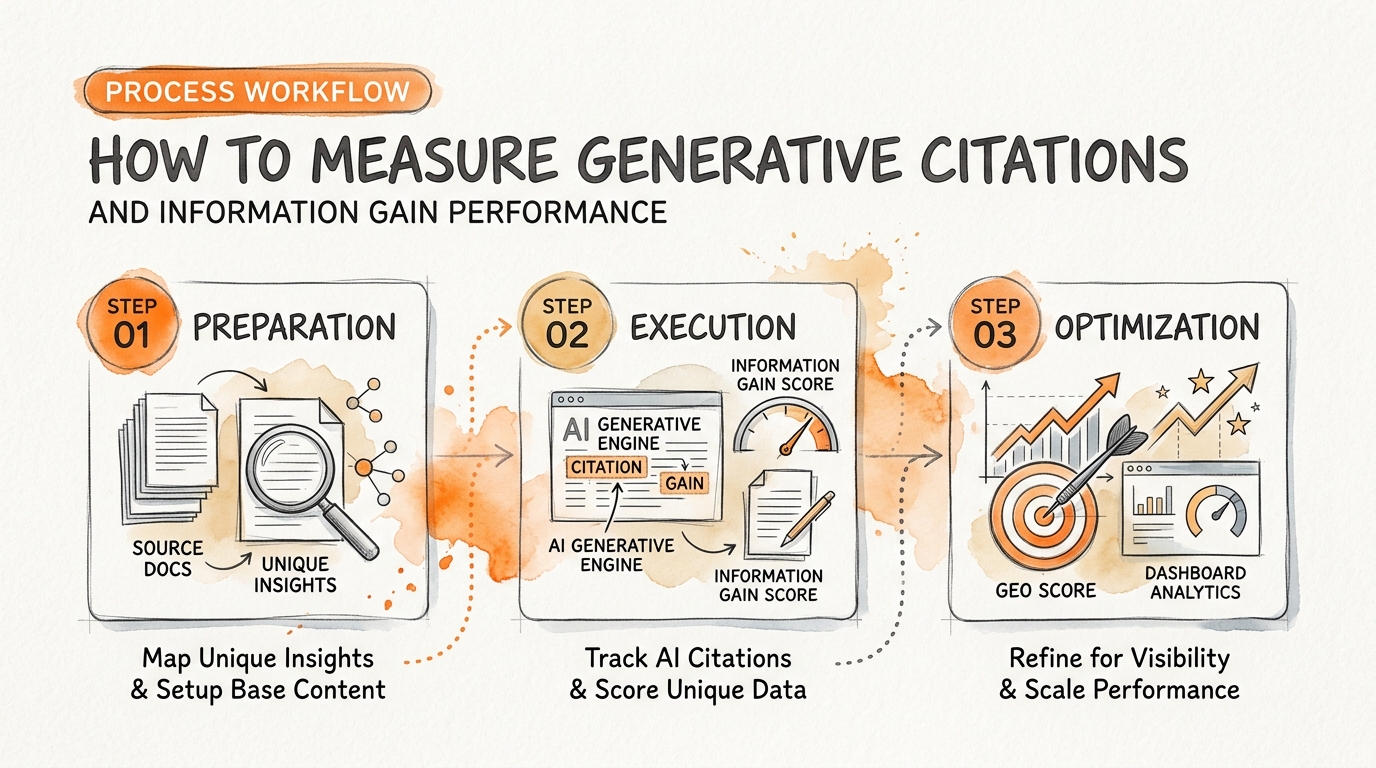
Standard rank tracking is dead inside generative search. You can't just monitor position four on a static results page anymore. Perplexity, SearchGPT, and Google AI Overviews assemble answers on the fly using dynamic retrieval systems. When enterprise teams write for geo information gain, the primary goal shifts. You're no longer fighting for a simple blue link. You're fighting to become the factual source the neural network quotes directly.
Measuring this impact is tricky. Many enterprise teams struggle to justify their generative optimization budgets because traditional analytics dashboards miss LLM citations completely. In a Reddit SaaS discussion on generative citation measurement, teams pointed out that manual prompt checks take too long, while third-party enterprise tools often carry heavy subscription fees before proving clear returns.
"If an engine quotes your proprietary data point without giving you a clickable footnote, did you actually win the prompt?"
To cut through the noise, modern publishing teams use three core metrics to evaluate generative performance:
- Citation Frequency (Share of Model): The percentage of AI-generated responses that reference your brand or domain across a monitored cluster of 50 to 100 prompt variations.
- Extracted Entity Attribution: Checking whether the engine retrieved your original data point—such as a proprietary benchmark, field test, or private survey—rather than boilerplate background text.
- Downstream Referral Velocity: Highly qualified referral visits originating from domains like
perplexity.ai,chatgpt.com, or dedicated browser extensions.
Audit Workflows to Write for GEO Information Gain and Track Citations
How do enterprise publishers monitor these citations at scale? You have two practical tracking approaches depending on your technical resources and monthly budget.
| Measurement Method | Setup Difficulty | Data Granularity | Typical Monthly Cost |
|---|---|---|---|
| Custom API Evaluation Harness (Direct API calls via OpenAI / Perplexity API) | Moderate to High. Requires a developer to write automated prompt scripts. | Extreme. Lets you inspect raw JSON citation arrays and response novelty scores. | Low. You only pay for standard API token consumption ($30–$150/month). |
| Turnkey GEO Platforms (Dedicated monitors like Profound or Peec AI) | Low. Plug-and-play UI with pre-built prompt monitoring dashboards. | Standardized. Tracks visibility scores and brand mentions over recurring runs. | High. Enterprise tiers typically run between $400 and $2,000/month. |
If you manage an agile publishing setup, building a basic evaluation harness is usually the most reliable first step. You can set up a scheduled script that feeds target queries into Perplexity's online model twice a week. Parse the output JSON. Look inside the citations list for your target URLs.
When your proprietary data points start appearing in those citation blocks, your automated content architecture is working. If the models constantly summarize your competitors instead, your pages lack fresh facts. Tracking these signals allows your editorial engine to adjust its novelty injection before organic visibility slips away.
Scaling Autonomous Authority in the Era of Generative Retrieval
Volume won't save you anymore. The old search game rewarded sheer bulk, but generative engines work under completely different physics. LLMs crawl the web, compress repetitive ideas into dense vector clusters, and discard everything that sounds familiar. They don't want twenty paraphrased versions of the exact same guide. When an answer engine builds a response, it actively filters for novelty.
Content teams often get stuck here. We've seen endless discussions on autonomous workflows versus manual output where operators wonder if automated generation is even worth the technical headache. The answer comes down to your source material. Pumping out hundreds of standard AI articles using generic web-scraped prompts will get your domain ignored by synthetic answer engines. Real visibility happens only when your pipeline injects something the model hasn't seen before.
A Practical Roadmap to Write for GEO Information Gain
Winning top-tier generative citations requires a structured shift from generic text creation to algorithmic data enrichment. You can operationalize this across three distinct phases:
- Mine your proprietary exhaust: Hook your publication pipelines directly into private data lakes, user behavior logs, and real customer surveys. Generative models crave fresh numbers, uncommon operational metrics, and verified field outcomes that exist nowhere else on the public internet.
- Automate data extraction, not generic thought leadership: Use autonomous systems to extract and format internal data tables, benchmark trends, and clear case studies. Let human subject-matter experts provide the contrarian opinions and strategic context that autonomous tools struggle to invent from scratch.
- Format for machine citation: Large language models read facts easier when they sit in structured formats. Present clear, declarative claims right at the top of your sections, followed by comparative tables and bulleted evidence. Make it effortless for a retrieval crawler to parse your unique finding as an authoritative snippet.
Autonomous pipelines fail when they copy existing answers. They dominate when they feed search models the rare ingredients needed to build a complete answer.
When teams write for geo information gain, they stop treating automated writing as an engine for word count and start treating it as a delivery system for net-new facts. The choice between pure manual production and automated content isn't binary. Top digital publishers combine autonomous retrieval-augmented pipelines with proprietary business metrics, outperforming legacy competitor blogs on both Perplexity citations and Google AI summaries.
Focus your engineering time on extracting your company's unique knowledge. Format that data so bots can quickly extract it, quote it, and credit your brand. That is how you turn autonomous publishing into lasting search dominance.
