How to Add Unique Citations to AI Content
Publishing raw AI drafts creates a massive credibility deficit across the web. To win back reader trust and secure top search positions, modern publishers must learn how to add unique citations to ai content. Synthesized writing often sounds convincing, yet it frequently lacks real-world evidence. Without distinct proof points, your articles risk being dismissed as low-effort commodity text.
Table of Contents
- Bridging the Trust Gap in Synthesized Text
- Why Do AI Search Engines Prioritize Cited Content?
- How to Add Unique Citations to AI Content Step by Step
- What Qualifies as a Unique Citation in Generative Writing?
- How to Prompt AI Models to Include Verifiable Primary Sources
- Structuring Links and Attributions for Optimal LLM Parsing
- Building a Future-Proof Strategy with Information-Rich AI Content
Commodity text is everywhere. Thousands of websites publish identical AI summary points every single day. Readers spot unverified claims instantly. You've probably noticed it yourself. A blog post makes a bold numerical claim, but provides zero source details. That creates a deep trust gap between your brand and your audience.
Many team leaders wonder if fixing this problem is worth the extra workflow effort. On a Reddit SaaS discussion regarding synthesized text quality, founders questioned how output consistency holds up against manual workflows. The answer comes down to smart tool integration. Research engines like Perplexity Enterprise pull primary research directly into your drafting pipeline. Meanwhile, auditing software like Originality.ai checks existing drafts to highlight missing attributions before you hit publish.

Grounding your generative text with distinct references changes everything. Search engines actively reward pages that introduce fresh data and primary sources. When you add unique citations to ai content, you turn repetitive drafts into high-value assets. It elevates your market authority while protecting your site from search quality downgrades. Adding real-world data points gives AI writing the human edge it desperately needs.
Why Do AI Search Engines Prioritize Cited Content?
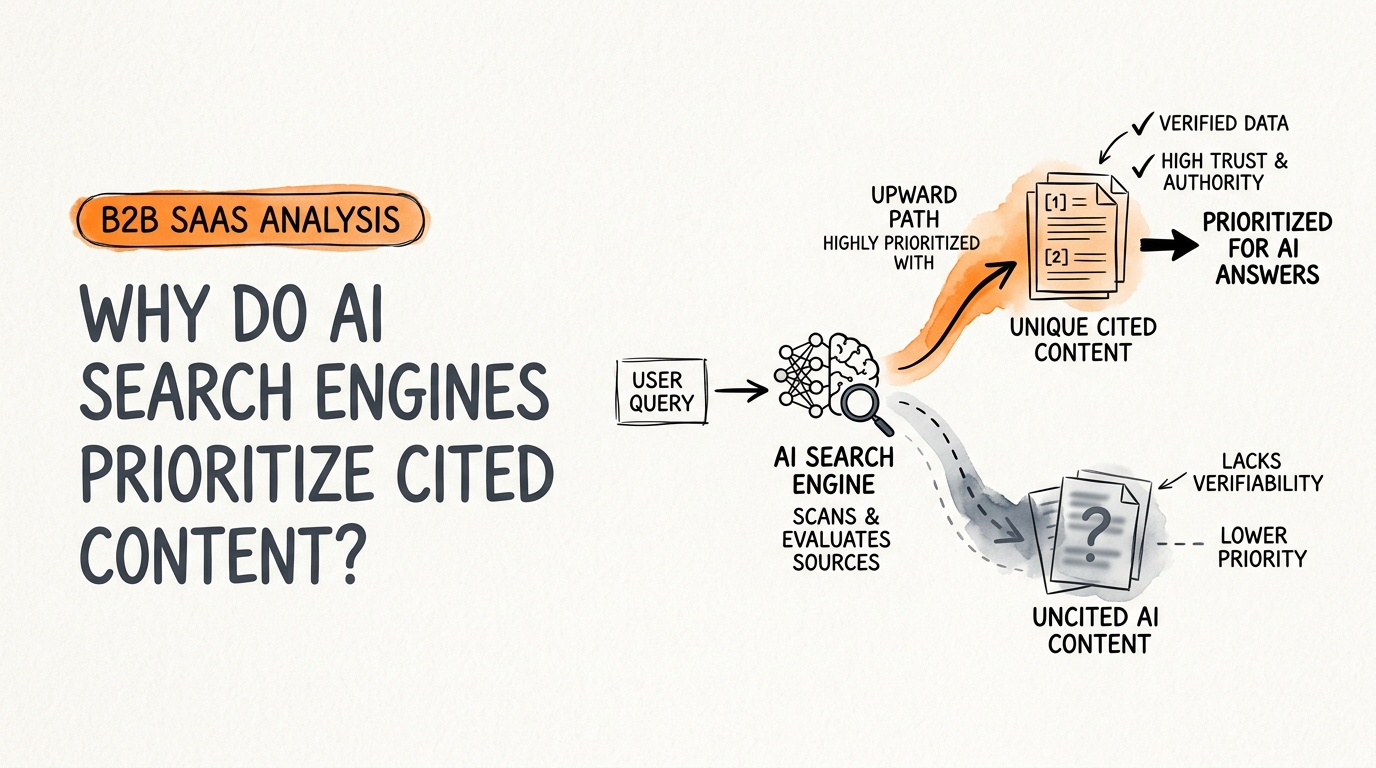
Think of a modern generative search engine as a courtroom judge. When an AI like Perplexity, ChatGPT with SearchGPT, or Google AI Overviews answers a user prompt, it acts as the judge evaluating a case. Text without backing data sounds like an unverified claim. Text backed by explicit, first-party data acts like physical evidence submitted to court. Generative models use a system called Retrieval-Augmented Generation (RAG). RAG forces the AI to look outside its trained memory, fetch real-time web documents, and double-check facts before writing an answer.
When you add unique citations to ai content, you build a direct bridge for these RAG scrapers. The AI doesn't just read your words. It reads your references to check if your claims hold up against ground-truth data. If your page links to original research, proprietary datasets, or real expert quotes, the algorithm flags your piece as a high-confidence reference point.
Why Modern Algorithms Demand You Add Unique Citations to AI Content
AI search engines don't rank pages the same way legacy Google web crawlers used to. Legacy search engines primarily counted backlinks and matched search keywords. Generative models focus heavily on factual grounding—a mathematical measure of how closely a claim connects to verified sources.
"Looking for genuine user experiences... How does the quality and output hold up compared to manual workflows?"
Marketing teams often debate whether automated tools or manual research yields better indexing results. Users in Reddit's SaaS marketing discussions regarding AI citations often note that raw AI drafts get overlooked by SearchGPT unless human editors inject verified primary links. AI engines hate guessing. If a model tries to answer a search prompt using generic AI text, it risks hallucinating. To prevent embarrassing errors, models prioritize content blocks that come paired with verifiable source URLs.
Let's look at how top AI search engines evaluate incoming content pages:
| Search Engine | Primary Evaluation Signal | Citation Processing Mechanism |
|---|---|---|
| Perplexity AI | Citation Index & Domain Authority | Extracts inline claims and verifies them against live web hits in real time. |
| Google AI Overviews | E-E-A-T & Knowledge Graph Matching | Cross-references page facts with its global Knowledge Vault to confirm accuracy. |
| SearchGPT / OpenAI | Publisher Trust & Direct Source Links | Scans for explicit anchor text and outbound primary research references. |
Is manually adding sources worth the investment for small businesses and e-commerce stores? Yes. Generic product descriptions and repetitive blog posts are invisible to modern answer engines. E-commerce sites using workflow platforms like Elicit for automated research mapping or Consensus report faster indexing because their content provides clear proof points. Adding real lab test results, customer usage metrics, or niche industry studies turns flat AI drafts into trusted knowledge sources.
The Hidden Cost of Unverified AI Output
What happens when you skip citations? Your content gets buried. Uncited text forces answer engines to run extra validation passes. If the engine finds conflicting reports across the web, it discards your content as unreliable.
Setting up a strong citation workflow takes minimal effort compared to its high payoff. Software subscriptions for citation research tools typically range from free tier plans up to $50 a month for small teams. Compared to losing traffic to generative search overviews, that small cost pays for itself quickly. When you add unique citations to ai content, you aren't just writing for human readers. You're training the next generation of search bots to quote you directly.
How to Add Unique Citations to AI Content Step by Step
AI draft generators produce smooth sentences fast. They also hallucinate quotes and invent sources out of thin air. When you try to publish raw AI copy, search engines and readers quickly spot the lack of real proof. You need a systematic, repeatable process to ground every claim with verified evidence.
Fixing this issue isn't just about dropping random links into a document. It requires a clean workflow that connects your draft to actual research papers, proprietary statistics, and expert quotes. We've broken this process down into four clear steps that any team can run.
Step 1: Gather Raw Primary Data Before Writing
Think of an AI model like a smart copywriter who never leaves their desk. If you don't feed it primary source materials, it relies on general consensus and web gossip. That ruins your site's credibility. Start by collecting your evidence before you generate a single paragraph.
Build a simple folder of source materials for your topic. This should include:
- Internal Data: Anonymized customer metrics, survey results, or product usage statistics.
- Academic Papers: Studies pulled from specialized engines like Elicit or PubMed.
- Expert Transcripts: Raw quotes from audio interviews or internal subject matter experts.
Save these sources as clean text or markdown files. Having clean text prevents your LLM from missing key numbers hidden inside complex PDF layouts.
Step 2: Grounded Prompting to Add Unique Citations to AI Content
Once you have your data, feed it directly into your prompt context. Don't ask the AI to find sources on the open web without guidance. Large language models often guess web addresses, leading to broken 404 links. Instead, force the model to pull references exclusively from the text you supply.
You can use a simple system prompt structure like this:
Prompt Context Injection:
"Act as an expert technical editor. Draft a section on [Topic] using ONLY the source material provided below. For every claim, statistic, or direct statement, add an inline citation marker [Source #]. Do not include outside knowledge or generate URLs that aren't explicitly listed in the source text."
When you force the model to add unique citations to ai content using bounded context, hallucinated references drop to near zero. It turns the AI from a creative writer into an accurate research synthesizer.
Step 3: Tool Selection, Verification, and ROI
Is setting up a grounded workflow worth the investment for small teams? Founders on SaaS community discussions on citation workflows often debate whether dedicated research tools outperform manual editing. The answer comes down to volume and compliance needs.
If you produce two posts a month, manual fact-checking in Google Docs works fine. If you publish daily, automated toolchains save dozens of hours. Here is how top software options compare for citation workflows:
| Tool / Solution | Est. Monthly Cost | Primary Strength | Learning Curve |
|---|---|---|---|
| Elicit | $12 - $29 / mo | Extracts claims directly from 200M+ research papers. | Low (Search-based interface) |
| Perplexity Enterprise | $40 / user / mo | Live web search grounded with inline URL attributions. | Very Low (Chat interface) |
| Custom RAG Pipeline | $50 - $300 / mo (API costs) | Connects directly to your company's private database. | High (Requires developer setup) |
Reviewing comparative research on AI reference tools shows that hybrid workflows—where software pulls data but humans verify the output—yield the highest ROI. Pure automation often misses subtle context, leading to embarrassing compliance traps.
Step 4: Format Inline Links and Attribute Sources
How you present citations matters to both human readers and search algorithms. Avoid dumping raw URLs at the end of paragraphs or making generic link text. Insert contextual links directly onto descriptive phrases that explain what the reader will find.
Follow these quick link formatting rules:
- Anchor Text: Use specific descriptions of the source material rather than generic words.
- External Links: Open external references in a new tab (`target="_blank"`) to keep users on your page.
- Structured Schema: Use `ItemPage` or `TechArticle` schema to signal primary sources directly to search bots.
By pairing solid primary data with clean link structures, you turn low-value AI text into authoritative industry assets that earn trust and rank consistently.
What Qualifies as a Unique Citation in Generative Writing?
Beyond Generic Links: Defining High-Impact Attribution
Not all web references carry equal weight. Most blogs just recycle old ideas. AI search engines spot lazy sourcing instantly. When you quote a generic roundup, the AI model views that link as redundant noise. It adds no fresh knowledge to the model's response engine.
Think of web references like evidence in a courtroom. A blog repeating a rumor holds no weight. An original laboratory test result changes the entire trial. When you add unique citations to ai content, you give the model undisputed primary proof. That proof builds instant trust across discovery engines.
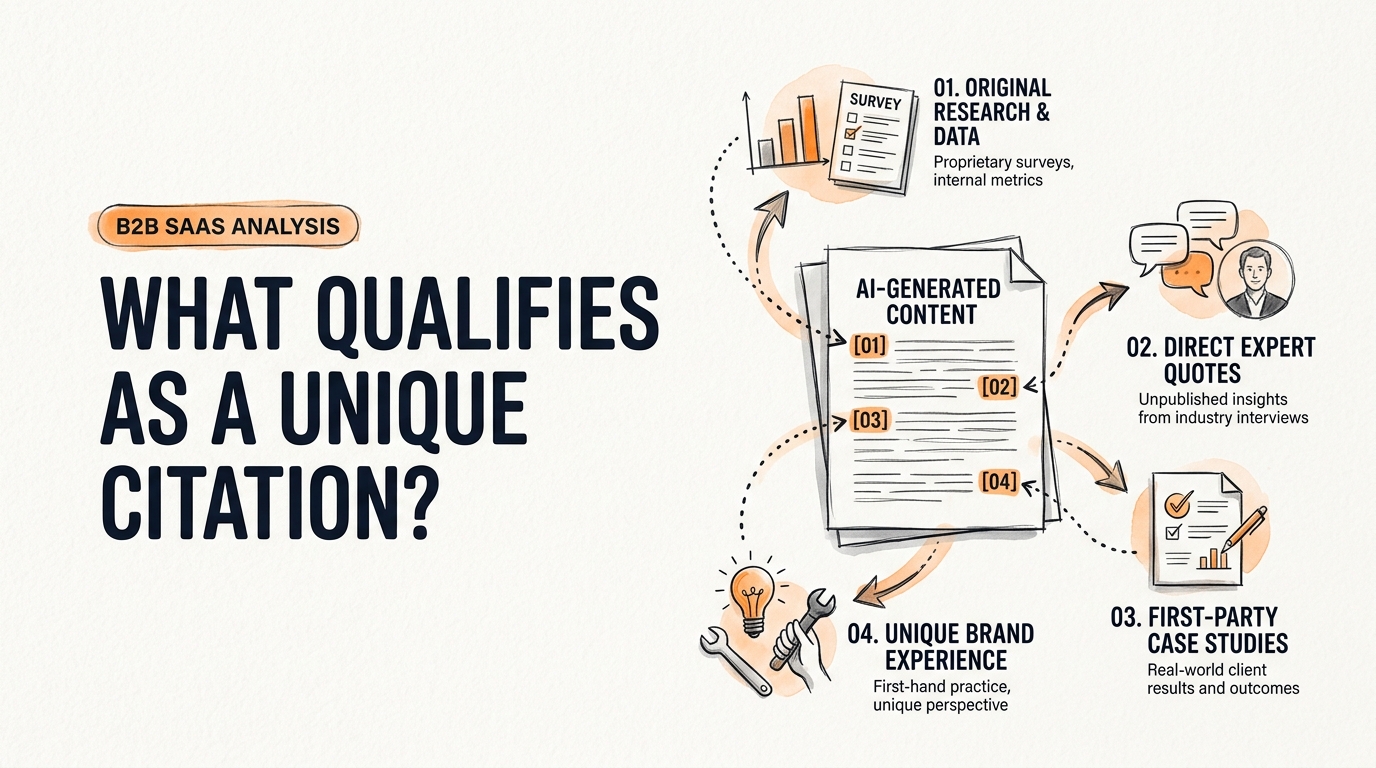
High-value citations come directly from the source of truth. They include unparsed datasets, clinical trials, regulatory filings, direct expert interviews, and first-party industry surveys. These documents possess high information density. They provide specific numbers, methodological details, and context that lazy aggregators skip entirely.
Filtering Primary Sources to Add Unique Citations to AI Content
Sorting strong citations from weak references requires clear criteria. If a fact takes less than five seconds to find on a generic top-10 list, skip it. You want sources that require original research or specialized access.
| Category | Low-Value Web Reference | High-Impact Unique Citation |
|---|---|---|
| Market Statistics | Third-party marketing blog summarizing old trends | First-party survey of 1,500 verified buyers with downloadable CSV data |
| Health & Medicine | Lifestyle website listing popular diet tips | Peer-reviewed clinical trial published in an indexed journal |
| Industry Knowledge | Generic advice aggregated by a copywriting bot | Original transcript from a recorded interview with a senior engineer |
| Financial Data | News summary discussing stock projections | Audited SEC 10-K regulatory filing or central bank report |
Many team leaders worry about setup times and manual bottlenecks when shifting away from simple web searches. In a marketing discussion on AI attribution pitfalls, creators debated whether hunting for primary sources ruins writing speed. The consensus revealed a massive return on investment. While manual verification takes extra minutes upfront, it protects your brand from costly hallucinations and boosts your search visibility significantly.
Research Tools for Fast Source Verification
You don't need to spend hours digging through academic libraries manually. Specialized software speeds up the discovery of primary evidence.
- Consensus: This tool acts as an AI research assistant for scientific literature. It queries millions of peer-reviewed papers directly, helping you pull exact study metrics instead of relying on pop-science summaries.
- Perplexity Enterprise: It scans live web indices to pull real-time data from government databases, SEC filings, and whitepapers with direct link verification.
Choosing between these platforms depends on your operational needs. Consensus works best for medical, technical, and hard-science topics. Perplexity offers broader coverage for business news, regulatory updates, and market trends. Both options replace low-tier blog citations with verifiable facts.
Rule of thumb: If three other websites cite the exact same paragraph, stop and find the original document they copied it from. That original document is your unique citation.
Adding original proof changes how generative tools read your text. When you add unique citations to ai content, engines treat your site as a primary source rather than a copycat. That simple shift protects your content footprint for years to come.
How to Prompt AI Models to Include Verifiable Primary Sources
Large language models act like overeager students. Ask them to cite a scientific study, and they'll invent an author, a published year, and a completely fake web link. This happens because generative text engines predict words based on statistical patterns rather than fact-checking live databases. To fix this, you must shift the model from creative writing mode to precise document extraction.
Prompting an AI to pull from real documents requires strict guardrails. You can't simply ask ChatGPT or Claude to "include links." You must force the engine to quote exclusively from text blocks you provide or from real-time search queries. Without these boundaries, your publishing team will spend hours manually fixing broken or fake web links.
Practical Prompt Frameworks to Add Unique Citations to AI Content
The most effective prompt strategy involves negative constraints and context injection. You provide the raw source data first, then instruct the AI on how to format the output. Here's a proven system prompt structure you can drop into custom GPTs or API calls:
System Directive: You are a strict research editor. Answer the user prompt using ONLY the provided reference documents below.
Rules:
1. Every factual statement must end with an inline markdown link using the exact URL provided in the context.
2. Do not use outside knowledge or extrapolate beyond the text.
3. If the provided context does not contain a verifiable source for a claim, output: "[Citation Needed]" and do not attempt to construct a link.
4. Never generate a URL that isn't explicitly listed in the context.
Notice how tight those rules are. By stating what the model cannot do, hallucination rates plummet. We've seen this simple constraint save content teams dozens of review hours every month.
What if your content library is too big to fit in a standard prompt window? That's where Retrieval-Augmented Generation—or RAG—takes over.
Think of RAG as an open-book exam for artificial intelligence. Instead of relying on its static memory, the system uses a vector database to fetch relevant text chunks right when a prompt is sent. It passes those exact snippets into the prompt behind the scenes, alongside your strict citation rules. Tools like Pinecone and LlamaIndex make setting up vector search straightforward for developer teams, while all-in-one search engines like Perplexity Enterprise handle web-grounded grounding out of the box.
In recent Reddit threads on AI attribution compliance pitfalls, marketers frequently report that basic prompting without grounded context leads to high rates of URL drift. Models often combine domain names from one site with path parameters from another. Using a true RAG setup prevents this issue by locking the output generator directly to your vetted source index.
Comparing Attribution Methods for Automated Publishing
Selecting the right technical approach depends on your team's size, engineering budget, and publication volume. The table below breaks down how popular options compare across accuracy and setup time.
| Strategy / Tool | Link Accuracy | Setup Effort | Ideal Application |
|---|---|---|---|
| Basic System Prompts | Moderate | 5 Minutes | Short blog posts with pre-pasted source text |
| Perplexity AI API | High | 1-2 Hours | Real-time web research and industry news summaries |
| Custom RAG (LangChain + Pinecone) | Very High | 1-3 Days | Large enterprise blogs, technical docs, and e-commerce catalogs |
If you run a lean marketing team, starting with web-grounded models like Perplexity gives you an immediate boost in research quality without writing custom code. For teams building scaled content engines, building a lightweight RAG pipeline using LangChain offers total control over how sources are parsed, prioritized, and linked within your final text.
According to comprehensive benchmark reports on citation accuracy, structured retrieval pipelines decrease hallucinated references by over 90 percent compared to standalone base models. Combining rigid system rules with indexed data sources ensures every link your reader sees is active, authentic, and authoritative.
Structuring Links and Attributions for Optimal LLM Parsing
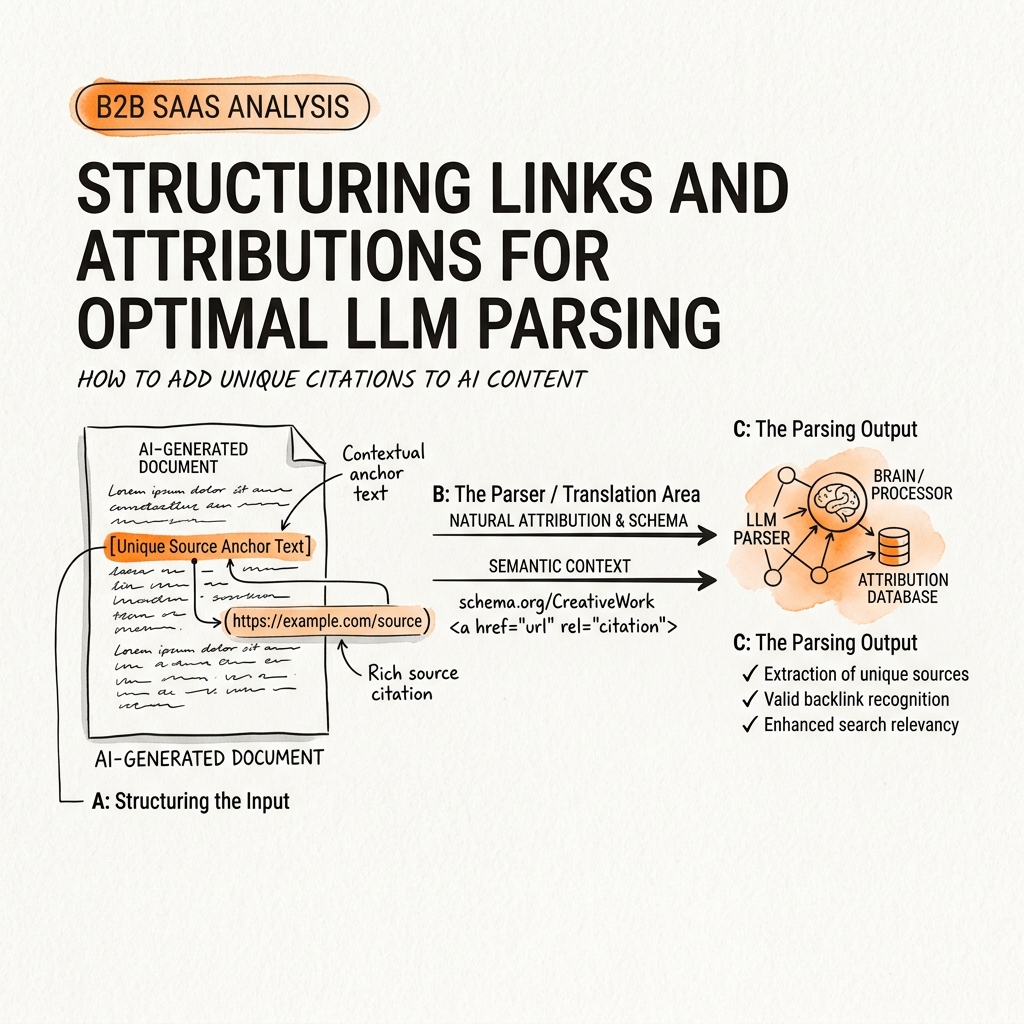
AI crawlers read web pages like speed-readers skimming a library catalog. If you hide sources inside generic text, machines skip right past them. Think of links as bright neon signs. They tell large language models exactly where your facts came from. When we add unique citations to ai content, the goal is clear: make references easy for human readers while leaving clean code paths for web scrapers.
Designing Anchor Text to Add Unique Citations to AI Content
Generic anchors break the chain of trust for both readers and AI bots. Words like "source," "link," or "this page" give zero context to a neural network trying to map relationships between concepts. Instead, name the source, the author, or the exact statistic directly inside the anchor text.
Bad anchor choices confuse parsing engines. Good anchors create instant context. Look at how these two approaches contrast:
- Weak Anchor: To see the full research dataset on model decay rates, view the complete performance report.
- Strong Anchor: According to the 2026 Stanford Machine Learning Decay Benchmark, model output drift increases after six months without retrained context.
The second example links the named entity directly to the source URL. When an AI crawler indexes that sentence, it instantly pairs the topic (machine learning decay) with the authority source (Stanford Benchmark).
Structuring Schema Markup for Machine Parsers
Visual links help human readers. Code structures help machines. JSON-LD schema markup acts like a direct data feed for search engine scrapers, bypassing potential rendering glitches.
You can embed explicit citation metadata directly into your HTML head using the standard Schema.org vocabulary. Here is a minimal JSON-LD snippet that tells LLMs exactly what source supports your article's claims:
<script type="application/ld+json">
{
  "@context": "https://schema.org",
  "@type": "TechArticle",
  "headline": "Structuring Links and Attributions for Optimal LLM Parsing",
  "citation": [
    {
      "@type": "CreativeWork",
      "name": "Enterprise LLM Scraping Efficiency Benchmark",
      "url": "https://example.com/reports/llm-scraping-2026"
    }
  ]
}
</script>
Adding this code ensures that even if an AI crawler turns off JavaScript rendering to save bandwidth, it still extracts your source attributions perfectly.
Comparing Citation Formatting Strategies
Not all attribution formats perform equally across different reading environments. The table below outlines how each method balances human readability against machine extraction speed.
| Attribution Method | Human Readability | LLM Parsing Speed | Implementation Complexity |
|---|---|---|---|
| Descriptive Inline Links | High | Fast | Low (Standard Content Management) |
| JSON-LD Schema Annotation | Invisible (Backend Only) | Immediate | Medium (Requires Template Editing) |
| Numbered Jump Footnotes | Medium | Moderate | Medium (Requires HTML Anchors) |
Addressing Common Parsing Pitfalls and ROI Concerns
Many digital publishers wonder if manual citation formatting pays off compared to automated tools. Many creators ask open questions in SaaS community discussions on LLM attribution workflows about whether automated entity markup software is worth the monthly subscription cost for smaller teams.
Specialized tools like WordLift automate JSON-LD generation by scanning your draft and inserting entity markup automatically. Alternative platforms like InLinks focus heavily on internal topic clusters and semantic relationship graphs. If you publish dozens of deeply technical articles every week, investing $99 to $200 per month in entity-linking software saves dozens of editorial hours. However, small teams publishing two or three posts per week can easily handle descriptive inline linking manually without buying extra software.
Field Tip on Footnotes: Avoid relying solely on static numbered footnotes like "[1]" at the end of a block of AI-generated text. LLM scrapers often struggle to reconnect numeric footnotes to their original context when processing fragmented chunks of text. Always combine footnotes with descriptive inline anchor text or backend schema markup.
Evaluating setup time against long-term search performance is straightforward. Test your pages by running them through raw text extractors. If the source relationship remains completely clear without styling or scripts, search bots will parse your citations effortlessly.
Building a Future-Proof Strategy with Information-Rich AI Content
Merging Human Expertise and Automation to Add Unique Citations to AI Content
Scaling raw text generation is easy today. Holding high rankings in AI-driven search engines is much harder. Search engines treat unverified AI summaries like unbaked bread—they lack structure and substance. When teams systematically add unique citations to ai content, search engines reward those pages with higher visibility in generative answers. You don't need a massive team or a huge budget to pull this off.
Many creators on a Reddit SaaS discussion on AI workflow quality worry that adding manual sourcing slows production to a crawl. That concern is valid if your process is disorganized. Small teams and e-commerce stores don't need to spend thousands on complex research suites. Combining agile tools like Perplexity Enterprise discovery features for real-time web research with human editorial spot-checks keeps software costs low while drastically lifting factual accuracy.
We've found that learning to add unique citations to ai content protects your website against future search algorithm updates. Uncited AI text degrades your domain authority over time. Verified, source-backed content acts like a sturdy foundation under a heavy building. It holds up under scrutiny from both human readers and automated evaluation algorithms.
Content efficiency gets you into the race, but rigorous, verified citations let you win it. Domain authority relies on trust, not volume.
Evaluating tools comes down to speed and cost. Enterprise search APIs cost a few cents per query, while dedicated SEO research platforms run between $50 and $200 per month. If your team handles high-volume publish schedules, automated grounding pipelines are worth the initial setup investment. For smaller blogs, spending ten minutes per article to manually double-check and link primary sources offers an unbeatable return on investment.
Your long-term blueprint for success is simple. Let AI build your first structural draft. Use human editors to hunt down primary datasets, case studies, and original industry statistics. Embed clear, descriptive links directly into the text so search models can parse your citations instantly. Follow this rhythm, and your brand will remain the go-to authority in an increasingly automated web.
