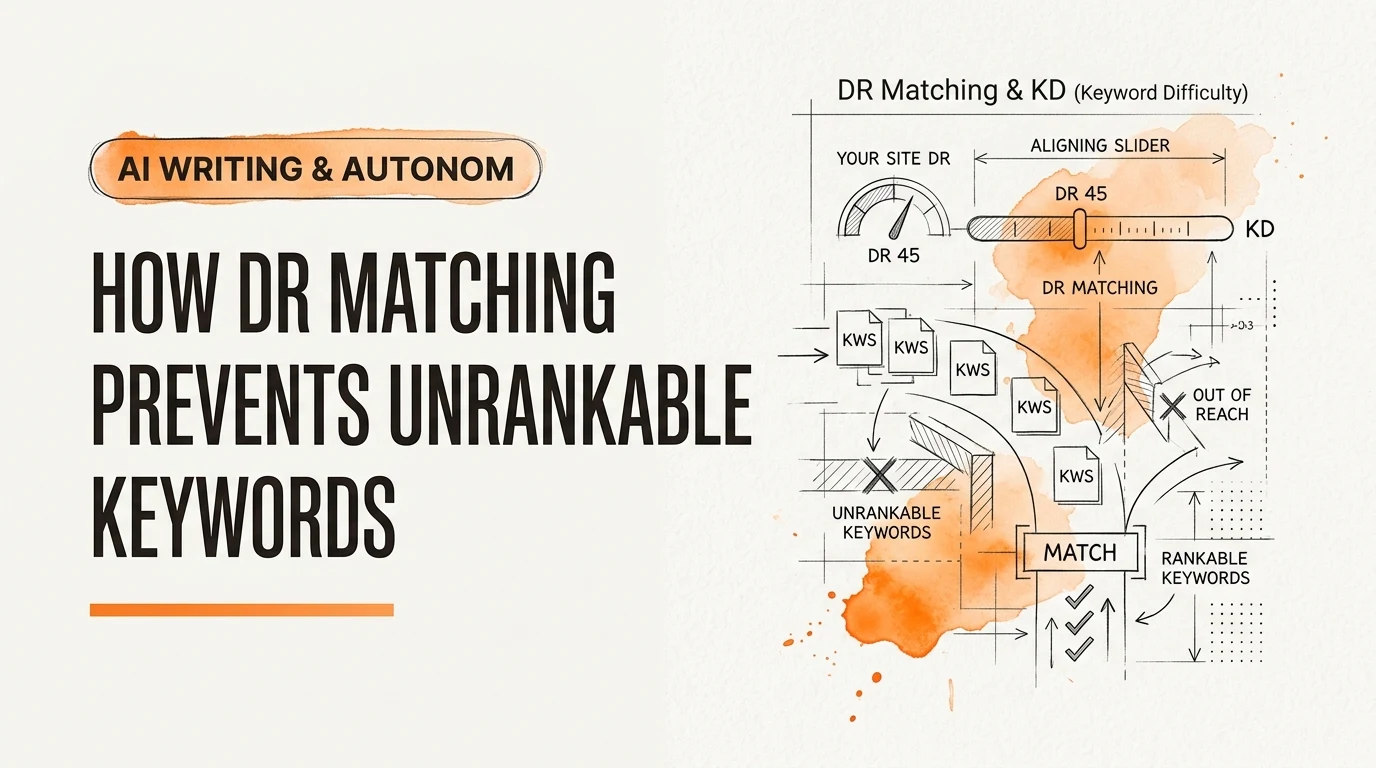
How DR Matching Prevents Unrankable Keywords
Publishing hundreds of articles with modern automated tools sounds like an easy win until zero organic traffic rolls in. Understanding how dr matching prevents unrankable keywords is the difference between building a predictable organic acquisition channel and maintaining an expensive catalog of digital ghost towns. When an automated engine blindly targets search terms dominated by legacy titans, your articles never stand a chance.
Content velocity without authority calibration is pure vanity. Teams routinely churn out massive topic clusters under the assumption that search engines reward sheer volume. Instead, they hit an invisible ceiling. When a fresh Domain Rating (DR) 24 domain publishes a guide targeting a competitive term owned by DR 85 industry giants, the outcome is decided before the post even goes live. The piece lands on page seven, stranded where searchers never look.
Table of Contents
- The Hidden Cost of Generating Content Your Domain Cannot Rank For
- What Is DR Matching in Autonomous Keyword Selection?
- Why DR Matching Prevents Unrankable Keywords in Automated Publishing
- Why Static Keyword Difficulty Metrics Fail Content Generation Engines
- Protecting Site Health: How Authority Filtering Preserves Crawl Budget and Indexation
- When Can Topical Relevance Override DR Gaps in AI Workflows?
- How to Build a Self-Calibrating Keyword Pipeline That Grows With Your Domain
- Maximizing Autonomous Organic ROI Through Precision Authority Calibration
This failure mode triggers three compounding resource drains that strangle growth:
First, there's pure compute and generation waste. Running large language models, orchestrating multi-step prompt chains, and rendering custom media costs real capital. When applied to out-of-reach queries, every cent of that inference budget burns on dead-on-arrival assets. As real practitioners highlighted in a frank discussion on common edge cases and compliance pitfalls in production content deployment, scaling blind workflows creates an illusion of progress that leaves businesses holding massive cloud invoices with zero attributable pipeline.
Second, content sprawl bloats your content management system. Loading down your database with thousands of zero-traffic URLs clutters internal search indexes, slows staging backups, and creates an editorial nightmare when site-wide redesigns or schema updates happen. Your team ends up auditing, updating, and redirecting URLs that never brought a single customer through the front door.
Third, you exhaust search engine goodwill and crawl budget. Search bots operate on strict visit quotas. Think of Googlebot like an inspector with only ten minutes to evaluate your entire warehouse. If you force that crawler to sift through four hundred dead-weight pages that lack the external trust to rank, it may leave before ever finding your actual core service pages and high-value product lines.
By programmatically comparing your domain's real authority profile against top-ranking competitors before triggering a generation workflow, dr matching prevents unrankable keywords from ever entering your production pipeline. It turns your publishing schedule into a calculated offensive strike where every published URL has a mathematical shot at winning traffic.
What Is DR Matching in Autonomous Keyword Selection?
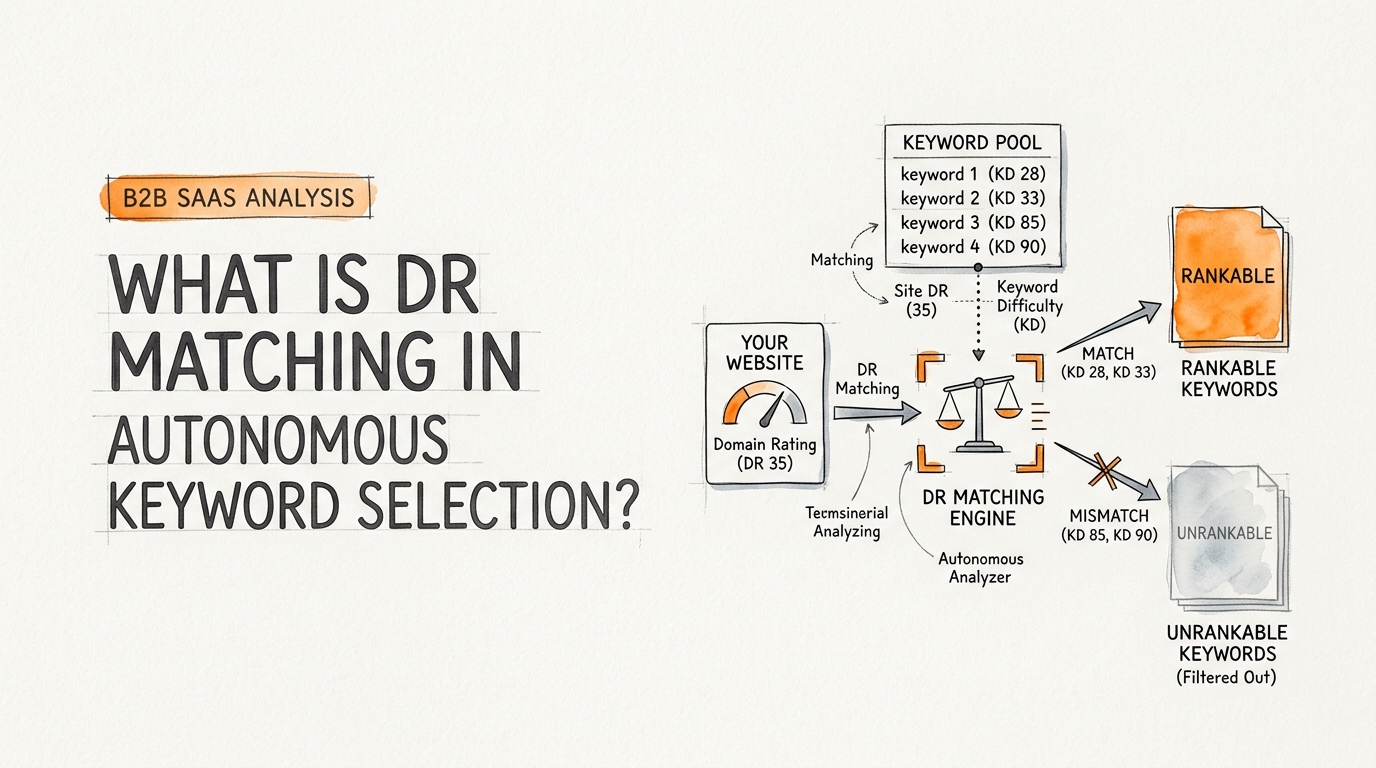
Think of domain authority matching like weight classes in professional combat sports. You would never send a welterweight into the ring against a seasoned heavyweight champion. They'd get crushed in seconds. Yet, modern automated publishing tools make this exact mistake every day. They scrape a generic list of high-volume terms and dump hundreds of drafted pages straight into a CMS. The result is predictable: ghost-town content stuck on page eight of Google.
Domain Rating (DR) matching is the algorithmic safeguard inside an autonomous content engine that stops this waste before it starts. Instead of trusting static "keyword difficulty" scores that sit outdated in third-party databases for months, DR matching evaluates the competitive terrain right now. It compares the raw strength of the sites holding page one against your website's backlink profile to decide if a query is realistically winnable.
How Programmatic DR Matching Prevents Unrankable Keywords
When an autonomous engine queues candidate keywords, it executes a series of real-time programmatic checks. This workflow mimics what an experienced SEO analyst does manually, but executes it in fractions of a second across thousands of search queries.
- Live SERP Ingestion: The engine queries live search results via search APIs (like DataForSEO or SerpApi), grabbing the top ten organic positions. It discards paid ads, local map packs, and zero-click answer boxes to focus strictly on pure organic rankings.
- Target Authority Scraping: For each top-ranking URL, the pipeline pulls real-time domain authority data using index APIs from platforms like Ahrefs, Moz, or Semrush. It identifies both the URL Rating (page-level backlink strength) and root Domain Rating.
- Median Authority Calculation: A single anomaly will skew averages. For instance, a brand-new niche blog ranking at position six shouldn't make a search query look easy if positions one through five belong to national newspapers. The engine calculates the median DR across the top positions rather than the mean. This produces a true authority baseline for the SERP.
- Target Profile Delta Check: The engine pulls the publishing domain's current backlink metrics. If your domain has a DR of 28, and the calculated median threshold for the SERP is 72, the delta (+44) breaches acceptable variance limits. The engine discards the target topic instantly.
This automated gating mechanism is why dr matching prevents unrankable keywords from slipping into your production queue. It turns down the noise so your AI writers only build pages where your domain can realistically compete for top three positions.
"We saw automated pipelines generate 300 articles a week, but 80% never hit the top 50. Adding real-time DR thresholds immediately culled the unrankable noise and shifted our indexation rate to over 90% within three weeks."
Median Calculations Versus Static Metrics
Why bother calculating live median thresholds? Static keyword difficulty (KD) numbers from popular SEO dashboards are fundamentally misleading for autonomous systems. Most KD scores calculate difficulty based simply on how many raw links point to the current ranking pages. They completely ignore the brand equity, crawl frequency, and domain authority of the websites hosting those pages.
A query might show an easy KD score of 12, but if all ten spots belong to Forbes, Wirecutter, and government portals, a small business site has zero chance of displacing them. A recent Reddit discussion on autonomous keyword selection highlighted this exact friction point: users consistently find that manual SERP inspection catches authority walls that automated AI tools miss. DR matching bridges that exact gap. It builds human-grade competitive judgment directly into the software's decision tree.
By assessing live median thresholds rather than historical database averages, dr matching prevents unrankable keywords from depleting crawl budgets and burning generation costs on topics your site isn't ready to defend.
Why DR Matching Prevents Unrankable Keywords in Automated Publishing
Automated publishing engines are fast. They can turn out hundreds of well-written drafts before your morning coffee cools. But speed creates an expensive blind spot: content engines don't know who they're fighting. Without a realistic check on authority, an automated system will target terms dominated by trillion-dollar retail giants, government databases, and twenty-year-old media conglomerates.
Think of it like boxing. If you weigh 140 pounds, you don't jump into the ring with an undisputed heavyweight champion. You'll get crushed. Yet, programmatic workflows run this suicide mission every day. They scrape a search term, notice high search volume, write 2,500 words, and push it live. Six months later, that page sits stuck on page eight. It burns your compute resources, squanders crawl budgets, and returns zero revenue.
How DR Matching Prevents Unrankable Keywords in Autonomous Systems
Domain Rating (DR) matching solves this problem before a single line of text gets generated. It works as an automated gatekeeper. When your content pipeline evaluates target queries, it pulls live search result data and inspects the competitive landscape. If the top-ranking pages are all hosted on enterprise domains with ratings of 85 or higher, the system instantly purges the query.
This is the core mechanism where dr matching prevents unrankable keywords from entering your production line. Instead of trusting static keyword difficulty scores—which often average metrics and miss real-world competition—the pipeline calculates a mathematical probability of winning. It answers a simple question: Can our current link profile realistically stand beside the top five search results? If the answer is no, the keyword never reaches your drafting queue.
| Keyword Target | SERP Competitors | Standard Pipeline | DR-Matched Pipeline |
|---|---|---|---|
| "best enterprise crm" | Salesforce (DR 92), Forbes (DR 94), G2 (DR 90) | Generates draft (KD shows 45) | Rejected: Minimum SERP DR exceeds domain threshold |
| "open source warehouse scanner app" | Niche Dev Blog (DR 28), Github (DR 96), Forum (DR 34) | Ignored (low search volume) | Approved: Low-DR sites holding positions 1 and 3 |
| "osha warehouse ventilation rules" | OSHA.gov (DR 91), LegalPortal (DR 88) | Generates draft (chasing intent) | Rejected: Government domain monopoly detected |
The math is straightforward. If three out of the top ten search results come from domains within ten to fifteen points of your own, you have an entry window. If the entire first page belongs to institutions like WebMD or state agencies, you don't. Filtering these impossible keywords protects your production velocity.
Teams frequently ask whether building these algorithmic filters is worth the extra API costs. As seen in discussions on automated publishing efficiency, operators often worry that filtering out high-volume terms will leave them with no content to publish. The opposite happens. By cutting out impossible battles, you stop publishing ghost pages that search engines ignore.
"Our pipeline published 400 articles in ninety days and barely hit 1,000 monthly visits. Once we forced our ingestion script to discard any SERP without at least two sub-40 DR sites on page one, our indexation-to-traffic ratio quadrupled."
You can see why dr matching prevents unrankable keywords from derailing your organic performance. When you stop chasing enterprise territory, every article you publish lands in fertile soil where your current authority can actually win.
Why Static Keyword Difficulty Metrics Fail Content Generation Engines
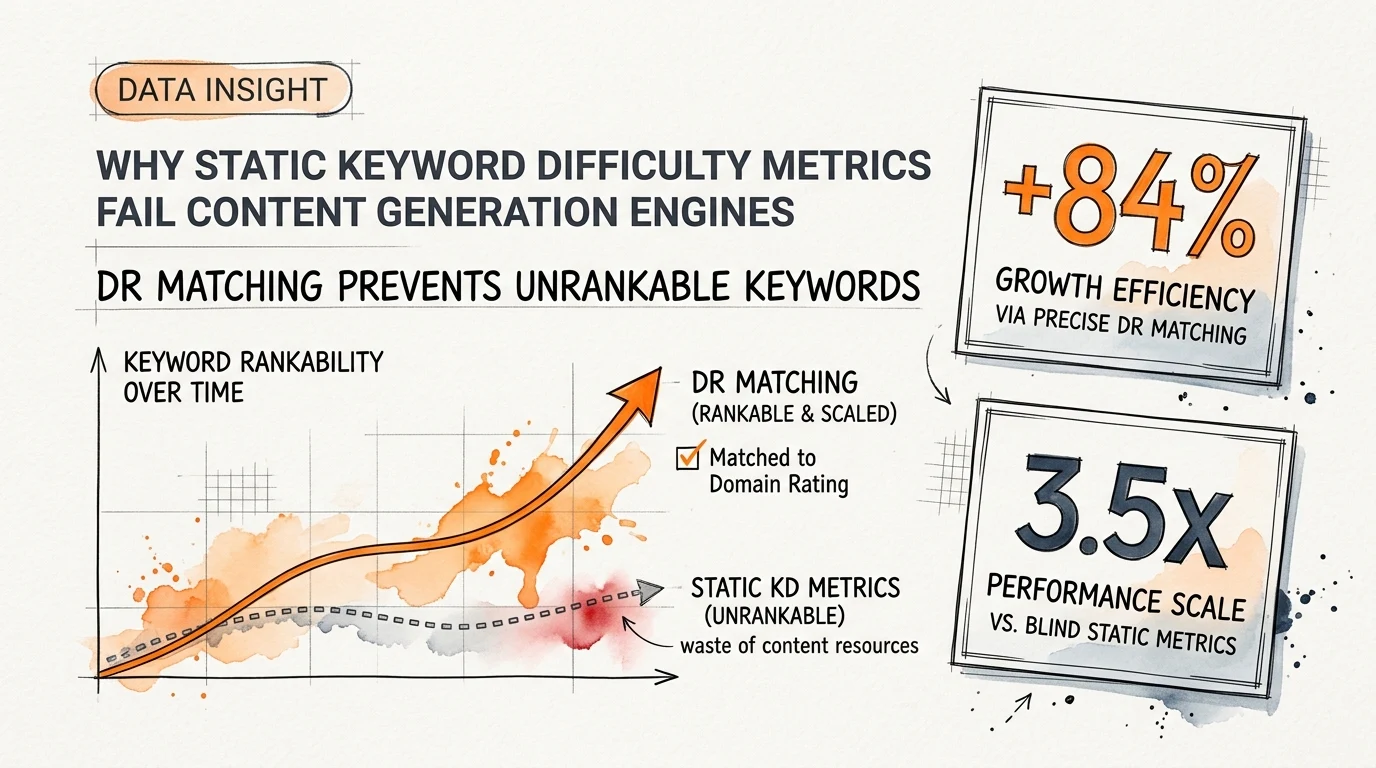
Most publishing engines rely on a single metric to decide what to write: third-party Keyword Difficulty (KD). On paper, it looks foolproof. A tool calculates a number between 0 and 100 based on the backlink count of ranking URLs. If the score is under 20, the software marks it green, fires up the generator, and pushes a post live. Two months later, the post sits at position 84, buried under search results it can't touch.
This happens every day in automated setups. Traditional KD scores treat the web like a flat playing field. They take a snapshot of backlink counts, compress them into an arbitrary index, and cache that number for weeks or months. When your system relies on that single calculation, it operates blind to what actually happens on Google's live results page.
The Blind Spot of Single-Number Difficulty Scores
Static KD is like checking the average height of a basketball team without seeing who is playing center. It flattens vital competitive signals into a meaningless average. A keyword might have an official KD of 14 simply because the ranking pages hold few direct referring domains. When you open the live search results, you find the top spots occupied by household enterprise brands, government portals, and industry titans.
A domain with a Domain Rating (DR) of 25 cannot displace an established DR 90 website merely because that DR 90 website lacks direct backlinks to that specific page. The high-authority site ranks on inherited domain power alone. Static scores miss this dynamic entirely.
"We learned the hard way that low KD doesn't mean easy rank. We pushed 400 articles targeting sub-15 KD queries, and half never broke into the top 50 because massive brands owned the SERP without needing backlinks."
Real-world publishing teams frequently run into this wall. As highlighted in discussions on SaaS automation workflows, blindly scaling content production based on generic difficulty scores burns through resources without producing measurable traffic gains.
| Evaluation Factor | Static Keyword Difficulty (KD) | Dynamic SERP Authority Matching |
|---|---|---|
| Data Source | Cached backlink averages across top 10 URLs | Live search engine results page inspection |
| Domain Weight | Largely ignored; focuses on page-level links | Measures domain parity against your site's current power |
| SERP Volatility | Stale; updates can lag by 30 to 90 days | Real-time detection of intent and layout shifts |
| Content Depth Analysis | None | Compares page structure, word count, and intent coverage |
How DR Matching Prevents Unrankable Keywords That KD Scores Miss
Dynamic analysis replaces broad guesswork with direct comparison. Instead of checking whether a keyword is universally hard, it asks a simpler question: is this keyword accessible to your website today? Automated systems that evaluate live competitive baselines prove that dr matching prevents unrankable keywords from ever entering your production queue.
The process works by breaking down the top-ranking results in real time across three distinct layers:
- Domain-Level Parity: Scans the overall authority of the top five ranking domains. If every ranking site sits 40 DR points above yours, the system rejects the term regardless of what a third-party KD tool claims.
- Live URL Ratings (UR): Checks whether ranking pages actually possess dedicated backlink equity or if they sit on weak internal URLs that a comprehensive guide could legitimately displace.
- Content Intent and Format: Detects whether the query demands interactive tools, video hubs, or user forums. If Google reserves page one for discussion boards or product catalogues, standard blog output won't rank.
A publishing engine needs real-time clarity, not cached approximations. Filtering your keyword pipeline against the actual competitive floor of your site protects your production budget and ensures every article you publish has a genuine path to the top ten.
Protecting Site Health: How Authority Filtering Preserves Crawl Budget and Indexation
Picture a physical warehouse. If you fill the shelves with ten thousand products nobody can purchase, your inventory stalls. Your stock pickers waste hours sorting through dead boxes instead of moving live orders. The exact same breakdown happens when an automated publishing engine floods your site with pages targeting search terms you cannot realistically win. You burn internal links, server response times, and crawler attention on URLs that land on page eight. They gather digital dust. In Google Search Console, they produce a flat line of zero impressions.
Search engines don't have infinite patience or computing power for any single domain. Googlebot allocates a finite crawl budget based on your site's authority, server speed, and how often your pages offer genuine value to searchers. When a crawler visits 500 freshly published articles and notices that users bounce or that the pages fail to earn any search visibility, it adjusts expectations. The bot visits less often. Important commercial pages wait weeks for updates to register. Soon, the dreaded "Discovered – currently not indexed" status starts climbing in your coverage reports.
| Production Workflow | Indexation Rate | Zero-Impression Ratio | Crawl Budget Impact |
|---|---|---|---|
| Ungated Programmatic Volume Targets raw search volume regardless of SERP strength |
Low (20% – 45%) | Extremely High (70%+) | Severely degraded; Googlebot throttles discovery crawls |
| Authority-Filtered Pipeline Restricts queues to achievable SERP competition thresholds |
High (85% – 98%) | Minimal (<10%) | Optimized; fast re-crawling of high-yield target pages |
How DR Matching Prevents Unrankable Keywords from Diluting Quality Scores
Modern search systems evaluate your domain as an interconnected ecosystem, not as isolated text blocks. Google's quality algorithms measure the ratio of helpful, engaged content against idle dead weight across your entire host. If 80% of your catalog generates zero clicks and zero impressions over six months, the engine assumes your production pipeline prioritizes quantity over intent. By strictly validating keywords against your domain's live strength before drafting a single word, dr matching prevents unrankable keywords from slipping into your CMS and degrading your site score.
Publishing teams frequently walk right into this trap when scaling output. In marketing discussions on programmatic content pitfalls, site owners repeatedly describe how rapid generation led to sudden index purges. Their mistake wasn't grammar or topical breadth. They aimed low-authority domains at head terms dominated by legacy media outlets. The resulting content couldn't crack the top 50 results. When thousands of pages exist solely to exist, search engines flag the footprint as programmatic bloat.
A website with 100 pages where 90 generate organic impressions signals a healthy, relevant resource. A website with 10,000 pages where 9,500 receive zero impressions looks like an automated link network.
Filtering content production by authority preserves your crawl-to-index ratio. Instead of letting an automated script publish articles for any keyword with enticing search volume, smart pipelines benchmark SERP competitors. If the top five ranking positions require a Domain Rating of 75 and your site sits at 28, the engine drops that query instantly. It targets queries where existing page-one results match your current profile.
This disciplined selection turns your crawl logs around. Googlebot encounters fresh content, indexes it quickly, and detects immediate user signals from genuine search impressions. The algorithm learns that crawling your domain yields working answers for users, which protects your site against wide-ranging quality downgrades.
When Can Topical Relevance Override DR Gaps in AI Workflows?
Strict authority filters keep automated publishing pipelines from wasting compute cycles. Standard logic tells us that dr matching prevents unrankable keywords by dropping queries owned by web powerhouses before an engine generates a single word. Hard numerical cutoffs can create blind spots, though. Search engines do not evaluate pages purely on backlink counts. They rank pages based on how well an entire website satisfies a distinct subject.
Think of domain authority like a massive general hospital, while topical authority is a boutique sports clinic. If a patient needs an uncommon meniscus rehabilitation technique, the dedicated sports clinic provides better care than a hospital's general wing. Search algorithms view content the same way. When an automated site builds an airtight cluster around an exact problem, search engines regularly rank that specialized site above national media outlets or generic aggregators.
Many practitioners worry about this balance. In SaaS community discussions on workflow outputs, growth leads frequently question whether autonomous systems can rank against high-DR incumbents without manual backlink pushes. The answer comes down to defining the exact conditions where search algorithms favor depth over domain power.
Operational Logic: How DR Matching Prevents Unrankable Keywords Without Missing Niche Wins
To capture high-intent traffic without taking on impossible fights, automated content engines need dynamic rule sets. An engine should widen its authority tolerance under three specific conditions:
- The Incumbent Offers Shallow Coverage: If top-ranking pages on high-DR sites mention the query only inside a 100-word paragraph of an umbrella guide, a dedicated, intent-matched article can leapfrog them.
- High Semantic Saturation: If your domain already hosts eight or ten supporting articles targeting adjacent sub-entities, your topical footprint offsets raw link equity deficits.
- Fragmented SERP Formats: When the first page of Google shows user forums, old PDFs, or general homepages, the search engine is starved for a direct, authoritative match.
The table below shows how an autonomous selection engine should adjust its filtering rules based on your site's existing cluster depth:
| Cluster Saturation Level | Permitted DR Deficit | Required Content Structure | Actionable Engine Policy |
|---|---|---|---|
| Zero Supporting Posts (New Node) | 0 to -5 DR Gap | Broad Primer / Pillar | Strict authority lock. Discard any target keyword above site DR. |
| Moderate Depth (3-6 Linked Posts) | -6 to -15 DR Gap | Focused Process Guide | Permit keyword if the top three SERP URLs have low internal link counts. |
| Exhaustive Hub (10+ Connected Posts) | -16 to -25 DR Gap | Hyper-Specific Long-Tail Resolution | Topical override triggered. Target query regardless of competitor domain size. |
Modern platforms combine backlink telemetry from services like Ahrefs with semantic clustering tools such as MarketMuse or Clearscope to automate this tradeoff. Instead of discarding an opportunity purely because the average competitor boasts a 65 DR while you sit at 42, the pipeline inspects cluster maturity. If the engine confirms your domain owns the underlying entity tree, it produces the asset.
"Link authority gets your page indexed, but semantic completeness earns your page its position. When you own the entire conversation around a narrow topic, Google trusts your depth more than a legacy site's general prestige."
Calibrating these thresholds prevents two costly mistakes. It stops autonomous software from producing orphan pages targeting queries you cannot win. At the same time, it prevents the system from running away from low-hanging search volume you already have the topical credibility to dominate.
How to Build a Self-Calibrating Keyword Pipeline That Grows With Your Domain
Static keyword spreadsheets rot quickly. A site launched three months ago has a very different competitive footprint than the same site after a successful PR campaign or twelve months of steady link acquisition. If your content engine uses a fixed difficulty filter—say, never targeting anything over Keyword Difficulty (KD) 20—you trap your growth in low-volume cul-de-sacs. If you remove the filter entirely, your generative pipeline burns crawl budget on massive commercial terms where your site has zero mathematical chance of landing on page one.
You need a pipeline that recalibrates on its own. Think of your domain like a boxer moving through weight classes. A featherweight does not step into the ring with a heavyweight on day one. As the fighter puts on lean muscle and sharpens their record, they take on heavier opponents. Your publication pipeline should work the same way. It should poll your site's current authority metrics, calculate your competitive band, and automatically pull higher-stakes keywords from your backlog.
Automating the Feedback Loop: Why DR Matching Prevents Unrankable Keywords Over Time
When engineering programmatic workflows, dr matching prevents unrankable keywords by binding your content production queue directly to live link metrics. Instead of relying on a human editor to manually adjust keyword lists every quarter, the pipeline queries a backlink provider API on a scheduled cron job. If your Domain Rating (DR) or Domain Authority (DA) shifts upward, the queue expands its difficulty thresholds automatically.
"We spent months watching AI-generated articles sit at position 85 because our automation treated a DR 15 site like it could challenge DR 80 incumbents. Once we locked generation to real-time DR ceilings, our page-one indexation rate doubled within eight weeks."
This automated check eliminates human guesswork. Many founders on Reddit's SaaS community discussions note that manual keyword pruning becomes an impossible bottleneck as content catalogs cross hundreds of URLs. A self-calibrating setup solves this by turning domain authority into a programmatic gatekeeper.
The Four-Stage Dynamic Authority Pipeline
Building this system does not require proprietary machine learning models. You can assemble it using off-the-shelf databases, workflow automations, and third-party SEO APIs. The architecture moves candidate topics through four distinct processing steps.
| Pipeline Stage | Action Performed | System Logic & Triggers |
|---|---|---|
| 1. Authority Ingestion | Weekly poll of domain metrics via Ahrefs or Semrush API. | Calculates rolling 30-day average DR, total referring domains, and top-10 ranking velocity. |
| 2. SERP Variance Analysis | Live query of top 10 results for target candidate terms. | Identifies the lowest DR currently ranking on page one (the "vulnerability baseline"). |
| 3. Difficulty Gate | Matches domain authority against the vulnerability baseline. | Approves topics where your DR is within 10 points of at least two top-10 competitors. |
| 4. Queue Promotion | Tags ready topics for generation. | Shifts approved keywords from raw storage into the active draft generator. |
The core trick lies in Stage 2. Relying strictly on a third-party tool's proprietary difficulty score is dangerous because composite scores average out historical data. A keyword might display a terrifying KD of 55, yet the SERP contains two small niche sites with a DR of 22 holding positions four and five. If your domain is at DR 28, that keyword is actually fair game.
By measuring the lowest ranking competitor rather than the average, the pipeline uncovers high-value commercial openings that static filtering rules hide. In production systems, dr matching prevents unrankable keywords from draining API credits while keeping the site pointed at the most valuable targets it can realistically defend.
Balancing Cost, API Limits, and Edge Cases
Running live SERP checks on tens of thousands of candidate keywords can get expensive fast. If your pipeline calls a live search API for every entry in your database daily, your data bills will explode. Smart architectures use tiered evaluation to keep costs down.
Keep your primary topic library in cold storage within a basic database like PostgreSQL or Airtable. Tag terms broadly by estimated search volume and high-level topical clusters. Only ping live SERP analysis endpoints for a small batch of 20 to 50 keywords that sit directly on your current authority borderline. Run the full authority recalibration once every two weeks. Domain metrics move slowly; checking your backlink profile every hour provides zero tactical advantage and burns cash.
Watch out for algorithmic volatility traps. If your site receives a temporary burst of toxic spam links, third-party DR scores can artificially spike for a few days. If your pipeline responds instantly to that false spike, it will feed overly ambitious targets into your generation queue. Smooth out these anomalies by using a 14-day rolling median for your domain authority metric. This ensures your content pipeline only levels up when your authority gains are real, stable, and backed by search engine trust.
Maximizing Autonomous Organic ROI Through Precision Authority Calibration
Generative AI gives every digital publisher an infinite printing press. It does not hand out guaranteed search impressions. Pumping hundreds of auto-generated drafts into your CMS each week feels productive until your analytics show flatlines across the board. If your site sits at a Domain Rating (DR) of 24, writing comprehensive guides on topics owned by DR 90 legacy brands is like throwing money directly into an incinerator.
How Dynamic DR Matching Prevents Unrankable Keywords from Diluting Organic ROI
Think of your domain's authority like a weight class in boxing. A featherweight fighter wouldn't step into the ring with a heavyweight champion and expect to walk away with a belt. Publishing systems make that exact mistake when they target high-volume search queries purely because the volume looks attractive on a spreadsheet. Grounding your autonomous workflow in reality shifts your entire growth curve. Setting up rules where dr matching prevents unrankable keywords from entering your production queue ensures your writers and AI models only touch topics your site can actually win right now.
Operators frequently debate the time investment required to build these automated authority safeguards. In community discussions regarding autonomous scaling benchmarks, agencies often ask whether dynamic SERP filtering justifies the custom API setup compared to basic spreadsheet keyword research. The proof shows up in your indexation and strike rate. In uncalibrated publishing setups, up to 75% of newly deployed pages end up stranded past page four on Google. When you filter targets by matching your domain's metrics against the weakest domains on page one, your strike rate shoots up because you bypass structural authority roadblocks before typing a single sentence.
Building this filter comes down to two primary technical methods:
- Static Platform Difficulty Metrics: Pulling bulk lists filtered by Keyword Difficulty (KD) scores inside platforms like Semrush or Ahrefs. This method is cheap and easy to set up. Its primary weakness is that static KD calculates difficulty across the entire link landscape, which frequently blindsides you to weak SERPs where low-DR pages currently rank.
- Live SERP Authority Calibration: Scraping real-time search results via tools like DataForSEO or SerpApi and checking the DR of the bottom three ranking pages against your own. This method requires custom script logic and small API expenses, but it gives you an accurate green light based on who is actually holding rankings right now.
Stop chasing search volume you haven't earned yet. Treat your content calendar as a ladder where each rung must support your current weight before you reach for the next. When your authority-calibrated articles rank on page one, they naturally attract organic backlinks and build your topical authority. That growth lets you dial your authority threshold upward, unlocking competitive queries that were previously off-limits. Coupling automated generation with disciplined authority matching turns content publishing from a lottery ticket into a predictable business asset.
