What is Generative Engine Optimization (GEO)?
Generative Engine Optimization (GEO) is the engineering practice of structuring digital content, schema metadata, and semantic facts so Large Language Models and AI search engines cite your domain as an authoritative source in synthesized answer cards. With Google AI Overviews, Perplexity Pro, and ChatGPT Search altering consumer discovery patterns, traditional SEO ranking tactics must evolve into citation engineering.
The Core Signals Generative Engines Seek
Large language models do not rank content solely by backlink quantity. Instead, their RAG (Retrieval-Augmented Generation) retrieval pipelines prioritize clear semantic signals:
- Information Gain: Unique empirical findings, benchmarks, or original datasets not replicated elsewhere in the web index.
- Direct Answer Syntax: Crisp, unambiguous 40 to 60-word definitions positioned directly beneath H2 question headers.
- Semantic Schema Graphs: Interconnected JSON-LD entities linking Organization, TechArticle, and FAQPage nodes.
- Domain Consensus Alignment: Technical assertions corroborated by established industry consensus and cited authorities.
Engineering Content for LLM Ingestion
To maximize your citation rate in AI Overviews, format your articles with distinct syntactic patterns. Use bulleted feature matrices, labeled step-by-step implementation code, and concise key-takeaway summary callouts. Avoid generic fluff and filler paragraphs that LLM compression filters discard during semantic chunking.
Automated Schema Graph Deployment
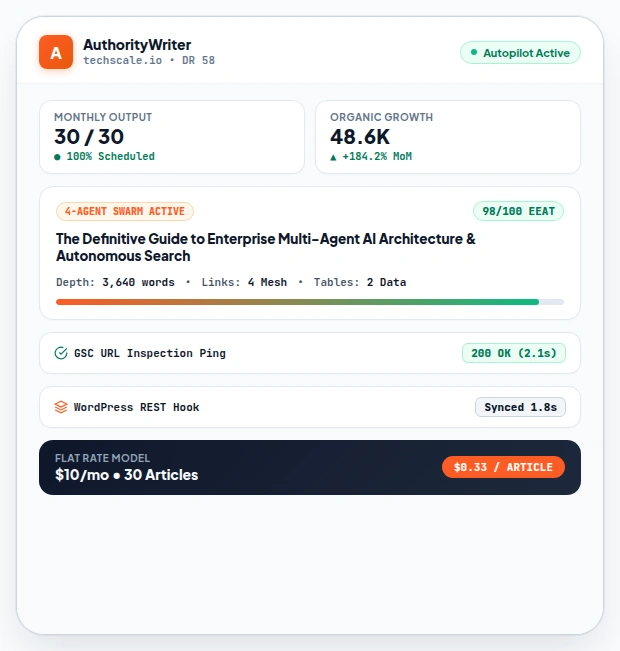
Every article produced by AuthorityWriter includes automated direct-answer breakout blocks and rich schema graphs that trigger high-probability AI citations across modern generative search engines.
