Frase vs AuthorityWriter for Agency Content - frase vs authoritywriter for agencies
Running a digital shop means juggling tight deadlines, shrinking retainers, and demanding clients who expect first-page search visibility yesterday. Deciding between frase vs authoritywriter for agencies has quickly become the central debate for teams trying to scale their agency content without sacrificing quality. Should you lean on an algorithmic research and optimization platform like Frase to crank out dozens of articles a week, or do you need a dedicated authority writer to keep client retention high?
Table of Contents
- The Agency Content Scaling Dilemma: Algorithmic Optimization vs. Human Domain Authority
- What Is the Operational Difference Between Frase and an Authority Writer?
- Frase vs AuthorityWriter for Agencies: Core Workflow and Deliverable Comparison
- How Do Turnaround Times and Production Scalability Compare?
- Margin Analysis: Evaluating SaaS Licensing Against Professional Writer Retainers
- Why Does Information Gain Matter for Client Rankings in Generative Search Engines?
- Which Content Strategy Best Fits Your Agency's Growth Stage and Niche?
- Building a High-Margin Content Engine: Software Automation Meets Human Expertise
Every agency director hits a production ceiling. You land three new retainer accounts, and suddenly your editorial calendar explodes. If you hire specialist freelance writers for every niche, your profit margins shrink fast. If you try to cut corners with generic AI generation tools, your deliverables start reading like every other bland post on the web. Clients notice shallow copy right away, and search algorithms do too.
Agency leaders frequently debate this operational tradeoff online. In community discussions, founders often evaluate how manual writing workflows compare to software-driven content production. They want to know whether a content score from an optimization engine can truly replace someone who has spent ten years working inside a technical industry.
Software like Frase solves a very clear production bottleneck. It scours top search results, clusters key phrases, and outlines competitor coverage in seconds. Think of it like a smart research assistant that hands you a detailed recipe before you cook. An authority writer, by contrast, is an experienced chef. They bring personal anecdotes, original data interpretations, and genuine industry perspective that no scraper can extract from existing search results.
Choosing the right path isn't just about saving a few hours every week. It dictates your agency's pricing model, staffing overhead, and client renewal rates. Looking closely at frase vs authoritywriter for agencies clarifies whether your business model thrives on high-volume production speed or high-ticket expert positioning.
What Is the Operational Difference Between Frase and an Authority Writer?
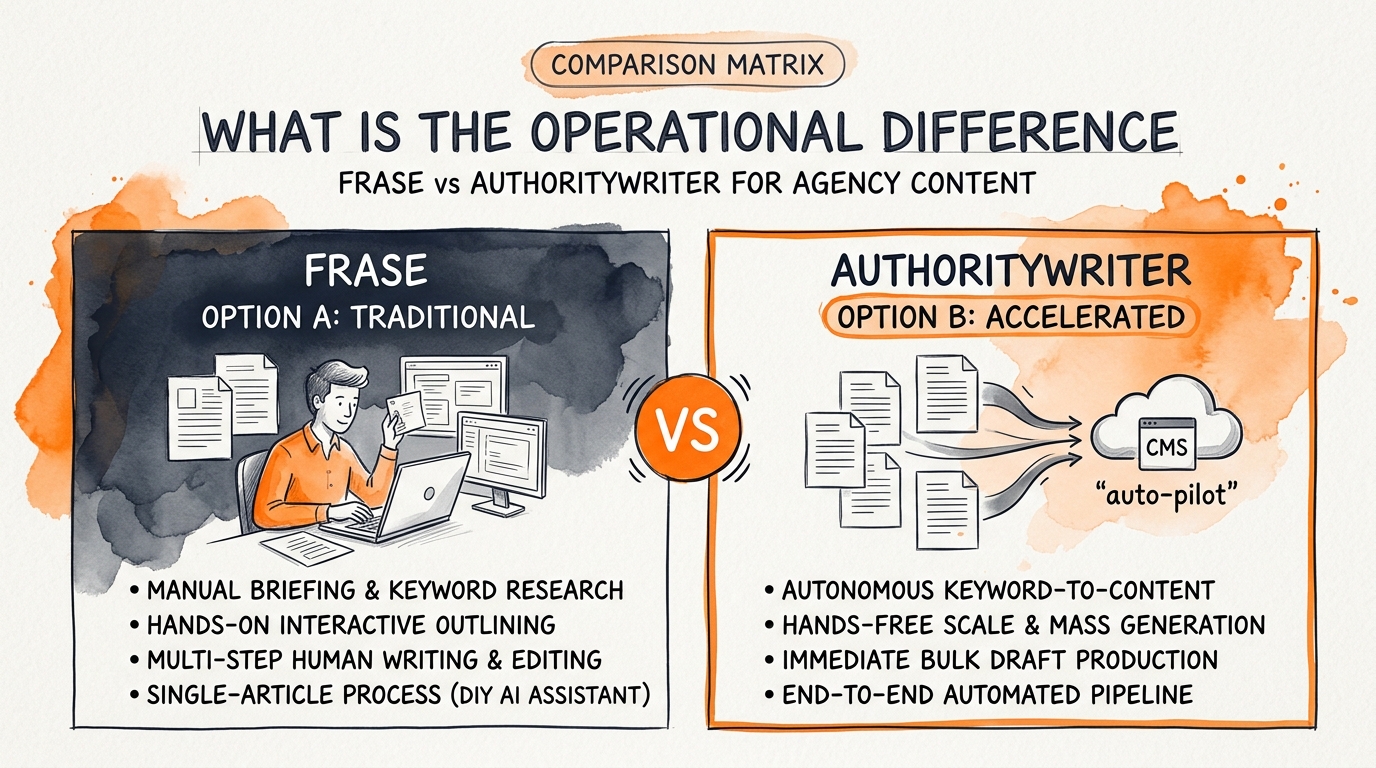
The operational divide between these two approaches comes down to software automation versus human cognition. Frase is an algorithmic research engine designed to reverse-engineer search engine results pages. An authority writer is a credentialed professional who translates real-world career experience onto the page. One optimizes for existing search patterns; the other creates original value from firsthand practice.
Think of Frase as an automated surveyor scanning an existing highway to see how wide it is and where the road signs sit. An authority writer is a veteran driver who knows every dangerous turn, blind intersection, and shortcut because they've driven that road in heavy storms for a decade.
Frase vs AuthorityWriter for Agencies: Reverse Engineering vs. Firsthand Knowledge
Frase operates through statistical natural language processing. When your content strategist inputs a target phrase, the platform scrapes the top twenty search results in seconds. It breaks down heading structures, tracks topic frequency, surfaces common questions, and generates a structured brief. This workflow gives your team an instant blueprint of what Google currently rewards for that query. It tells you what everyone else is saying so your production team doesn't miss standard talking points.
The human specialist works from the inside out. When an authority writer takes on an assignment, their primary input isn't a competitor's blog post. It's their background in the field. If your agency produces content for B2B fintech companies, an authority writer with a background in corporate finance understands regulatory compliance hurdles, payment rails, and ledger reconciliations without needing an outline to explain them. They can challenge industry myths, structure contrarian arguments, and translate executive-level concepts into persuasive prose.
| Operational Factor | Frase (AI Optimization Platform) | Authority Writer (Human Subject Specialist) |
|---|---|---|
| Primary Source Material | Current top-ranking search engine results | Hands-on career experience, interviews, and primary data |
| Content Nature | Consensus-driven and structurally comprehensive | Perspective-driven with net-new insights |
| Agency Bottleneck | Requires human writers to draft and fact-check | Requires higher budgets and structured onboarding |
| Risk Profile | Derivative content; possible algorithmic sameness | Human availability limits; variable turnaround times |
This operational difference directly affects day-to-day agency delivery. When relying solely on software, your agency risk profile shifts toward derivative output. Agency owners frequently debate this balance in Reddit SaaS discussions on manual versus automated workflows, noting that tools like Frase speed up prep time but still require heavy human intervention to avoid hollow, repetitive articles.
Evaluating frase vs authoritywriter for agencies means diagnosing what your production pipeline actually lacks. If your agency already employs capable writers who waste hours manually clicking through Google results to build outlines, Frase removes that administrative drag instantly. It organizes the research phase so your team can write faster.
Conversely, if your clients operate in technically dense sectors like healthcare, enterprise software, or law, briefs built from search scrapes aren't enough. Competitor pages often contain outdated information, surface-level definitions, or subtle factual errors. An authority writer spots those errors immediately, saving your agency from awkward client revisions and reputation damage.
"Software tells you what competitors have already said. A domain expert tells your clients' audience what they actually need to know."
Frase gives agencies an operational accelerator by standardizing research and identifying coverage gaps across search rankings. An authority writer provides the institutional credibility, strategic nuance, and factual accuracy that algorithms cannot extract from a search page.
Frase vs AuthorityWriter for Agencies: Core Workflow and Deliverable Comparison
Running a content team requires balancing speed with client retention. When agency directors evaluate frase vs authoritywriter for agencies, the choice usually comes down to where team hours are spent. One path automates data gathering through software algorithms. The other leans on human domain experience to build trust from scratch.
Frase acts like a high-speed research assistant. It scours Google's first page, groups common headings, and extracts related search terms within seconds. An authority writer, by comparison, functions more like an investigative journalist. They interview subject matter experts, interpret raw industry data, and craft stories based on real-world scars and successes.
Comparing Workflows: Frase vs AuthorityWriter for Agencies
Every step from topic ideation to client sign-off looks completely different depending on which path your agency takes. The table below details how your team's day-to-day operations shift between an algorithmic software approach and a specialized human writer.
| Workflow Stage | Frase (AI & Algorithmic Model) | Authority Writer (Domain Specialist) |
|---|---|---|
| Research & Discovery | Aggregates top 20 Google results. Extracts shared keywords, common questions, and typical heading setups. | Conducts stakeholder interviews, digs into proprietary company data, and references actual client experiences. |
| Brief Creation | Generates auto-populated briefs in minutes based on existing competitor outlines. Fast, but duplicates SERP patterns. | Collaborates with the agency strategist to find an original angle or counter-narrative competitors missed. |
| Drafting Process | Uses machine learning prompts to output long-form paragraphs against a real-time topic score. | Writes customized copy that blends practical anecdotes, technical clarity, and authentic storytelling. |
| Voice & Tone Consistency | Relies on prompt conditioning. It often defaults to generic corporate phrasing unless heavily edited. | Naturally internalizes client brand guidelines, nuance, audience pain points, and forbidden industry clichés. |
| Fact-Checking & Accuracy | Requires human editors to manually verify stats, citations, and product details to catch subtle hallucinations. | Sources data directly from peer-reviewed studies, primary case studies, and credible primary sources. |
| Client Review Cycles | Heavy initial feedback. Clients in technical niches often flag a lack of depth, demanding multiple revision rounds. | Light review cycles focused on preference rather than substance. Clients trust the technical authority immediately. |
Agency teams frequently share candid feedback in marketing agency discussions on production pitfalls about this exact tradeoff. Software gets words on the page rapidly. Yet, if an agency account manager spends two hours editing out repetitive text or fact-checking basic industry terms, the perceived speed advantage quickly disappears.
The Research and Briefing Handoff
Software handles research from the outside looking in. When your agency inputs a target query into Frase, it inspects existing search results. Think of it like taking a poll of what everyone else already said at a dinner party. It shows what is working right now across search engine result pages. That saves your strategists hours of copying and pasting competitor subheadings into Google Docs.
An authority writer approaches research from the inside out. They start by asking what the search results are missing. What changes happened in the industry last week? Why is the current top-ranking advice outdated or wrong? The human writer brings perspective that search crawlers have never indexed. The resulting brief doesn't mimic existing pages. It introduces an original perspective that demands attention.
Where the Editorial Burden Actually Lands
Every piece of agency content demands a set amount of total effort. The main question is whether you pay for that effort during the draft creation or during the revision cycle.
"When we relied purely on automated optimization tools, our junior writers pushed drafts out in thirty minutes. The problem was our senior editors then spent two hours fixing tone-deaf phrases before the client saw it."
Drafting with automated optimization requires an internal safety net. Your team needs clear editorial guidelines and strict fact-checkers. If you submit unvetted software output to an enterprise B2B client, they will spot the lack of depth immediately. An authority writer shifts that burden away from your internal team. The writer carries the mental load of research, framing, and tone matching. When their deliverable lands in your agency inbox, it's already ninety percent ready for client delivery.
Deliverable Comparison: What the Client Actually Receives
Consider what your client sees in their shared folder at the end of the month.
A deliverable powered by Frase is mathematically optimized. It covers every common subtopic, matches standard reading levels, and hits target keyword counts. For basic informational queries or top-of-funnel glossaries, this asset works smoothly. It fills content gaps efficiently without breaking the bank.
A deliverable crafted by an authority writer reads like an insider report. It contains field-tested examples, direct client quotes, and pragmatic workflows. For high-stakes verticals like corporate finance, healthcare compliance, or enterprise DevOps, this difference defines client retention. The piece does not just rank. It builds client reputation, drives sales conversations, and establishes unmistakable industry credibility.
How Do Turnaround Times and Production Scalability Compare?
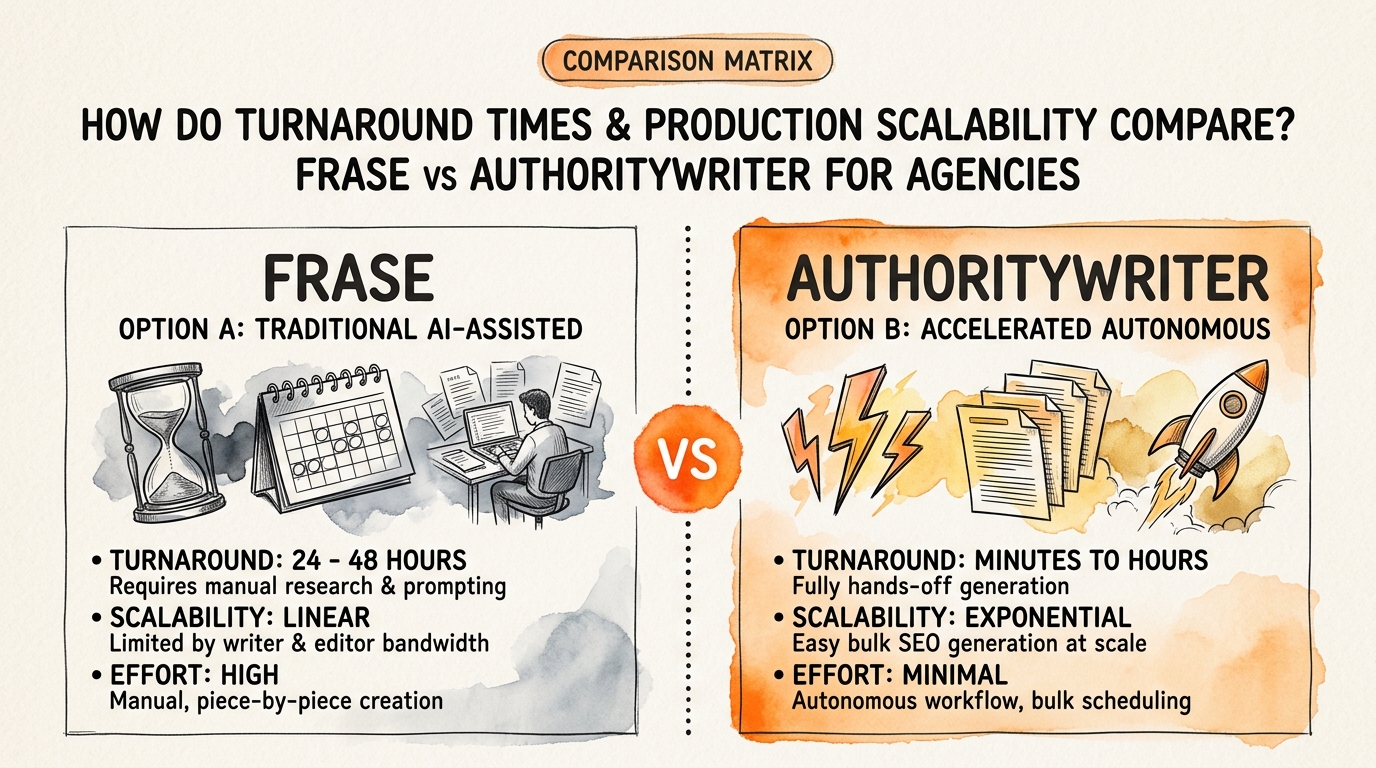
Speed dictates agency margins. If your team spends three weeks waiting on a single article, your client onboarding stalls and retainer profitability plunges. Comparing software automation against specialized human labor requires looking honestly at turnaround times and output caps.
Frase operates on demand. You enter a target search query, and the platform scrapes the top Google results, identifies key topic clusters, and generates an optimized outline within minutes. From there, an in-house editor can produce a scored draft in under an hour. When an agency needs to publish twenty product roundups or local landing pages before Friday, software handles the volume without hesitation.
An authority writer works on an entirely different timeline. A true subject matter expert does not just rephrase top-ranking search results. They schedule interviews, review proprietary data, pull case studies, and craft arguments based on genuine career experience. That depth takes time. Most veteran freelance specialists need five to ten business days to return a polished first draft. If your client requests revisions, that timeline stretches even further.
Turnaround Times: Frase vs AuthorityWriter for Agencies
When evaluating frase vs authoritywriter for agencies from a capacity standpoint, you are really balancing raw velocity against conceptual depth. One model scales by multiplying computing power, while the other scales by recruiting scarce human talent.
| Production Metric | Frase Workflow | Authority Writer Workflow |
|---|---|---|
| Brief Creation | 5 to 10 minutes | 1 to 2 business days |
| First Draft Delivery | 30 to 60 minutes | 5 to 10 business days |
| Monthly Output Limit | Hundreds of articles per license | 6 to 12 articles per writer |
| Operational Bottleneck | Fact-checking and voice editing | Writer availability and research lag |
Agency owners often discuss the hidden friction of both approaches. In a Reddit SaaS discussion on production speed, content leads noted that automated tools produce words instantly, but the true bottleneck simply shifts downstream. Instead of waiting for a freelancer's draft, your internal editors spend hours fixing generic phrasing, verifying hallucinations, and adding brand voice.
Frase removes the blank-page syndrome. It acts like an automated assembly line. Your strategist feeds in keywords, the tool builds the structural scaffolding, and an editor guides the AI text generation. One editor can manage 30 to 40 client articles each month using this system. Output scales smoothly as you add clients because software doesn't get sick, ask for rate hikes, or miss deadlines.
A professional domain writer caps out quickly. A top-tier technical writer or healthcare expert can produce around two comprehensive pieces a week before quality drops. To scale an agency relying on human authority, you must constantly source, test, onboard, and manage new writers. That recruitment cycle creates substantial operational overhead.
Software gives you infinite production bandwidth, but human domain experts give you trust that algorithms cannot simulate.
Client deadlines expose this divide clearly. If an e-commerce client demands fifty seasonal buying guides in two weeks, an authority writer model collapses under the weight. You simply cannot source ten specialist writers on short notice without burning your margins. Frase solves that immediate throughput problem. You build the templates, score the copy against search competitors, and push content live fast.
Long-term strategic campaigns invert this advantage. If a B2B client needs a definitive industry manifesto to win C-suite enterprise deals, an instant AI draft fails completely. The client will notice the lack of real-world nuance right away. In those high-stakes niches, the five-day research turnaround of an authority writer is not a delay. It's the entire value proposition.
Choosing between frase vs authoritywriter for agencies comes down to where you can afford your production bottlenecks. Frase trades original field insights for immediate delivery and infinite volume. An authority writer sacrifices rapid scale to deliver original perspectives that keep high-paying clients on long-term retainers.
Margin Analysis: Evaluating SaaS Licensing Against Professional Writer Retainers
Agency finance looks tidy on paper. Software subscriptions feel like predictable overhead, while skilled human writers look like heavy line items. But balance sheets hide operational friction. When modeling frase vs authoritywriter for agencies, the debate boils down to an agency balancing act: software leverage versus direct talent expenditure.
Every content deliverable carries two distinct price tags. You pay the invoice price you see upfront. Then you pay the labor cost required to make the asset client-ready. Ignoring that second number is how agencies accidentally kill their margins.
Calculating Blended Production Margins: Frase vs AuthorityWriter for Agencies
Frase offers transparent, attractive software pricing. A team plan runs around $115 per month for three user seats, with extra seats costing $25 each. If your agency adds the Pro Content add-on for unlimited AI generation, you tack on another $35 monthly. For under $200 per month, your agency gains the capacity to research and generate dozens of content briefs and drafts. On a pure software basis, each article costs pennies.
The invoice stops there, but your operational payroll does not. Raw software outputs are rarely client-ready. Search engine optimization algorithms assemble patterns; they do not possess domain expertise. A junior writer or content manager earning $35 to $45 per hour must sit with each generated draft. They verify hallucinated statistics. They smooth out robotic syntax. They re-insert brand positioning that algorithmic models miss.
If an editor spends two and a half hours refining a Frase draft, that post just cost you roughly $100 in internal wages. Add your junior writer's briefing time, and your true unit production cost hovers near $140 to $170 per asset.
Hiring a specialized authority writer flips this cost structure entirely. An experienced professional covering technical topics—like cloud architecture, fintech, or healthcare law—typically commands $0.25 to $0.50 per word, or a predictable monthly retainer between $3,000 and $6,000. For a 2,000-word deep dive, you write a direct check for $600 to $800.
That initial figure feels steep to a growing agency. Yet the hidden labor drops off a cliff. A true domain authority submits work that matches client briefs on the first pass. Your senior editor spends twenty minutes checking tone and formatting before shipping it out. The invoice is high, but internal payroll consumption is negligible.
| Cost Variable (Per 2,000-Word Post) | Frase Workflow (SaaS + Internal Labor) | Authority Writer (Specialized Retainer) |
|---|---|---|
| Direct Tool or Freelance Cost | ~$10 (Allocated SaaS & Add-ons) | $600 - $800 (Flat Retainer Fee) |
| Internal Editing & Fact-Checking | 2.5 to 3.5 Hours ($100 - $150) | 0.5 Hours (~$20 - $30) |
| Client Revisions Required | Moderate to High (1 - 2 Rounds) | Low (Minor Touch-ups) |
| Total Internal Asset Cost | $110 - $160 | $620 - $830 |
| Gross Margin on $1,200 Client Retainer | 86% - 90% | 31% - 48% |
"Software scales volume instantly, but human domain authority protects retention. If an agency burns forty hours a month fixing shallow briefs, that software subscription isn't cheap anymore."
Agencies often run into trouble when they evaluate tools without looking at team capacity. On marketing discussion boards, agency founders routinely talk about team burnout after switching entirely to algorithmic platforms. A practical breakdown of setup times and workflow headaches on this Reddit agency operations thread highlights how unbilled revision cycles quickly erase the mathematical margins software promises.
Choosing between these two models requires honesty about what your client pays you to do:
- Top-of-Funnel Product Catalogs and Directories: If you produce broad explanatory content for local businesses or general e-commerce brands, Frase paired with an organized in-house editor yields exceptional gross margins. The information is readily available across the public web, making algorithm-assisted synthesis safe and fast.
- B2B Tech, Healthcare, and Professional Services: If your clients sell complex solutions with high deal sizes, clients notice shallow writing immediately. Paying an authority writer cuts your gross margin down to 35% or 45%, but it protects account retention. Losing an $8,000 monthly retainer because a client spotted factual hallucinations costs far more than hiring expert talent.
The smartest agency operators do not view this as an either-or choice. They deploy software to map keyword gaps and outline information hierarchies. Then they pass those frameworks to specialized writers who provide the genuine perspective search algorithms cannot fabricate.
Why Does Information Gain Matter for Client Rankings in Generative Search Engines?
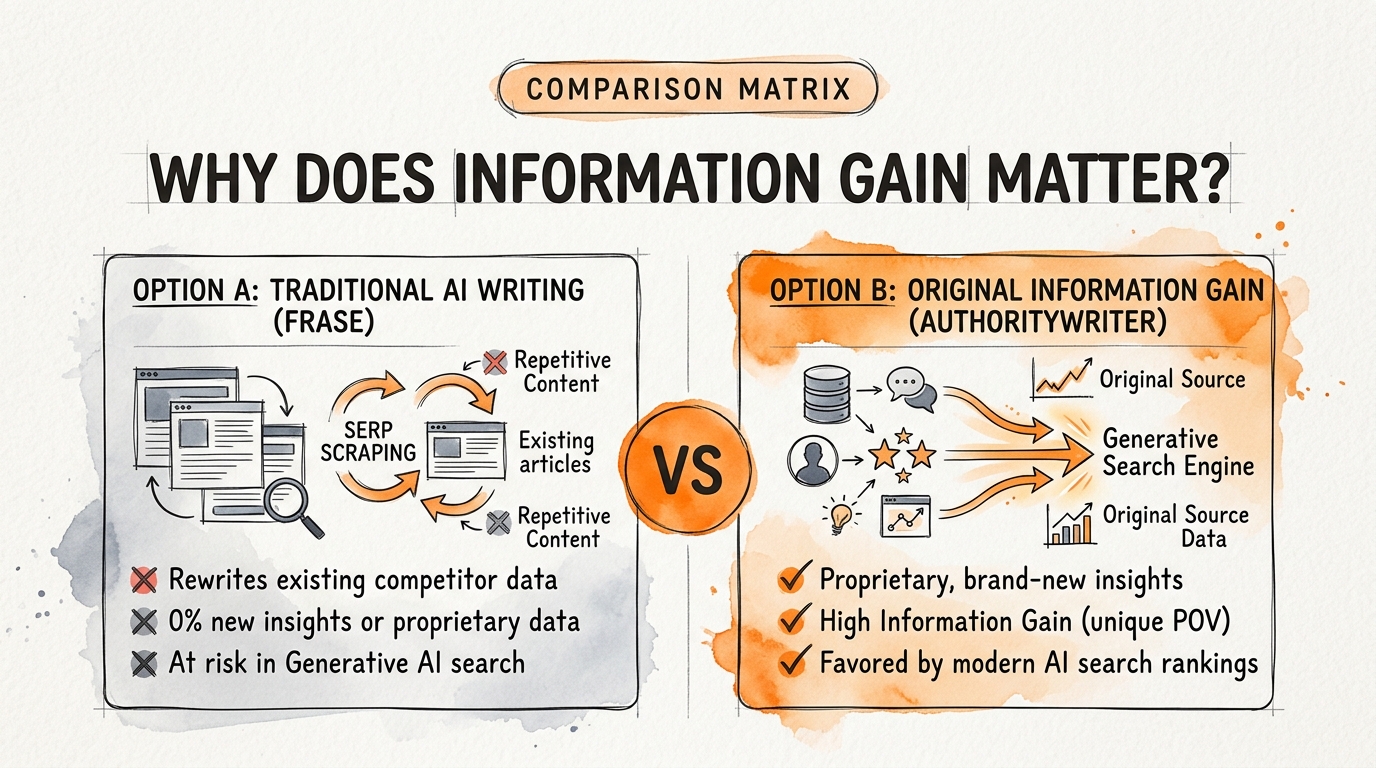
Generative search models do not read content the way people do. When Google surfaces an AI Overview or Perplexity answers a query, the model checks dozens of documents to spot patterns. If every post says the exact same thing using the exact same headings, the engine treats those pages as background noise. It synthesizes a quick summary and leaves those websites without a click.
This is where information gain decides search visibility. Information gain measures the amount of new, verified detail an article adds compared to what is already on the web. Search engines file patents around this concept to reward pages that offer fresh data, contrarian takeaways, or firsthand case studies. If an agency produces articles that only mirror existing search results, generative engines simply swallow that content and cite someone else.
Agency teams often run into this exact wall when scaling output. On forums like Reddit, operators frequently question how output quality holds up compared to manual workflows when relying on automated content briefs. The tension comes down to a core strategic choice: do you summarize existing web pages, or do you inject genuine domain experience into every draft?
Frase vs AuthorityWriter for Agencies: SERP Parity Versus Novel Value
Frase approaches content production through reverse engineering. The software scrapes the top twenty search engine results, runs natural language processing on the text, and highlights term frequencies. It tells your copywriter to use phrases like "pipeline velocity" six times and "sales attribution" four times. This workflow creates SERP parity. It helps a page match what Google already ranks, which was the standard path to organic traffic for years.
The problem is that term-frequency aggregation cannot create original thought. It cannot share a lesson learned from a failed multi-channel ad campaign. It cannot interview a client's VP of Product to explain how their proprietary system handles data privacy. By definition, an aggregation tool only knows what other websites have already published.
An authority writer operates on the opposite end of the spectrum. A professional writer with direct industry background gathers first-party insights, interviews internal subject matter experts, and weaves proprietary agency data directly into the piece. That workflow builds true Experience, Expertise, Authoritativeness, and Trustworthiness (E-E-A-T). When evaluating frase vs authoritywriter for agencies, this gap in original information becomes make-or-break for client rankings in modern generative engines.
"If an AI model can generate the entire response by simply averaging the top five search results, the user has zero reason to click through to your client's website. You must provide the missing puzzle piece."
Consider how both approaches perform when targeting Generative Engine Optimization (GEO) metrics:
- Data Origins: Frase surfaces existing statistics already cited across competitor blogs. An authority writer pulls unreleased benchmark numbers, anonymized campaign figures, and customer testimonials straight from the client.
- Point of View: Content built solely on aggregated briefs tends to blend into an impartial, neutral summary. An experienced domain writer takes a definitive stance, answers direct pain points, and challenges popular industry misconceptions.
- Citation Potential: Large language models prioritize original sources. When an engine creates an AI snapshot, it attributes quotes, specific data points, and counter-intuitive logic to the publication that broke the story first.
Generative search engines need a reason to send traffic your client's way. Software tools give agencies speed and keyword coverage, but they cap your content at whatever the consensus happens to be today. Partnering with a skilled authority writer ensures your client delivers the novel perspectives search algorithms actually want to cite.
Which Content Strategy Best Fits Your Agency's Growth Stage and Niche?
Every digital shop eventually hits a production wall. The right choice in the debate over frase vs authoritywriter for agencies comes down to where your agency sits on the maturity curve and what your clients actually pay you to deliver.
If you hand a generic, algorithmic draft to a VP of Engineering at an enterprise cybersecurity startup, they'll fire you before the second invoice. Run an in-house team of three dedicated technical journalists for twenty local plumbing websites, and your payroll will swallow your margins whole. You need a content setup that matches your overhead, your editors' bandwidth, and your clients' tolerance for fluff.
Evaluating Frase vs AuthorityWriter for Agencies Across Growth Stages
Think of software like Frase as an electric kitchen mixer. It speeds up preparation, gathers the ingredients from top search results, and helps an experienced cook assemble recipes fast. An authority writer, by contrast, is a specialist private chef. They bring their own secret recipes, proprietary industry know-how, and professional instincts that software simply can't scrape from existing Google search results.
| Agency Growth Stage | Typical Retainer Range | Niche Complexity | Editorial Capacity | Optimal Approach |
|---|---|---|---|---|
| Bootstrap & Early Scale | $1,500 – $3,500/mo | Low to Moderate (Local, Lifestyle, Simple DTC) | Solo founder or one generalist editor | Frase-Led Workflow |
| Mid-Market Growth | $4,000 – $8,500/mo | Mixed (B2B SaaS, Real Estate, E-comm Tech) | 2-3 dedicated in-house content managers | Hybrid Blend |
| Mature & Enterprise | $10,000+/mo | High Complexity (Fintech, MedTech, Legal, YMYL) | Specialized strategists; limited rewriting time | Authority Writer Network |
Four Make-or-Break Agency Levers
To choose your direction without blowing up your client retention rates, stress-test your pipeline against these four operational realities:
- Technical Niche Difficulty: When you operate in fields governed by strict compliance, such as clinical health or corporate securities, automated topic summaries present huge liability hazards. As highlighted in a candid Reddit agency discussion on content workflow pitfalls, unvetted algorithmic output often creates compliance headaches that ruin client trust. In deeply technical niches, subject-matter authority writers are mandatory.
- Client Budget Expectations: Small business clients on shoestring budgets care about volume, broad organic footprints, and keeping turnaround times brisk. They don't have the budget to pay for deep subject matter experts. Algorithmic software lets you serve those clients profitably without running into the red.
- Monthly Content Volume Demands: If your deliverables require pumping out 60 to 100 programmatic or top-of-funnel glossaries each month, commissioning individual freelance experts will quickly run into five-figure invoices. Tools like Frase let your existing staff build outlines and draft structural pieces at scale.
- Editorial Bench Strength: Never buy software thinking it eliminates human labor. If you hand an algorithmic draft to a junior team member who lacks industry knowledge, they won't know if the facts are right. If your senior editor spends four hours fixing an automated draft, you haven't saved money. You've simply shifted your payroll from freelance writers to expensive in-house editors.
"Our rule of thumb is straightforward: If the reader needs a license or five years of field experience to spot an error in the text, you hire an authority writer. If the topic is answering common questions that have lived on page one for five years, you use software to build the brief and write it fast."
Pick the model that protects your delivery margins today, but stay agile. The most profitable agencies use Frase to handle research and brief creation for standard commercial queries, then reserve veteran human authorities for the cornerstone assets that earn brand trust and genuine industry back links.
Building a High-Margin Content Engine: Software Automation Meets Human Expertise
Cheap content is an expensive mistake. Agency founders often trap themselves in a false dilemma when deciding between frase vs authoritywriter for agencies, treating software and specialist talent as mutually exclusive choices. Slashing fulfillment expenses down to zero with automated tools might pad your balance sheet this month. Next quarter, when your client's organic traffic tanks because their articles lack real substance, that client leaves. You have to win their business all over again.
Balancing Frase vs AuthorityWriter for Agencies to Protect Client Retention
Search engines now prioritize fresh perspectives, first-party data, and verifiable experience over rephrased search engine results. When you run an agency production line solely on algorithmic scrapers, you end up shipping the exact same talking points as every other competitor in the search results. Many agency leaders discuss these exact quality bottlenecks in agency debates on content automation workflows, pointing out how difficult it is to keep clients happy when automated drafts fail to reflect actual industry depth.
Frase gives your team speed. It pulls down the competitive landscape, flags missing topical subheads, and builds structured content briefs in minutes instead of hours. That efficiency is where your operational margin comes from. What Frase cannot do is interview an engineer, analyze proprietary client data, or share a battle-tested point of view from years in the field. That is where a dedicated authority writer earns their fee.
The Operational Golden Rule: Let software run the quantitative prep work, but pay a domain expert to handle qualitative storytelling. Algorithms build the skeleton; practitioners supply the pulse.
The most profitable content agencies don't sell raw word counts or tool outputs. They sell revenue outcomes, organic search footprint protection, and industry reputation. You can build an enviable bottom line by using software like Frase to collapse eighty percent of your manual research time, then reinvesting those saved hours into hiring an experienced authority writer who transforms those outlines into standout thought leadership.
Take an honest look at your current publishing pipeline. If your agency is churning through clients every ninety days, you're likely leaning too hard on raw automation without enough lived perspective to back it up. Set up a workflow where algorithmic research informs the brief, and an authentic domain writer closes the loop. That is how you defend client rankings against generative search shifts, build sustainable production margins, and create agency retainers that last for years.
