DR Matching: How to Target Keywords by Domain Rating
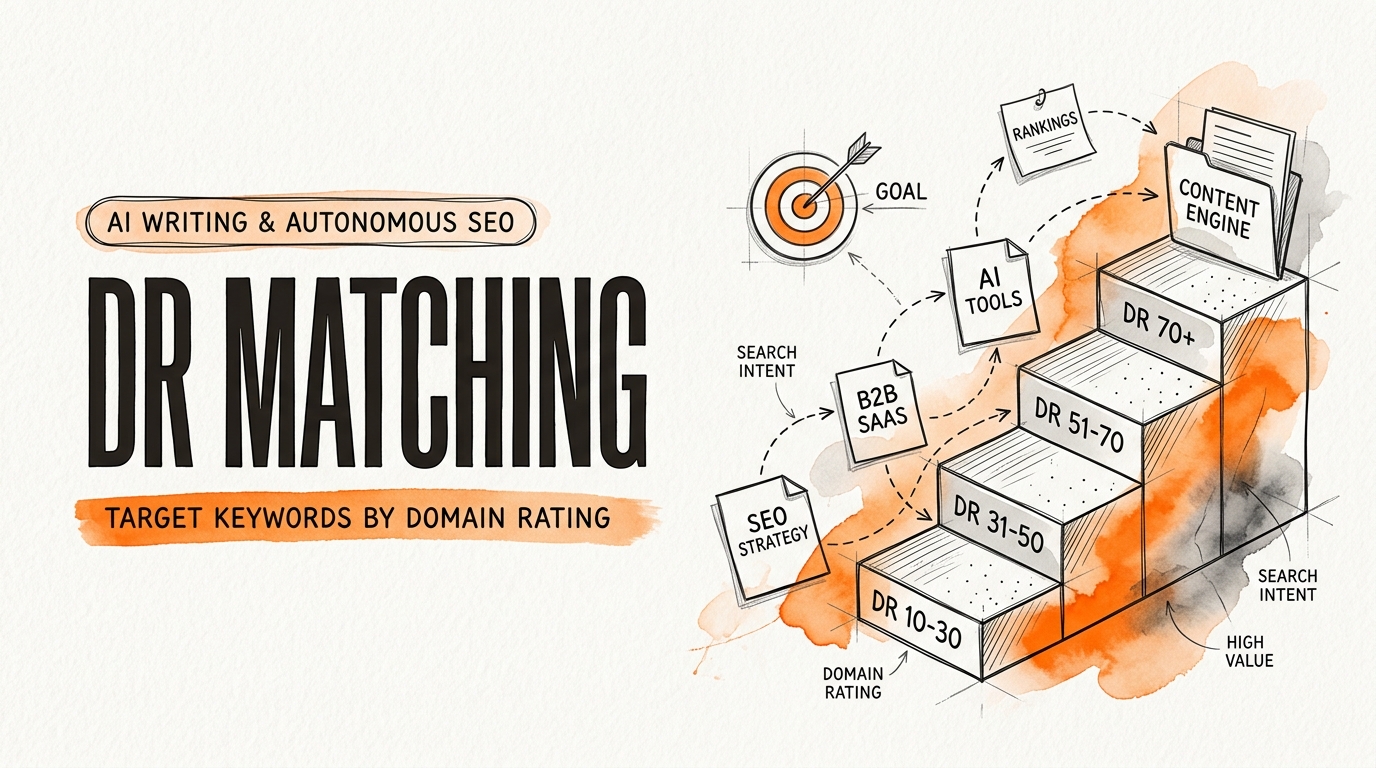
Building search engine traffic takes more than writing great content. If you want top rankings, you must target keywords by domain rating so your content matches your website's actual ranking power. Far too many marketers waste thousands of dollars writing blog posts for competitive keywords their sites can't win. By matching your target search terms to your site's current Domain Rating (DR), you protect your content budget, set accurate expectations, and build real traffic momentum.
Table of Contents
- Why Aligning Keyword Strategy with Website Authority Dictates Organic Success
- What Is the Relationship Between Domain Rating and Keyword Difficulty?
- How to Target Keywords by Domain Rating: A Step-by-Step Framework
- How Can Low-DR Websites Uncover High-Intent Search Opportunities?
- Why Does Topical Authority Sometimes Overpower High Domain Rating?
- How Should You Upgrade Your Keyword Strategy as Your Domain Rating Increases?
- Turn Authority Metrics into a Sustainable Organic Growth Engine
SEO isn't a game of chance. When a new site targets search terms dominated by high-authority platforms, search engine algorithms usually bury that content deep in search results. Think of it like a local high school athlete jumping straight into the professional leagues. You need proper conditioning first. Domain Rating—a metric popularized by platforms like Ahrefs' backlink checker tools alongside Semrush's Authority Score—gives you an honest mirror. It shows how much authority search engines recognize in your site profile.

Small teams often ask if strict DR matching is worth the extra planning time. Many founders in Reddit SaaS marketing communities wonder if automated DR filtering actually yields better return on investment than simple intuition. The output speaks for itself. When you choose battles your site can actually win, your published pages index faster, move up the search engine results pages quicker, and generate steady organic leads. We've seen early-stage e-commerce stores scale organic traffic by 300% simply by stopping their pursuit of high-difficulty terms and focusing strictly on low-competition opportunities aligned with their domain score.
Understanding how to target keywords by domain rating keeps you from burning valuable resources. It turns raw authority metrics into a predictable roadmap for sustainable growth.
What Is the Relationship Between Domain Rating and Keyword Difficulty?
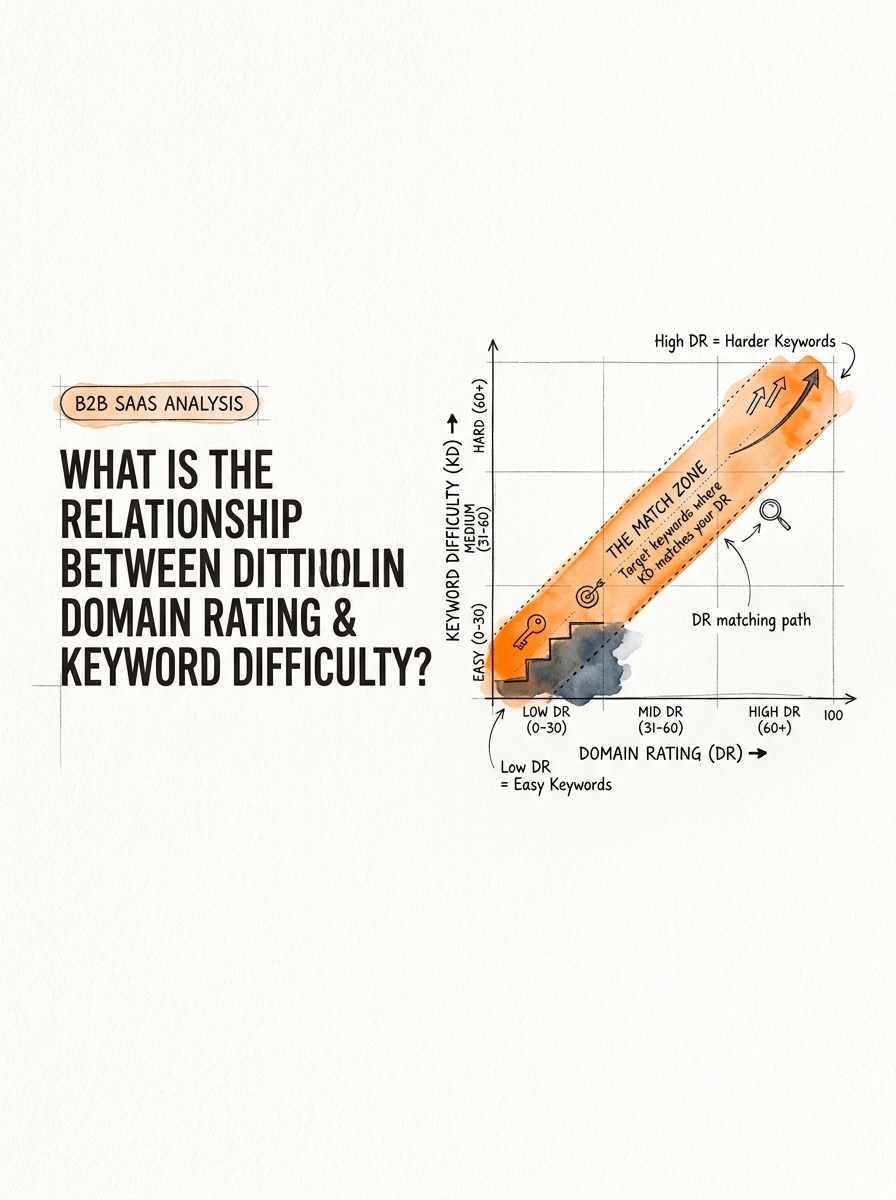
Think of your website's Domain Rating (DR) as engine power. Keyword Difficulty (KD) acts like the steepness of a hill. If your site packs a 400-horsepower engine, tackling a mild incline requires zero effort. If you're driving a low-powered hatchback, that same hill brings your vehicle to a complete crawl.
In organic search, DR measures your domain's total backlink strength on a 100-point scale. SEO software platforms like Ahrefs calculate DR by examining how many unique websites link to your entire domain. Keyword Difficulty estimates how many external links a single page needs to rank on Google's first page. Understanding how these two metrics interact prevents you from throwing away hours on content that will never rank.
Matching Target Keywords by Domain Rating to Page-Level Competition
High-DR domains rank easily because search engines already trust their content. When a site like HubSpot (DR 92) or Forbes (DR 94) writes a simple guide, Google indexes the page within minutes. Their domain-wide link weight pushes that new URL into top positions before it earns a single direct backlink.
Low-DR sites operate under completely different rules. If your store has a DR of 15, publishing content for a KD 70 query is an uphill battle. You lack the domain-wide authority needed to beat established market leaders. Smart practitioners choose to target keywords by domain rating rather than chasing high-volume search terms blindly.
Many founders on a Reddit SaaS marketing discussion report that tool-generated difficulty scores can mislead beginners. They ask whether automated metrics hold up against manual evaluation. The short answer comes down to calculation formulas. Ahrefs calculates KD strictly on backlink counts among top-ranking pages. Semrush factors in search intent and page-level authority balances alongside overall link volume. Relying on a single difficulty number without inspecting who sits in the top three spots leads to poor targeting decisions.
"Domain Rating gives your content a lift-off velocity. High DR acts like gravity assistance, while low DR means your page content must carry 100% of the weight."
How do domain authority metrics and page difficulty balance out in real SERP results?
Search engines weigh overall domain trust against specific page relevance. Here is how authority levels dictate ranking strategy across popular SEO tools:
| Authority Level | DR / Authority Score Range | Target Keyword Difficulty (KD) | Strategic Focus & Expectations |
|---|---|---|---|
| New / Emerging | DR 0 – 20 | KD 0 – 15 | Requires long-tail intent and zero-search-volume queries. Slow index movement. |
| Growing Authority | DR 21 – 50 | KD 16 – 40 | Moderate ranking speed. Demands internal link structures and unique data. |
| Established / High Authority | DR 51 – 100 | KD 41 – 100 | Fast indexing. Ranks primarily on domain reputation and brand trust signals. |
Strategic alignment saves time and money. Matching your content calendar to realistic authority thresholds helps your pages rank faster. Skipping authority tiers leaves great content hidden on page five of search results.
How to Target Keywords by Domain Rating: A Step-by-Step Framework
Building organic traffic takes patience. It also takes a realistic strategy. If your website is brand new, trying to rank for competitive search terms burns time and money. Think of your Domain Rating (DR) like a credit score. A new site has no history in the eyes of search engine algorithms. You must build trust with smaller, achievable wins before banks—or search engines—hand you big rewards.
Search engines use backlinks to measure how much authority your website holds. Tools like Ahrefs and Semrush convert these backlink profiles into scores ranging from 0 to 100. When you match these domain scores against Keyword Difficulty (KD), you stop guessing. You start building content that can actually hit page one.
Actionable Framework to Target Keywords by Domain Rating
Every website falls into a specific authority tier. Using a structured matrix helps your editorial team filter out terms that are out of reach. Learning how to target keywords by domain rating protects your marketing budget by keeping your writers focused on wins you can actually rank for today.
| Website DR Tier | Authority Level | Target KD Range (Ahrefs) | Recommended Content Strategy |
|---|---|---|---|
| DR 0 – 20 | Emerging / New Site | KD 0 – 10 | Focus on hyper-specific long-tail questions, low-competition niche topics, and zero-volume queries. |
| DR 21 – 40 | Growing Site | KD 11 – 30 | Target specific commercial intent keywords, simple product alternatives, and detailed how-to guides. |
| DR 41 – 60 | Established Site | KD 31 – 50 | Compete for broader category terms, high-intent buyer guides, and mid-funnel comparison keywords. |
| DR 60+ | High Authority Domain | KD 51 – 100 | Go after competitive head terms, industry landing pages, and primary commercial search phrases. |
If you operate in the DR 0 to 20 range, your priority is establishing initial indexation and topical context. Do not chase broad terms like "best CRM software." Instead, write about "best CRM for solo freelance plumbers." The monthly search volume will look small. However, conversion rates are usually much higher because the user intent is exact.
Once your domain hits the DR 21 to 40 bracket, you have enough baseline trust to compete for moderate terms. Here, you can push into terms with slightly higher competition. As your authority reaches DR 41 and above, your site acts like a heavy flywheel. You can publish broader content and watch it rank faster without needing dozens of direct backlinks for every single post.
Setting Search Filters in Ahrefs and Semrush
You do not need to sift through thousands of keyword suggestions manually. Modern SEO software lets you set strict filters to instantly reveal hidden search opportunities.
Here is how to set up your workflow in Ahrefs Keywords Explorer:
- Step 1: Type your seed topic into the search bar and navigate to the Matching terms report.
- Step 2: Click the KD filter at the top bar. Enter a maximum value that matches your current DR tier (e.g., Max KD = 10 for low-DR sites).
- Step 3: Open the Lowest DR filter. Set the "Top 5" parameter to match your current DR. This shows you search results where at least one weak domain is already ranking on page one.
- Step 4: Filter out irrelevant terms by setting a minimum Word Count filter of 3 or 4 words to highlight long-tail intent.
If you prefer using Semrush Keyword Magic Tool, the process is very similar:
- Step 1: Enter your core topic and select your primary target market.
- Step 2: Click the KD % dropdown menu. Choose the preset filter ranges such as Very Easy (0-14%) or Easy (15-29%) based on your website score.
- Step 3: Apply an Intent filter (such as Commercial or Transactional) to highlight keywords that lead directly to sales.
Many site owners ask whether automated software subscriptions are worth the monthly fee. Base plans for these tools generally cost between $99 and $140 per month. Recent discussions among SaaS marketers on Reddit point out that relying blindly on automated metric scores without manually inspecting the first page of search results can lead to missed opportunities. Keyword difficulty scores are estimates. Always open the actual search engine results page to verify who holds the top spots.
"Keyword difficulty numbers give you a quick map, but manual SERP analysis tells you what the terrain actually looks like. If a KD 15 keyword has three DR 80 sites taking up the top spots with thin content, a low-DR site can still win with better depth."
Evaluating Competitor Alternatives and Budget Pitfalls
Small business owners often worry about the cost of enterprise SEO software. If paying over $100 monthly is not feasible for your team, look at competitive keyword research alternatives like LowFruits, SE Ranking, or Ubersuggest. These platforms provide similar difficulty filtering at a lower entry price.
When selecting tools for your workflow, watch out for these three common traps:
1. Confusing tool-specific metrics: Ahrefs DR is not identical to Semrush Authority Score or Moz Domain Authority. A site might show a DR of 30 on Ahrefs but an Authority Score of 42 on Semrush. Stick to one tool ecosystem when matching domain strength against difficulty scores to keep your baseline consistent.
2. Ignoring SERP intent: A low difficulty score does not mean an easy win if the intent does not match your page type. If top results are all video tutorials, an 8,000-word blog post will struggle to rank regardless of how well you target keywords by domain rating parameters.
3. Overlooking page-level authority: High-DR websites sometimes rank for low-competition terms simply because their overall brand power spills over onto new URLs. Look for top-ranking pages that have zero external backlinks. If a low-authority page sits in position one, you have found a genuine entry point.
How Can Low-DR Websites Uncover High-Intent Search Opportunities?
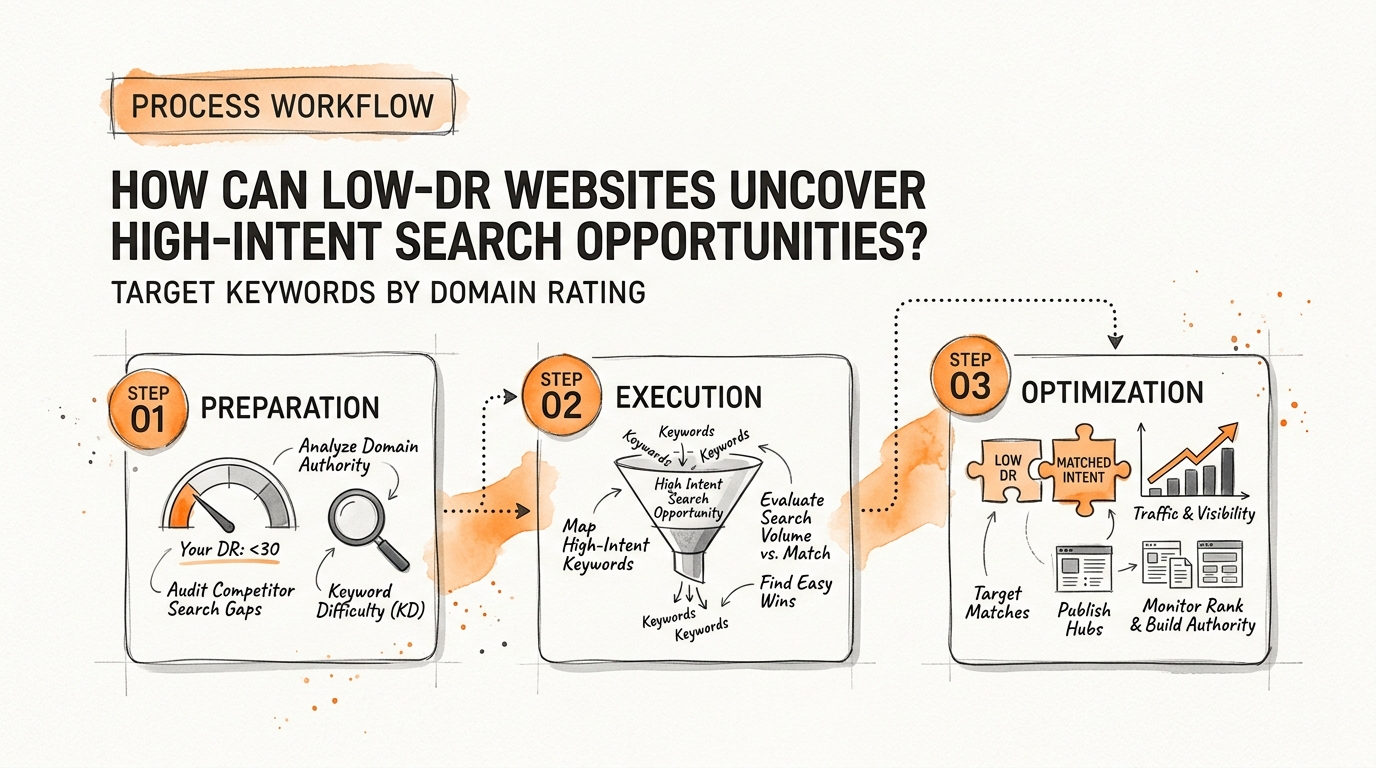
New websites don't lose the SEO game because their content is bad. They lose because they walk into unwinnable fights. If your site has a Domain Rating (DR) under 20, chasing broad search terms like "best CRM software" is like fighting a heavyweight champion on your first day in the ring. The web giants will crush you every time. You don't need massive authority to generate revenue. You just need to change where you fight.
When you target keywords by domain rating, your goal isn't to chase high search volume—it's to capture conversion-ready buyers before competitors notice them. Small teams and new e-commerce brands often think manual research takes too much time, but relying blindly on standard tool metrics will mislead you.
Finding High-Intent Opportunities: How to Target Keywords by Domain Rating for Low-Authority Sites
Let's break down how low-DR sites bypass authority filters to win top ranks quickly without spending thousands on link building.
1. Tap Into Zero-Volume, High-Intent Queries
Standard SEO tools like Semrush or Ahrefs calculate search volume using sampled database logs. If a phrase gets queried 15 times a month, tools often round it down to zero. That creates a huge blind spot. Large publishers skip zero-volume keywords because their editorial calendars demand massive reach.
That's your opening. A query like "best accounting software for mobile dog groomers" might show zero volume in software tools, but someone typing that phrase is holding a credit card in their hand. Write the definitive guide for that specific user. You'll often rank on page one within days because search engines have no better match for that hyper-specific intent.
2. Spot Forum Weak Spots in Search Results
Search results populated by Reddit threads, Quora answers, or outdated forum posts are clear signposts of weak competition. When Google ranks a forum thread on page one, it's admitting a lack of a comprehensive, dedicated article on the topic.
Tools like LowFruits automate this discovery by scanning SERPs for low-DR sites and user-generated content in top positions. As noted in a Reddit SaaS community discussion on low-DR tactics, manually spot-checking search results often uncovers high-converting opportunities that automated difficulty scores completely miss. If a DR 12 blog or a Reddit thread holds slot #3, your low-DR site can snatch that ranking with a well-structured, thoroughly researched piece.
| Strategy Element | Traditional High-Volume Approach | Low-DR High-Intent Framework |
|---|---|---|
| Keyword Selection | Broad head terms (1,000+ monthly searches) | Long-tail & zero-volume queries (<100 searches) |
| SERP Analysis Focus | Keyword Difficulty (KD) score | Presence of forums (Reddit/Quora) in Top 5 |
| Search Intent | Informational / Top-of-funnel | Commercial / Direct comparison |
| Time to Rank | 6-18 months (requires heavy link building) | 2-8 weeks (via exact intent matching) |
3. Target "Alternative To" and Niche Comparison Keywords
Buyers near the end of their decision process search for direct comparisons. Phrases like "[Major Brand] alternative for freelancers" or "[Product A] vs [Product B] for non-profits" carry immense commercial value. They don't attract casual readers; they attract buyers ready to switch tools.
Major software review sites cover broad categories, but they produce generic template pages. Learning how to target keywords by domain rating means shifting your mindset from raw search volume to intent density. A small store or niche SaaS brand can easily beat generic aggregate pages by providing real hands-on testing, clear pricing breakdowns, and direct side-by-side feature tables.
Field Tip: Don't rely solely on automated difficulty scores. Always inspect the live search results yourself. If the top ranking pages lack direct answers, clear schema, or updated information, your lower-authority domain can outrank them purely through content quality and intent precision.
Why Does Topical Authority Sometimes Overpower High Domain Rating?
Domain Rating acts like a broad popularity score for a website. It measures backlink quantity and raw link power, but it doesn't measure subject mastery. When you target keywords by domain rating alone, you might assume a site with a DR of 25 can't compete with a digital behemoth boasting a DR of 85. That assumption falls apart when a smaller site owns an entire topic end-to-end.
Think of it like hiring a professional. If your custom espresso machine breaks down, you don't consult a general department store clerk just because the store is massive. You hire a certified espresso technician. Google operates under the same logic. Search algorithms evaluate how thoroughly a site covers a narrow subject area, often favoring specialized knowledge over raw link power.
Evaluating Target Keywords by Domain Rating Against Micro-Niche Authority
Generalist publications cover thousands of unrelated topics. A single high-DR media site might publish an article on crypto tax law today and an electric toothbrush review tomorrow. Because their overall content footprint is fragmented, Google treats their individual pages as isolated islands. They lack the supportive ecosystem of internal links, detailed sub-topic breakdowns, and exact search intent match that a dedicated specialist site provides.
Search engines look for complete topical clusters. When a boutique store builds 40 tightly linked articles covering every sub-topic of organic soil remediation, Google recognizes that deep context. A low-DR specialist site that answers every nuance of a search query will routinely take the top spot from a high-DR generalist site that only scratched the surface in a brief summary.
| Ranking Factor | High-DR Generalist Site | Low-DR Specialist Site |
|---|---|---|
| Topic Breadth | Broad (Thousands of unrelated categories) | Hyper-focused (Single niche focus) |
| Internal Link Mesh | Shallow and scattered | Deep contextual interconnectivity |
| Search Intent Alignment | Generic surface-level answers | Exact problem-solving depth |
| Algorithm Trust Signal | High off-page authority | High on-page and semantic relevance |
Small business owners often debate whether building out exhaustive content hubs justifies the effort. As members discuss on Reddit's SaaS strategy community, manual content production feels slow compared to buying high-authority backlinks. Yet, investing in deep topical authority creates a durable moat. Backlinks can be devalued, but direct relevance to search intent remains a primary ranking signal.
SEO teams use tools like Ahrefs to analyze raw backlink profiles while leveraging content intelligence platforms like SurferSEO to map semantic coverage. When you strategically select your target keywords by domain rating while backing them up with comprehensive topical coverage, your lower-DR site can consistently outrank enterprise competitors.
Search engines don't rank domain names; they rank individual web pages based on how effectively they resolve a user's problem within a specific context.
Focusing purely on domain-level metrics causes marketers to miss easy wins. When your site provides the single best answer supported by a complete cluster of related guides, algorithm updates will reward your depth over your competitor's link budget.
How Should You Upgrade Your Keyword Strategy as Your Domain Rating Increases?
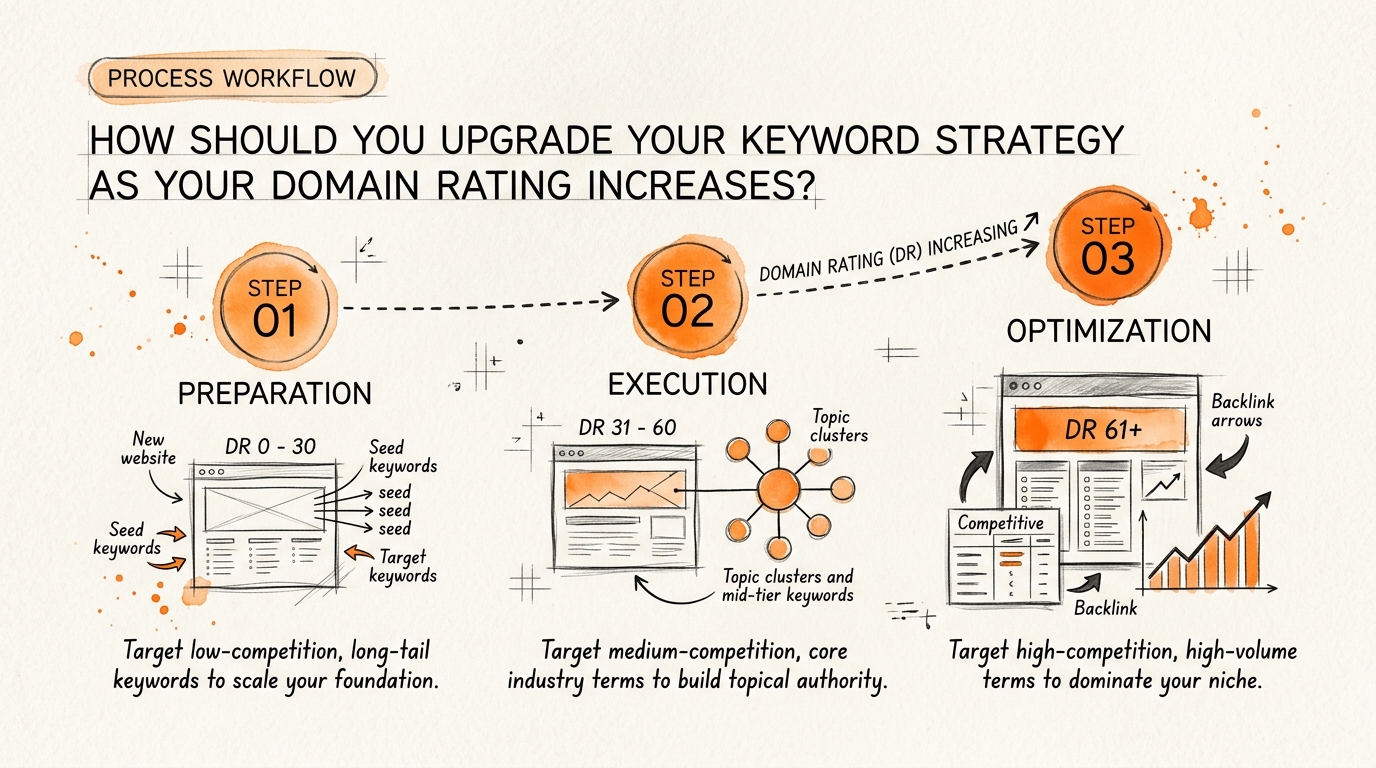
Your website gains strength over time. When you launch a brand-new site, attempting to rank for broad commercial terms is like entering a professional heavyweight boxing match on your very first day of training. You'll get knocked out fast. As your backlink profile grows and search engines begin trusting your domain, the rules of engagement change completely.
Sticking strictly to ultra-low search volume queries forever limits your revenue potential. You must systematically graduate your target criteria as your site matures. This evolution requires shifting your focus from isolated long-tail phrases to competitive head terms and broad commercial queries.
Pivoting How You Target Keywords by Domain Rating as Authority Grows
When you learn how to target keywords by domain rating effectively, you stop wasting time on terms your site cannot win yet. You also avoid leaving valuable search volume on the table. Upgrading your keyword framework isn't a one-time event. It's a continuous process tied directly to your domain's crawling frequency, backlink velocity, and indexing speed.
Many site owners ask whether shifting strategies mid-game is worth the investment. As noted in Reddit SaaS community discussions on upgrading keyword targeting, business owners often struggle with knowing when to replace low-difficulty content workflows with higher-risk, high-reward topics. The key lies in managing your risk profile through clear domain rating tiers.
| Domain Rating Tier | Primary Keyword Focus | Keyword Difficulty (KD) Target | Strategic Objective |
|---|---|---|---|
| DR 0 - 20 | Long-tail questions, low-volume product alternatives, hyper-niche tutorials | KD 0 - 15 | Establish initial indexing trust and capture fast, high-intent traffic conversions. |
| DR 21 - 50 | Mid-tail commercial comparisons, categorical "best" lists, industry sub-topics | KD 16 - 40 | Build topical authority clusters and capture mid-funnel buyer intent. |
| DR 51+ | High-volume head terms, short-tail broad keywords, industry definition pages | KD 41 - 80+ | Dominate top-of-funnel traffic and compete directly with legacy category leaders. |
The Three-Tier Maturity Model for Content Upgrades
Upgrading your keyword target strategy involves three distinct phases. Each phase requires a different blend of content depth, internal linking, and software tracking tools.
Phase 1: The Foundation Phase (DR 0 to 20)
During this stage, your site lacks the link equity to push competitive pages to page one. Focus almost entirely on zero-volume or low-volume queries. Look for terms where the top search results lack specific answers or suffer from poor formatting. When you publish a page targeting a KD 5 keyword, search engines index and rank it quickly because established authority isn't required to win.
Phase 2: The Expansion Phase (DR 21 to 50)
Once your backlink count grows, your existing pages pass link equity across your site. You don't need to hunt exclusively for zero-difficulty keywords anymore. Start targeting mid-tier commercial phrases like "best accounting software for freelancers" or specific category terms. Combine multiple low-tier long-tail articles into hub-and-spoke models, linking them up to a central mid-tier pillar page.
Phase 3: The Dominance Phase (DR 51 and Above)
With high domain authority, your site acts like a magnet for fast indexing. Now you can target broad head terms like "accounting software" or "project management." At this stage, published pages often rank on page two or three immediately without requiring fresh external backlinks. Your job shifts to updating existing content, optimizing internal anchor text, and defending high-volume positions against aggressive competitors.
"We wasted six months trying to rank for broad industry terms with a DR of 12. The moment we recalibrated our content map to match our actual authority tier, organic traffic jumped 300% in ninety days."
Software Investment and Workflow Trade-Offs
As your strategy shifts, your tool stack needs to evolve too. Founders in e-commerce growth discussions around keyword difficulty scaling often ask whether manual keyword research is better than paid tool scoring. Manual evaluation works early on, but scaling requires reliable data automation.
Tools like Ahrefs and Semrush provide realistic difficulty benchmarks that save hundreds of hours of manual search engine page analysis. Ahrefs excels at calculating keyword difficulty based on backlink counts to top-ranking pages. Semrush offers real-time search intent signals and SERP feature tracking, helping teams prioritize which head terms are actually winnable.
For smaller teams, relying exclusively on high-cost suites can get expensive quickly. Supplementing enterprise tools with niche options like LowFruits allows growing teams to spot weak SERPs automatically without spending thousands upfront. Balance your software budget against your operational capacity. Don't pay for enterprise level difficulty filters if your team only publishes two articles a month.
When you continuously align your strategic goals with your current authority metrics, your content team stops guessing. You build a predictable growth engine that scales naturally alongside your domain authority.
Turn Authority Metrics into a Sustainable Organic Growth Engine
SEO success doesn't happen overnight. It builds slowly over time.
When you target keywords by domain rating, you bridge the gap between your site's current standing and your future traffic goals. Pitching your content against high-DR industry giants right away usually leads to burned budgets and zero page-one rankings. You need a realistic roadmap instead. Win the low-competition, high-intent searches first. Those early wins generate steady revenue, bring in clean referral links, and establish your core topical authority.
Over time, your website authority expands organically. Search queries that used to seem completely out of reach suddenly sit within your competitive range. Software suites like Ahrefs and Semrush provide excellent baseline metrics for tracking this progress, though leaner alternatives like LowFruits or manual SERP analysis often serve smaller teams and e-commerce stores just as effectively without high monthly fees.

"The biggest mistake we made early on was treating third-party domain metrics as gospel rather than rough guides. Real rankings come from matching user intent better than anyone else on the page."
Many founders in community discussions on SEO tool ROI and manual workflows debate whether automated authority metrics justify their subscription costs. The truth is simple. Tools give you speed, but strategy gives you growth. Never rely entirely on automated scores while ignoring real-world search intent or content quality.
Learning how to target keywords by domain rating keeps your team focused on reachable search traffic rather than chasing unachievable rankings. Focus on immediate wins today. Build your site's backlink profile and content depth step by step. Tomorrow, those ambitious keyword targets will be yours for the taking.
